I have created this blog in an attempt to provide a place for teachers and parents of children with special needs to find positive strategies that promote academic, social and emotional growth. I believe in early intervention and in positively addressing both the challenges and strengths of students with disabilities.
Saturday, October 23, 2021
Pumpkin Patch
Friday, August 13, 2021
Easy Interactive Books
My friend Bev came up with this brilliant idea years ago. I didn't need it for a number of years, but last year I had several students who benefitted from having more interaction during their story time.
We simply took an inexpensive paperback book and cut it apart. Next we ran the pages through the laminator. We then took a targeted vocabulary word from each page and created a Boardmaker document with a picture. Next we used the hole punch binding tool that we have in our teacher workroom to bind the book back together. Finally, we used velcro dots to make each page interactive.
This has been a great way for us to create inexpensive interactive books for circle time.
Monday, January 25, 2021
Temporary Quarantine
Our district has had a plan in place in case we had to have specific classes quarantine. I was hoping my class wouldn't have to do this, but alas, we had a direct exposure and we were moved to remote learning for our quarantine period.
I searched for social stories to help my students understand what was happening, but didn't find one that directly supported our situation. I adapted Going Back to Distance Learning from Autism Little Learners to create one that made sense for our situation.
I also made some simple visuals on our calendar to help the students see how many more days of zoom lessons we would have and when we would return to school.
Monday, December 21, 2020
Holiday Gift
I like to have my preschoolers directly DOING something to particiapte in the gift we send to their parents in the holiday season. We always have a wide range of abilities and skill sets in my class, so I usually pick something simple that everyone can complete. This year I chose to have the kids glue pom poms to a frame and included a picture of them standing in the gingerbread house center we made. Cute right?
One student came to the table to complete his project and picked up the pom poms and said "What is this? A virus?"
There you go. Merry Christmas 2020....I guess I sent all of our families a virus frame.
Saturday, September 12, 2020
Covid19 Adjustments for Preschool Housekeeping Center
We have just finished our first two weeks of school with all of our new re-opening policies for safety, disinfecting, and social distancing. It's tough! Last year I started my preschool special needs class with 15 students and ended my year with 17. This year with all of our new policies, I am so thankful for lower numbers. We currently have 7 children in the classroom and 4 remote learners that I teach concurrently through zoom lessons for circle time, small groups and therapies.
My last post showed the adjustments we made for our block center. This center worked great from day one! The reduced choices, the reduced visual "clutter" by removing the ABC rug, and simple visual supports from the painters tape and Lesson Pix symbols really helped this center to be successful.
Our housekeeping center is functioning well after two weeks of adult support. Remember, my district has a policy for limiting shared materials, disinfecting after each use, all students must wear masks, and we must attempt to social distance to the best of our ability. The housekeeping center isn't great for social distancing! The kids naturally want to play together and be in close proximity. Most years, this is exactly what we are hoping for, however, as we all know, this year is a bit different. I wanted the kids to continue to have opportunities for pretend play and natural conflict resolution, but I still have to adhere to my district policies.
We decided to remove the small table and chair set that we typically would have in the housekeeping center. This created more floor space for distancing. We also removed many of the props including all of our dress up clothes. We decided to limit the center to 2 children (typically we would have 4 children playing here) and set up the center as a "store" for our first few weeks. We have two shopping carts, two cash registers, two sets of keys, and sets of food. We have enough these categories of toys to either disinfect quickly after each use or rotate toys with our rotation system.
It took a LOT of support initially and I still don't love it. But at this point, I have not figured out a different way to provide the students with the play opportunities and adhere to the district guidance plan. So I can live with it. The students are playing, they are talking and solving problems through the "trade" solution, the "timer" solution, and the "wait and take turns" solution. Our "solution board" visuals can be found for free at the CSEFEL site under their practical strategies section. I'll show photos of this in another post! At this point in time, I feel like this option is at least allowing us to continue with developmentally appropriate play and natural opportunities to work on our social emotional goals.
Saturday, August 29, 2020
Covid19 Adjustments for Preschool Block Center
As I was setting up my classroom this year, I felt as if I were a beginning teacher. There were so many new issues to think about and plan for. One of the things that was central to my planning was figuring out a safe way for my young pre-k students to continue to have opportunities to play!
In my district, any child over the age of two must wear a mask when on a school campus. My students are all ages 3-5, so this includes my class. We also are required to meet social distancing requirements to the greatest extent possible. This was the biggest challenge in planning my center time this year.
I have referenced the TATS site, my district's guidance plan and of course my knowledge of the benefits of visual supports and the importance of developmentally appropriate practice. My students start Monday, so this is not kid tested yet! I may come back next week with a new plan.
Wednesday, August 26, 2020
It's Been A Long Time......

It's been a long time since I've posted here. There have been many changes over the years. My Mom got sick and passed away, my husband's Mom needed helping moving to an assisted living facility, and of course we have all been living the reality of our current pandemic adjusted world for the last 5 months.
I'm hoping to come back to this blog and share ideas again. I'm working on digital resources for my remote learners and setting up my special needs preschool classroom to support our current climate. Photos and ideas to come! In the meantime, check out the amazing resources at TATS. They have been a "go to" site for me for the last several weeks.
https://tats.ucf.edu/links-to-topics-pages-of-resources-resources-information/
photo:https://ccsearch.creativecommons.org/photos/4cae8414-f754-4481-99e6-f2f304768b0a
Monday, August 1, 2016
Journals for Pre-K
Ten Tips for Keeping a Journal in Preschool
Pre-School Journaling
J is for Journal
After reading about how others started, organized and maintained their journals; I started making the decisions about how I would use the journals in my classroom.
I chose to use simple black and white composition books for our journals. I used a name label sticker on the front of each child's journal and also made one for myself.
My class typically is most successful when I model expectations for them before they attempt a structured task like this. Before the kids ever used their journal, I had all of the journals prepped and in a basket and I modeled drawing a picture in my journal. Since most of the students in my class have language impairments, I wanted the focus of our journals based on increasing their communication skills. After I drew my picture, I talked about it. I labeled the picture, told the class a sentence about my picture. We did this a few times, using the word journal and modeling how to draw, turn pages, choose the next page, etc. The first time I passed out their journals at circle time, all we did was look at the journal and turn the blank pages.
We used our journals in a small group, structured center with adult support at first. After all of the students started to understand the purpose and became more proficient at drawing their pictures, I would also put them out for a table activity or "morning work" first thing in the morning in a large group.
Since my goal was to help increase communication, every time the students worked in their journal, they talked to an adult (me, my assistant, a volunteer) about it and we wrote their exact words on the paper. Through this, we also had ongoing documentation showing how their language skills improved over time. You can see the length of utterance increases, use of age appropriate vocabulary, use of pronouns and use of action words. This became a great way for me to show parents what language skill I might be working on with a child and how they could help.
I also found that our science center was a great inspiration spot for lots of writing and observation.
Here are some photos of some of our journal work:
And here are some from a different student:
Tuesday, July 14, 2015
Sensory Bin: Left Over Rice Krispies
I decided to turn the leftovers into a very simple sensory bin for my two year old nephews. I simply added the Rice Krispies, some sea life manipulatives from Lakeshore, and some left over small containers from individual applesauces. Cheap and easy!
Since they are two years old, I made one bin for each of them as sharing and turn taking can still be a bit of a challenge at times. They both started off in their own bins finding sea life, exploring the textures, and scooping the Rice Krispies with their hands into the applesauce containers.
Then something wonderful emerged! They gravitated towards each other and playing together in one bin. Scooping, pouring, filling, dumping, exploring and giggling.
Bubbles and Problem Solving
He kept saying "more bubbles?" I had to tell him "bubbles all gone. no more." He cried (he is 2) and then was able to be redirected to his train for a bit and then went back to the bubbles.
The next thing I knew, he was attempting to fill his lawn mower with the no-spill container. He knew he had bubbles left in the no spill container and he was doing his best to get them where he wanted them. I thought that was pretty good thinking and problem solving for a 2 year old! (even if it didn't work.....I loved the process of his thinking.)
(The little guy in the picture has delays in the communication and social/personal domains. So fun to see his strengths clearly evident, too!)
Thursday, June 11, 2015
Simple Visual for Change of Schedule
During our standardized testing window, specials and lunch changed school-wide, which prompted a change in my reading and math blocks. I had one student this year who mainstreamed for a large portion of the day, but she started her day with me to organize her schedule and any known changes, and then returned to me in the late afternoon. Under normal circumstances, she knew when she would have time to "hang out with her BFF."
Although she is very bright, she didn't "see" when she was going to be able to have time with her best friend within all of our schedule changes. This particular child is very high functioning on the autism spectrum and we have found that often writing things down helps her process information. She was quite anxious about the multiple schedule changes and started to move into her "whiny" voice. This is usually a pre-cursor for more intense behavior (throwing books, tipping chairs, yelling), so if we can catch her during the "whine," we can usually prevent the major meltdowns.
I loved this intervention because it was "quick and dirty." There is nothing pretty or fancy about it, but we completed it in about 3 minutes during our morning check in and it resolved her anxiety. When she started to whine about when she was going to have time with her friend, I simply asked her, "Would you like me to write down both afternoon schedules so you can see when you have time together?" She said yes and then added her comments on when they could "hang out."
Quick and simple but very effective!
Saturday, May 30, 2015
Pre-K Again
My "most likely" assignment for next year is back with the pre-k special needs population. I'm ready for a change again, but I LOVE my school, so I didn't want to change that! One of our pre-k teachers retired this May, so an opening came up at our school. I love the language development and developmental play aspects of pre-k, so I"m excited.
I've started culling through some of my old pre-k files and rediscovered a blog from a pre-k teacher, Christi Seward in Cobb County.
She hasn't posted in a few years, so perhaps her teaching assignment changed or something else in her life changed, but she has a WONDERFUL collection of picture books with essential vocabulary and comprehension questions that she discusses. She also has created many power points to support her lessons.
One of the books she highlights is "Bear Wants More" by Karma Wilson.
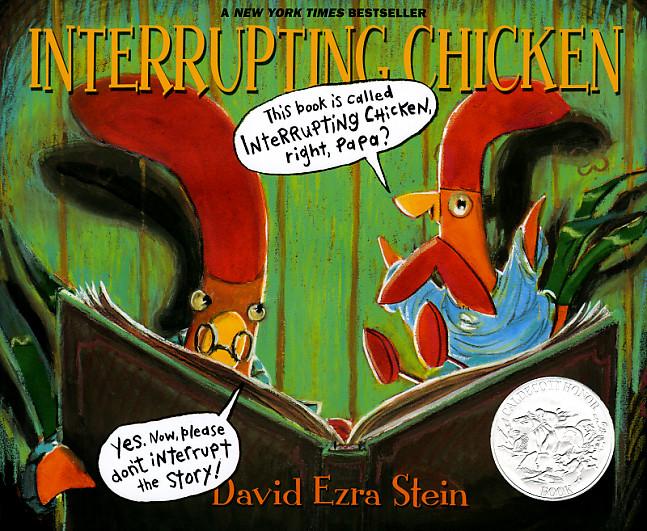
Interrupting Chicken: A Social Skills Lesson
This is a great book to help children learn about controlling those impulsive moments of wanting to interrupt or blurt out during our whole group time.
Wednesday, May 6, 2015
Rainforest Riddles...So Fun!
a) Students are usually very interested in the Rainforest theme and can be easily encouraged to read and write.
b) We have an expository text on the Rainforest in our reading series and I am required to base lessons off of our core curriculum materials. (So I would have to do this anyway.)
c) There are hundreds of free resources and extensions available online.
d) Our school was in the middle of FSA testing. Although I don't have any students testing this year, the resource teacher next to me is testing every day which means my class needs to be close to silent for the entire morning block. Brutal (for the kids and me.....so I held out the carrot....if we were super quiet in the morning then we could do some fun, noisy rainforest activities in the afternoon.)
One of my favorite things we did with the unit was to write our own Rainforest Riddles. I found a free pdf from First Grade Hip Hip Hooray on Teachers Pay Teachers. The set gives several rainforest riddles already written that the students have to solve. It has a nice set of graphics for a simple read, then cut and paste activity. Finally, it also includes graphic organizers to help students write their own riddles.
My class really loved writing their riddles "in secret" and creating their animal from pieces from our arts and crafts scraps/materials. We then combined all of our animal creations to make a rainforest bulletin board.
Here's our bulletin board. Sorry! The picture is a bit fuzzy and I still need to add "forest floor" to our layers.
Thursday, February 5, 2015
Telling Time
Touch Math Time (I looked for this on google. It used to be part of the Upper Grades set, but I can't find it anymore. I really like it because it's visuals are clean and simple with a lot of white space. It also integrates time before and time after within each interval.)
Clocks from two paper plates from E Is for Explore
I also have quite a few file folder games that I have made and collected over the years. Those are coming out too.
Sunday, January 4, 2015
You won't believe it.....
Additional Info: Have you ever had this one??? A student had a nosebleed at the computer and there is blood in between and underneath the control key and the key next to it. I've unplugged the keyboard from the computer and set it on the gray counter.
Categories: CompDev : Other
I knew the keys needed to be popped off and the keyboard sanitized, but I didn't know what was safe to use to get rid of the blood and what was safe that would not ruin the keyboard. She gave me a new keyboard for the time being......she didn't know either!
Thursday, December 4, 2014
Satin Hands and an Intervention....Strange Combination
I never used to need lotion for my hands. However, ten years ago, I started teaching my varying exceptionalities pre-k class and I found myself washing my hands 100 times a day. And let's face it....school soap is not gentle on your hands.
About that time, I discovered Satin Hands from Mary Kay and could probably have been their poster child. (I'm not a Mary Kay consultant, I just happen to really like this product.) The ladies that I work with found out how much I like it, and it is now a frequent gift for me during the holidays and at my birthday. So now, I actually have a set a home and at school.
Little did I know that my Satin Hands would become an intervention this year!
I have a little girl in my class who tends to scratch her arms when she perceives work as being too difficult. It can be pretty bad on occasion and she has picked scabs and opened old scratches. Bleeding in the classroom is not a good thing! Interrupting reading groups or math groups 3-4x every week to deal with bleeding is also not a good thing.
One day, I was using the lotion while she was at my table and she asked me what it was. I told her it was lotion and asked her if she wanted a little squirt. She said yes and "mmm, smells good." Then I got my bright idea. If she likes the smell and the feel of the lotion, maybe we could replace her scratching behavior by asking for some lotion. I asked her if she would like to do that and of course she said yes. So I told her she could use the lotion but she was not allowed to scratch.
I now have a tube of lotion at my reading table. She still sometimes starts to scratch in moments of academic frustration, but with a simple verbal prompt of "Mary, do you want some lotion?" She will stop and gently rub her arms. We haven't had a bleeding episode since we started. It is MUCH easier and less distracting to give her a quick squirt of lotion than it is to deal with washing, drying and band-aiding arms when she scratches and draws blood.
Thursday, November 6, 2014
Funny is Funny
Every year, my para tells the kids how she does not like frogs. We live in Florida. Once during the rainy season, she was laying on her couch reading her book and a frog that got into her house jumped on her face. She tells the story and the kids laugh but for the most part understand why she doesn't like frogs anymore.
This year I have a little girl who is very bright and on the autism spectrum. She and I do a lot of social stories to help her learn new skills. Her mom sent me this link because Mrs. B. (my para) has to watch this video. According to our student "we can teach her to like frogs again. They're not bad. They can be our friends."
We cracked up laughing when we watched the link.
Thursday, September 4, 2014
Accountable Talk
I'm adding to my bag of tricks.
For the past few years my 1st-3rd grade students have loved having "Nacho Karaoke" day once a month. On the day the cafeteria serves nachos, I let them all eat in the classroom and we sing karaoke to songs with lyrics that I have saved from YouTube.
I'm reviewing my list of songs before this year's first Nacho Karaoke and was re-introduced to the song "Brave" by Sara Barielles.
As I paid attention to the lyrics, I really noticed the refrain this time: "Say what you wanna say. I wanna see you be brave!"
I thought this would be a great way to introduce "Accountable Talk" to my students! For the past few years, it's been challenging to teach children how to agree or disagree with a peer based on text evidence. It can be hard to raise your hand and speak up during a group, especially if you are disagreeing with a friend. However, when students DO engage in accountable talk, I have found that they truly start to engage with each other and the text in a purposeful and meaningful way.
My class has already set our essential agreements (rules) including one that states "We will be kind to each other." With that as a foundation and also practice of the roles of "speaker" and "listener," I think we can use this song to talk about how important it is to speak up and "say what you wanna say" during an accountable talk discussion time.
Sunday, August 31, 2014
Fair vs. the Same
What is FAIR is not always the SAME thing for everyone. At the beginning of the school year, my class has a meeting and we generate our class rules. We call these "agreements" (and sometimes for little kids I call them "promises.") The students agree to follow the rules we generate. Then my assistant and I make agreements with the class too. One of our most important agreements is to help make things fair.
I find the concept of fairness to be one that even my youngest three year olds could understand. When the adults promise to be fair, it sets the stage nicely for differentiating your lessons according to your data. When someone asks me why something is different for one person or one group, I simply reply "Because I promised you all that I would help make things fair; and you have what you need right now, and so do your friends."
Clearly the boy who is tall doesn't need a box to stand on (even if he wants one) and clearly the child who is the shortest needs 2 boxes if he is going to be able to see the game. What is fair, is not always the same thing for everyone.