Showing posts with label vocabulary. Show all posts

Friday, August 13, 2021

Easy Interactive Books

My friend Bev came up with this brilliant idea years ago.  I didn't need it for a number of years, but last year I had several students who benefitted from having more interaction during their story time.

We simply took an inexpensive paperback book and cut it apart.  Next we ran the pages through the laminator.  We then took a targeted vocabulary word from each page and created a Boardmaker document with a picture. Next we used the hole punch binding tool that we have in our teacher workroom to bind the book back together.  Finally, we used velcro dots to make each page interactive.

This has been a great way for us to create inexpensive interactive books for circle time.


Monday, August 1, 2016

Journals for Pre-K

Last year I started looking for ideas on Pinterest about journaling with preschoolers.  I came across a few pins that helped me get started:

Ten Tips for Keeping a Journal in Preschool

Pre-School Journaling

J is for Journal


After reading about how others started, organized and maintained their journals; I started making the decisions about how I would use the journals in my classroom.

I chose to use simple black and white composition books for our journals.  I used a name label sticker on the front of each child's journal and also made one for myself.

My class typically is most successful when I model expectations for them before they attempt a structured task like this.  Before the kids ever used their journal, I had all of the journals prepped and in a basket and I modeled drawing a picture in my journal.  Since most of the students in my class have language impairments, I wanted the focus of our journals based on increasing their communication skills.  After I drew my picture, I talked about it.  I labeled the picture, told the class a sentence about my picture.  We did this a few times, using the word journal and modeling how to draw, turn pages, choose the next page, etc.  The first time I passed out their journals at circle time, all we did was look at the journal and turn the blank pages.

We used our journals in a small group, structured center with adult support at first.  After all of the students started to understand the purpose and became more proficient at drawing their pictures, I would also put them out for a table activity or "morning work" first thing in the morning in a large group.

Since my goal was to help increase communication, every time the students worked in their journal, they talked to an adult (me, my assistant, a volunteer) about it and we wrote their exact words on the paper.  Through this, we also had ongoing documentation showing how their language skills improved over time.  You can see the length of utterance increases, use of age appropriate vocabulary, use of pronouns and use of action words.  This became a great way for  me to show parents what language skill I might be working on with a child and how they could help.

I also found that our science center was a great inspiration spot for lots of writing and observation.

Here are some photos of some of  our journal work:


And here are some from a different student:


Saturday, May 30, 2015

Pre-K Again

As this school year draws to a close, our principal has sent out our "most likely" assignments for next year.  She calls them "most likely" because, as we all know, things can change over the summer.  If the needs of our students change, then staff assignments sometimes have to change too.

My "most likely" assignment for next year is back with the pre-k special needs population.  I'm ready for a change again, but I LOVE my school, so I didn't want to change that!  One of our pre-k teachers retired this May, so an opening came up at our school.  I love the language development and developmental play aspects of pre-k, so I"m excited.

I've started culling through some of my old pre-k files and rediscovered a blog from a pre-k teacher, Christi Seward in Cobb County.

She hasn't posted in a few years, so perhaps her teaching assignment changed or something else in her life changed, but she has a WONDERFUL collection of picture books with essential vocabulary and comprehension questions that she discusses.  She also has created many power points to support her lessons.

One of the books she highlights is "Bear Wants More" by Karma Wilson.


In addition to Christi's resources, there is also a YouTube read aloud with the book, too.  (This version is really sweet.  A boy received this as a birthday present and his family recorded him reading it out loud for the person who gave him the book.)


This has been a busy year and I haven't completed too many posts, but hopefully that will change this next year coming up!


Saturday, January 4, 2014

Writing Haikus

Way back in 2009, I worked with a friend of mine who is an SLP to devise a manipulative word bank to help my summer school students with autism generate their own sentences and write a simple paragraph.  It sounds pretty straightforward, but it was actually quite a bit of work for me because I had never had to provide quite that level of support for students.  You can read about it here.

This year, I used this strategy again.  While my current students, don't have the severe needs of the class I developed the system for, I thought it would be helpful for some of them.

We were working on a unit that focused on different forms of poetry.  One of the lessons for the general education students at grade level was to write a haiku.  I wanted my students to do this too.  So I stole some ideas from my general ed teacher friends and then added some supports to them.  Here is what we did:

1) Each student painted a background of mixed colors with yellow and orange.  My assistants and I used our Elison machine to cut out some "bare trees," spiders, and leaves.  The kids used the black shapes to glue a scene to their previously painted background.  (Sorry I don't have a picture of this! I'll see if I can update this with a "fake" one that I make so you can see what I"m talking about.)

2) As a whole group we looked at the pictures that were created and generated a word bank of words that described our pictures.  I wrote them on the board and the kids copied them.  We also reviewed the rules and syllable pattern for creating a haiku.


3) Two of my students were able to generate their haikus after completing these activities, others needed some more help.

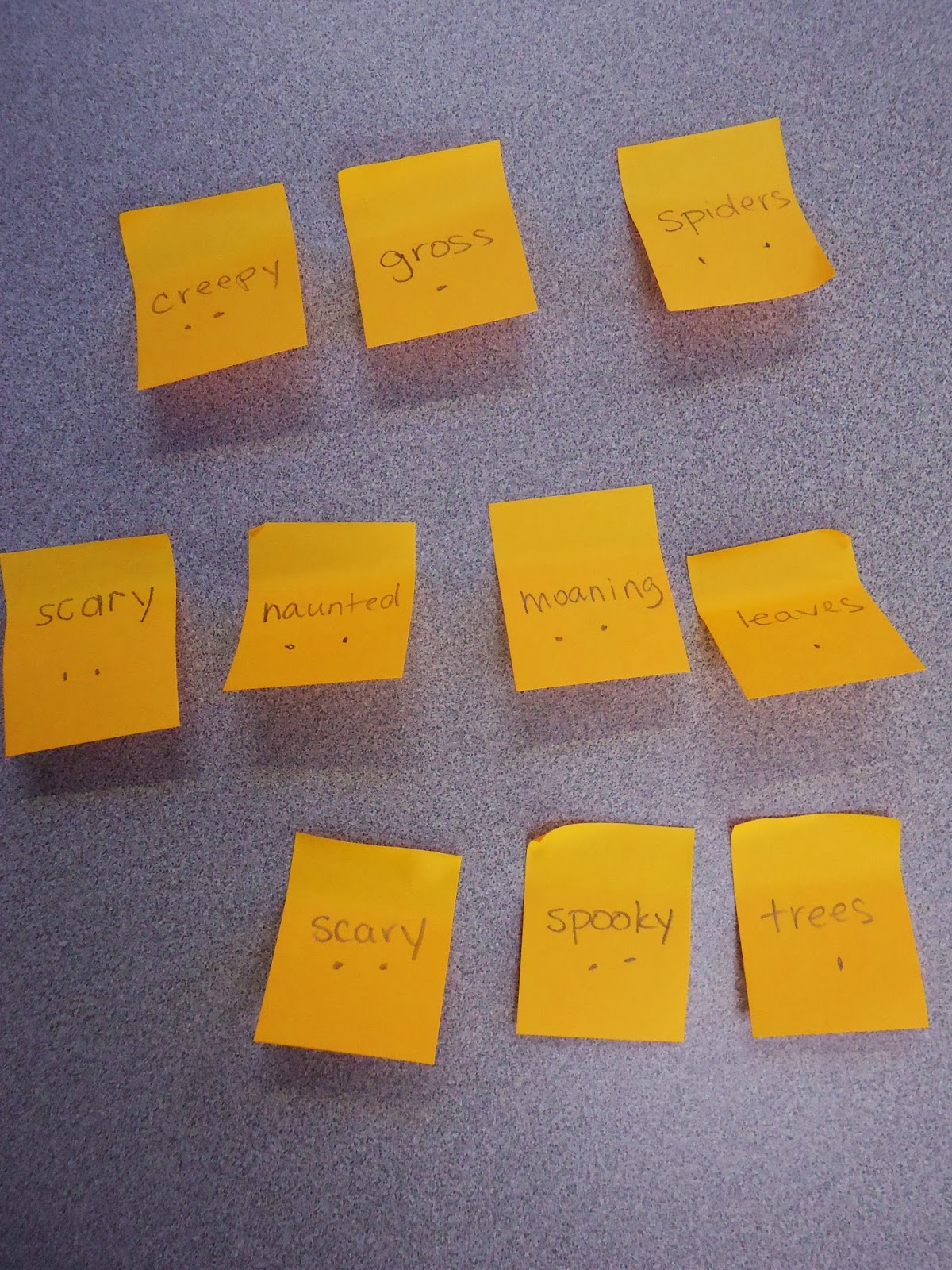
4) I transferred the word bank to post it notes and put dots underneath each word to identify how many syllables the word had.


4) The students moved and manipulated the words to create a phrase that made sense and also fit the syllable pattern for a haiku.


5) When they finished writing their haiku, they read it to me and I typed it on the computer.  We printed their haiku and they used craft scissors to cut the edges of the paper the poem was printed on.  Then they glued their haiku to their picture and we hung it up for display!


When my general education team decided this was going to be one of the "published" pieces we would do for our quarter 2 writing grades, I was a bit worried.  Writing a haiku is very abstract.  I needed to find a way to teach the syllable pattern and the emphasis on nature to my students.  The art project and the post it notes (as well as previous experience with haikus we read aloud) helped them to successfully complete this! It's nice to be "pushed" into doing something that is a bit uncomfortable sometimes. (I never would have chosen haikus as a published writing sample.)   As a teacher, it made my brain stretch and think about how to make this lesson work with my students.


Wednesday, October 23, 2013

Dog's Colorful Day

My niece is expecting her first baby! Yay! So what's an aunt to do? Of course, I am cyber-stalking her "future mommy" page on Pinterest. I was so excited to see her pin and re-pin many felt board and felt play activities. So when it was decided that instead of giving a card at her baby shower, we would give her a children's book; I had to start thinking about which felt board books I loved so I could send her some felt play along with my book. One of my favorites is "Dog's Colorful Day" by Emma Dodd.


Dog has some very exciting, messy and colorful adventures throughout the day. The readers are encouraged to count and describe the spots that start to appear on dog's fur as the evidence of his adventures. For example, dog starts off with one black spot on his left ear, but after passing the painted door he now has two spots. One black spot on his left ear and one blue spot from the paint. The adventures continue throughout Dog's day.
My preschoolers loved interacting with this book with a felt board activity I made. As we read the book, the children would sequence the item that caused the spot on Dog at the top of my felt board in left to right progression. We would also add the appropriate spot to dog. At the end of the story, we put dog in the bath to get clean and then finally in his bed. This is a lesson the kids wanted repeated time and time again. They loved playing with the colors and the sequence of the story through the felt pieces.


Consequently, I got to have lots of conversations about colors, numbers and retelling stories through play. Isn't that the best?


 Photo credit:http://www.google.com/imgres?imgurl=http://heightslibrary.org/wordpress/explorastory/wp-content/uploads/2012/08/dogs-colorful-day.jpg&imgrefurl=http://heightslibrary.org/wordpress/explorastory/?attachment_id%3D887&h=648&w=520&sz=47&tbnid=FZAWTeo3zYglYM:&tbnh=90&tbnw=72&zoom=1&usg=__hMqMXyP36XSG5ETzjcMhWGHbaYo=&docid=xxOX9rSEuAhdaM&sa=X&ei=c1toUuvDIoq-kQeb2IGgAQ&ved=0CDsQ9QEwAQ

Thursday, January 5, 2012

Valentine's Activity: Hearts Everywhere

If you are in any way similar to me in how you plan lessons for activities you've seen online, you need some time to read about the idea, think about how you would use it with your group, prepare your materials and then implement it.  One of the teacher's on my team this year says he likes to let concepts have a chance to "marinate."  We've all adopted his lingo.  We like to let kids have the chance to have repeated exposure to concepts, but sometimes we also need some marinating time for ourselves. 

In an effort to give everyone some time to "marinate" the following ideas, I'm sending them out early (or really late considering I took the pictures last February!)

For my pre-schoolers that I've had in the past, this lesson focused on the positional concept "on" as well as identification of common objects.

I started with the interactive book, "Hearts Everywhere",  from the Jefferson Parish AAC link.  I would read the book to my class using the felt board and laminated hearts.  On each page, the students would take turns placing the heart "on" the object identified in the book.

After introducing the book and the vocabulary, the next day before the children came in the classroom, my assistant and I placed construction paper hearts all over the classroom.  During circle time, I would call a few students at a time to go "look for a red heart" and bring it back to the carpet.  When they brought their heart back, I would ask them where they found their heart.  Once they answered the question, we would place it on our chart and I would call the next group of children to go look. 

TIP:  If you are working with pre-school age children, be sure to write on the heart the location that you placed it.  For example, "on the fish tank."  When you have several children looking at the same time, it's easy to miss who picked one up from specific locations.  If you don't have several children looking at the same time, the waiting period gets to be too long for little ones.  And if you have students at levels similar to the students I have taught, when you ask the question, "Where was your heart?" you will inevitable get the answer "over there" a few times.  You want to be sure you can accurately prompt them to answer the question using the positional word "on" and the correct common object where it was.

I love activities that get students actively engaged.  These types of scavenger hunts always produce smiles, laughter and excitement.

Because of that I'm trying to think of a way I can adapt the activity to be appropriate for my current third graders.

I think I will connect it to our writer's workshop lessons.  We have been working on using more descriptive phrases in our paragraphs.  I am going to  place many hearts all over the room with their labels.  Have the students put their heads down with their eyes closed and give each student 10 or 15 seconds (one at a time) to go get a heart from somewhere in the room.  After they collect their hearts, they will describe where they found the heart, but they are not allowed to name the object.  Then they will read their paragraphs to their classmates who will need to guess where the heart was originally.

I'll have to let you know how it goes!  I'd love to see other ideas on how to use a scavenger hunt type activity to support academic goals for older students.  Please post your ideas in the comments section.

Sunday, April 10, 2011

National Geographic Website

My school is inundated with caterpillars right now. With so many natural, incidental learning experiences available, this is a perfect time to implement our life cycles unit.

National Geographic Kids has many great resources to also support this theme. Of course, in addition to bugs and butterflies National Geographic also has many other topics addressed too. Check them out!

Creature Feature: Monarch Butterflies

What in the World: Bugging Out!

Saturday, February 12, 2011

More Sea Life Resources

Since I live in South West Florida, a unit on sea life is particularly meaningful to my students and there are many opportunities to extend with real life experiences.

We have a field trip to Mote Marine Aquarium planned in March. I took my class on this particular field trip about 4 or 5 years ago. This year we are going to participate in the lesson about sea turtles and will actually get to make squid "popsicles" and then feed the turtles in the aquarium.

Of course, we also support this unit with many classroom experiences. I have found a few new resources to share:

Fern Goes for a Dive (free, animated read aloud story)

Fern Goes to Hawaii (free, animated read aloud story)


Mermaid Lullaby

Seashore Tap and Type

You can find other Sea life resources that I have gathered at this post, this post, this post and this post.

Monday, June 7, 2010

Memorable Moment # 8: Building Structures

Here's one of my recent memorable moments:

During the last week of school, I took a look in my storage room to see what materials we had not used yet this year and came across a bucket of plastic building materials. They have white lines and white curves and colorful couplings to join them together. I got them out and asked one of my assistants if she would support that center during our center time.

She and the kids ran with it! It was so much fun to watch.

For the first 20 minutes or so, they really explored and experimented with how the pieces fit together and what they could do with them. Then they decided to get a little bit more complex and I hear one of the kids say, "Can we have some paper and markers?"

Naturally, any time a child wants to write, I say yes. So they got the markers and paper and brought them over to the area they were playing. My assistant ended up showing them that you can make a plan for building structures. One little boy in particular really understood the relationship between the drawing and the structure. Here's what he came up with:


The first picture is the picture of his plan. The second picture is a picture of what he started building off of his plan.

My personal learning experience from this is a confirmation and gentle reminder to respect and seek the contributions and ideas of the assistants with whom you work. I didn't have a lesson plan for the children to talk about blueprints, architects, and builders. She introduced some really sophisticated vocabulary that they understood through their play and their plans. The lesson plan evolved as she responded to the children and was better for it!

My other take away is an appreciation for the personal interests and aptitudes of young children. While the plan does not look very sophisticated, it was drawn and then implemented by a 4 year old boy.

The level of symbolic representation of a concrete product that isn't even built yet is actually quite sophisticated! I wouldn't have expected this child to be able to do this, but his natural interest, his visual spatial skills and the support of an adult who was engaged with him helped him to reach a level of thinking and problem solving that surprised and delighted us!

Monday, October 19, 2009

Pumpkin Template


Disney has a free, interactive
pumpkin template.

We use this on our ActiveBoard to work on choice making, turn taking and language skills.

The vocabulary we work on using this lesson is: pumpkin, jack-o-lantern, eyes, nose, mouth, change, arrow, same, different, shape.

After each child completes a template we print them and save them for a coloring task later.


Photo courtesy
Tigerlily 09 at Flickr Creative Commons

Tuesday, June 30, 2009

Word Bank and Writing Strategy

This summer I have been working with a group of kindergarten through third grade students who have autism. Several of the students have writing goals that need to be addressed and all of them have expressive language goals that need to be addressed. If you have read any of my previous posts, you know that I am a big fan of digital photos to build play skills, critical thinking skills and oral language skills.

Since I find the digital photos so beneficial, I decided to pair that strategy with a manipulative word bank in the hopes of having my students build sentences that they would copy to create a simple paragraph. My goal was that they would build one topic sentence and two detail sentences. We started with modeling and a lot of physical prompts, but I'm hoping the level of prompting will decrease.

Here's what we did:

1) I printed several photos featuring sea life from www.flickr.com.

2) Each student chose a picture that we glued to a large sheet of construction paper.

3) The students were given a file folder with a word bank targeting words that made sense with their picture. (I met with their SLP and we color coded the post its to correspond with the colors and word categories that they already use on their manual communication boards based on Gail Van Tatenhove's system.)

4) Then the students built a sentence by moving the post its to a sentence strip (the sentence strip is just length of file folder cut down).

5) Next the students copied their sentence on a pre-cut piece of paper. (I did this to to visually define the space of the sentence for them. This way the letter spacing and formation is confined to an area that already "looks" like a sentence. )

6) Then they glued the sentence to the piece of construction paper to which we had previously glued their photo choice.

7) We cleared off the sentence strip and started to build another sentence and repeated the steps.

Here's what our first writing samples look like:

Wednesday, October 1, 2008

Book lists and vocabulary

Have you noticed my Shelfari shelf has changed? (You may have to scroll down the blog and look to the right hand side to see my shelf.)

I was originally playing with the features of Shelfari with the books that I read for myself. Then the Boardmaker listserve on Yahoo had a thread going about favorite books and correlating vocabulary.

That made me think.

Since this blog is really about education and educational strategies, what if I used Shelfari to organize the books that I use in my classroom? So I started playing with the features again.

Here's what I've decided so far:

I will post the book and how many stars I think it deserves for classroom use. Under the review feature (move your cursor over the picture of the book on my Shelfari shelf and you will be able to see my review), I will post:

theme/unit
age/grade level
concept
vocabulary words

I will try to have a blog post with a list of all of the books in a particular theme.

Since I'm still in the "playing with the features stage,"
I reserve the right to change my mind. :-)