Showing posts with label reflective teaching. Show all posts

Tuesday, July 14, 2015

Bubbles and Problem Solving

I have 2 year old twin nephews.  They both love bubbles right now and have a lawn mower bubble maker as well as several no-spill bubble containers.  We ran out of re-fill bubbles one day when I was watching them and one of the boys really wanted his lawn mower to have more bubbles.

He kept saying "more bubbles?"  I had to tell him "bubbles all gone.  no more."  He cried (he is 2) and then was able to be redirected to his train for a bit and then went back to the bubbles.

The next thing I knew, he was attempting to fill his lawn mower with the no-spill container.  He knew he had bubbles left in the no spill container and he was doing his best to get them where he wanted them.  I thought that was pretty good thinking and problem solving for a 2 year old! (even if it didn't work.....I loved the process of his thinking.)

(The little guy in the picture has delays in the communication and social/personal domains.  So fun to see his strengths clearly evident, too!)


Thursday, December 4, 2014

Satin Hands and an Intervention....Strange Combination


I never used to need lotion for my hands.  However, ten years ago, I started teaching my varying exceptionalities pre-k class and I found myself washing my hands 100 times a day.  And let's face it....school soap is not gentle on your hands.

About that time, I discovered Satin Hands from Mary Kay and could probably have been their poster child.  (I'm not a Mary Kay consultant, I just happen to really like this product.)  The ladies that I work with found out how much I like it, and it is now a frequent gift for me during the holidays and at my birthday.  So now, I actually have a set a home and at school.

Little did I know that my Satin Hands would become an intervention this year!

I have a little girl in my class who tends to scratch her arms when she perceives work as being too difficult.  It can be pretty bad on occasion and she has picked scabs and opened old scratches.  Bleeding in the classroom is not a good thing!  Interrupting reading groups or math groups 3-4x every week to deal with bleeding is also not a good thing.

One day, I was using the lotion while she was at my table and she asked me what it was.  I told her it was lotion and asked her if she wanted a little squirt.  She said yes and "mmm, smells good."  Then I got my bright idea.  If she likes the smell and the feel of the lotion, maybe we could replace her scratching behavior by asking for some lotion.  I asked her if she would like to do that and of course she said yes.  So I told her she could use the lotion but she was not allowed to scratch.

I now have a tube of lotion at my reading table.  She still sometimes starts to scratch in moments of academic frustration, but with a simple verbal prompt of "Mary, do you want some lotion?"  She will stop and gently rub her arms.  We haven't had a bleeding episode since we started. It is MUCH easier and less distracting to give her a quick squirt of lotion than it is to deal with washing, drying and band-aiding arms when she scratches and draws blood.

Monday, August 4, 2014

Chapter Book Read Alouds 2nd and 3rd Grade

My class loves to listen to me read to them.  Since my students are 2nd and 3rd graders now, I like to try to expose them to chapter books as read alouds.  The following is a list of some of the books we read this past year with some brief comments about each.


1) Boxcar Children #1


I chose this book because it was one of the extended complex texts that was recommended to go with our first unit with our reading curriculum, Wonders.  The students liked it and enjoyed the adventure of the children living in the train boxcar.


2) Stuart Little

"Stuart Little" was our next read aloud because of a play we were scheduled to see.  My district is very fortunate to have a lot of support for education for children within the arts.  Part of that is experience at our local theater for live performances.  "Stuart Little" was actually a very difficult book to read to my students. The language and vocabulary that is used actually puts it much higher than a second or third grade level (I think it's more like 5th or 6th grade.)  However, my students loved the story.  We  went through this book pretty slowly and stopped to explain a lot of the words or phrases in the book.  By the time we got to the play, my class loved that they could "see" parts of the story they already knew and we had great discussions about the parts that were different.


3) Horrible Harry and the Drop of Doom

Horrible Harry has a great series of introductory chapter books.  I read this book to my class to introduce Harry and Song Lee to my students.  I have found that once students are familiar with some of the characters they are more likely to make the transition between picture books to chapter books.


4) Santa Clause Doesn't Mop Floors
We read this book as a purely enjoyable read at the holidays.  As we progressed through the story, we had some great conversations for our social skills lessons.


5) The One and Only Ivan
Oh! How I loved this book.  The story is told from Ivan's point of view.  Ivan is a gorilla that was once wild and is now kept in captivity in a shopping mall.  My class loved hearing about Ivan's thoughts and feelings and solutions.  They also loved learning that the story was based on a real gorilla.  This gave us the chance to talk about what they phrase "based on a true story" means (how often the main idea and the theme of the story stay true but frequently the author changes some of the details to make the plot of the story work.)  **This was my favorite read aloud this year.


6) Little Dog Lost
We all enjoyed this story too.  It is written in the style of a poem, even though it is also presented as a chapter book.  This was the first time my class had seen a free verse poem this long.  That was a great way to show them there are many different ways a writer can share their thoughts and ideas with the reader.


7) How to Eat Fried Worms
If you have read any my previous post about "How to Eat Fried Worms," you will know I love this book.  I first was introduced to it when MY second grade teacher read it out loud to my class.  I remember simultaneously loving it and being grossed out by it!


8) Charlotte's Web
My students loved this book...well except for the one who hated it and the one that it stressed out (but she still loved it!)....For more information on this read here.  Overall though, the class really did like this classic!  This was a novel that we had plenty of copies of throughout our school.  I was able to get a copy for every student in my room and the liked tracking our progress in their own book as I read it to them.   We ended our school year with an "old school" thematic until based on this novel.  My class loved that kind of structure to our day.  I wish we could do more of it.


Photo credits:
http://www.amazon.com/The-Boxcar-Children-No-Mysteries/dp/0807508527
http://www.amazon.com/Stuart-Little-E-B-White/dp/0064400565/ref=sr_1_1?s=books&ie=UTF8&qid=1407204457&sr=1-1&keywords=stuart+little
http://www.amazon.com/s/ref=nb_sb_noss_1?url=search-alias%3Dstripbooks&field-keywords=horrible%20harry%20and%20the%20drop%20of%20doom&sprefix=horrible+harry+and+the+d%2Cstripbooks&rh=i%3Astripbooks%2Ck%3Ahorrible%20harry%20and%20the%20drop%20of%20doom
http://www.amazon.com/Santa-Doesnt-Floors-Bailey-School/dp/0590444778/ref=sr_1_1?s=books&ie=UTF8&qid=1407205160&sr=1-1&keywords=santa+clause+doesn%27t+mop+floors
http://www.amazon.com/s/ref=nb_sb_ss_i_0_14?url=search-alias%3Dstripbooks&field-keywords=one%20and%20only%20ivan&sprefix=one+and+only+i%2Cstripbooks%2C167&rh=i%3Astripbooks%2Ck%3Aone%20and%20only%20ivan
http://www.amazon.com/s/ref=nb_sb_ss_i_0_22?url=search-alias%3Dstripbooks&field-keywords=how+to+eat+fried+worms&sprefix=how+to+eat+fried+worms%2Cstripbooks%2C259&rh=n%3A283155%2Ck%3Ahow+to+eat+fried+worms
http://www.amazon.com/s/ref=nb_sb_ss_i_0_12?url=search-alias%3Dstripbooks&field-keywords=charlotte%27s+web&sprefix=Charlotte%27s+%2Cstripbooks%2C259&rh=n%3A283155%2Ck%3Acharlotte%27s+web

Tuesday, July 8, 2014

Doll House and Choice Time

At the end of the day this past year, my class enjoyed "Choice Time."

If you were to walk in my classroom, "choice time" looks remarkably similar to "free time."  I don't call it "free time" however, because the children are not "free" to do whatever they want...they have to make a choice from the leisure activities we have available and then stay productively engaged, unless they have asked permission to make a different choice.

Unproductive wandering throughout the classroom is one of my "teacher pet peeves."  It drives me crazy and I have found that unproductive wandering leads to lots of management or behavior issues. Hence, we have "choice time" and not "free time."

One of my older third grade girls wanted me to buy a Barbie doll house for them to play with during choice time.  I explained that Barbie houses cost a lot of money and we didn't have enough to buy one.  She accepted this and went on to play with something else.

A few days later while browsing on Pinterest, I came across this pin that uses a 3 ring binder to make a Barbie doll house from Southern Disposition.  Take a look.  Kendra includes lots of ideas and instructions.


How serendipitous!

When we got to choice time the following day, I asked that little girl if she would be interested in looking at a possible solution to our Barbie doll house problem.  We looked through the website and directions.  She was hooked!

I happen to have lots of scrapbook paper at home that I don't use anymore because I now do most of my photo albums digitally.  I also have a scrap craft bucket of ribbon, lace, beads, etc that I keep for projects at school.  I purchased some scraps of cheap fabric from the scrap bin at Jo-Ann's.

I also happened to know that our bookkeeper has A LOT of old binders that no one wants to use because they aren't perfect.  They were "perfect" for us because they were free!

So for about $8 for fabric scraps and some Stitch Witchery (no sew tape that fuses fabric together), we were in business!

Two girls wanted to make doll houses but they didn't really know where to start.  We talked about how sometimes people use an "inspiration room."  I asked them what colors they wanted their rooms to be.  One chose blue and the other chose pink.  We googled images of girls bedrooms.

One girl choose this blue room from Amecdes as her inspiration.


The other girl chose this pink and green and cream room from Bess.Net as her inspiration.


Our choice time lasts for 15 or 20 minutes at the end of each day.  For about three weeks, the girls spent their choice time creating, figuring things out, problem solving and adding details to their doll house.


Here's one girl making a mirror out of a file folder, aluminum foil, and lace ribbon she cut apart.


Here's her room after she covered up a granola bar box for her bed.


And here is her final product.  The curtain rod is a pipe cleaner with some blue beads we had in our craft bucket (I think they were table scatter beads from the Dollar Tree.)  The curtains are just lengths of lace ribbon she cut and then threaded onto the pipe cleaner.  The rug is a scrap of felt. We printed an image of a dresser off of another Google image search and she glued it to the wall.  The bedspread is a scrap of fabric that she cut.  I helped her make the pillows and the column of fabric that covers the 3 rings with an iron and the Stitch Witchery. (Hot irons and young children are not a good combination!)


Here is the other girl after she finished her mural and began working on her window.


And here is her final room.  She decided to make her bed a daybed.  We used a Girl Scout cookie box for this and scraps of fabric that she cut.  Her curtain rod is a pipe cleaner with some of a pearl strand that she twisted together (the pearls were is my scrap bucket.)  The curtain ties are more of the pearl strand.  The rug is a scrap of felt.  She also cut some mat board to frame her butterfly mural.  Again, I helped with the iron and Stitch Witchery of the column of fabric in the middle and the pillows.  


The two rooms together looked like this (sorry the photo is a little fuzzy!):


The girls had so much fun making their own doll house bedrooms.  They also had a lot of fun playing with them during choice time once they were completed.

I know I can't prove that they practiced their social skills or their problem solving skills and I certainly don't have any data to justify letting them spend 15 or 20 minutes every day making a doll house.  However, these little doll houses have been one of my favorite memories from the year.  To me it shows:

1) Willingness to accept and handle disappointment and the word "no" (We didn't buy their doll house that they wanted.)
2) Willingness to accept a compromise and take responsibility to follow through on the compromise
3) Ability to think in a problem solving process (Watching the one girl work for 2 days to get her mirror to stand up by itself was awesome!)
4) Ability to persist at a long term task (relatively speaking)
5) Thinking creatively
6) Using materials for another purpose other than its intended use

****One little girl is in my class for help with an emotional and behavioral disorder (EBD) and the other is in my room for  help with a severe learning disability.  I'm pretty happy with all of the skills they practiced in an authentic and personally meaningful way.

Many, many thanks to Kendra at Southern Disposition for her great idea!

Friday, June 6, 2014

Charlotte's Web

We ended our school year with a novel study.  Two of the general education teachers and I pulled together a unit on Charlotte's Web for the students.  I'm so glad we did!  After so much emphasis on our standardized testing this quarter, it was refreshing and rejuvenating to go back to great literature and helping children understand and enjoy it.

Here are a few of the lessons we completed:

1) Every student had a novel and was expected to follow along.  I hadn't typically done this in the past when there was such a difference in my students' reading skills and the level of difficulty of the text.  This sounds silly, but it was almost an "A-ha" moment for me.  The brailled book that we had was in contracted braille and Gabby is still reading uncontracted braille.  This book was too hard for her, but she was able to explore the book and track through some of the chapters when she had 1:1 support.  I have 2 students who are also still reading at a beginning first grade level.  When they were given a simple verbal prompt on when to move to the next page, they could inconsistently track with us too.

2) We completed a "following directions" lesson based on the passages in the text to map out and create the barn scene.  We added more details as we learned them throughout the book.  (The white circle is just blocking out all of the kids names.)


3) When Charlotte was finally introduced in the book, the students all picked a spider to research.  They made a spider body and were responsible for finding 8 facts about their spider.  Then they read their planning sheet and facts to me; and I helped them type it into a word document so they could cut out the facts and glue them to the spiders legs.  We started them with 3 facts: all spiders are arachnids, all spiders have 2 body parts, all spiders have 8 legs.


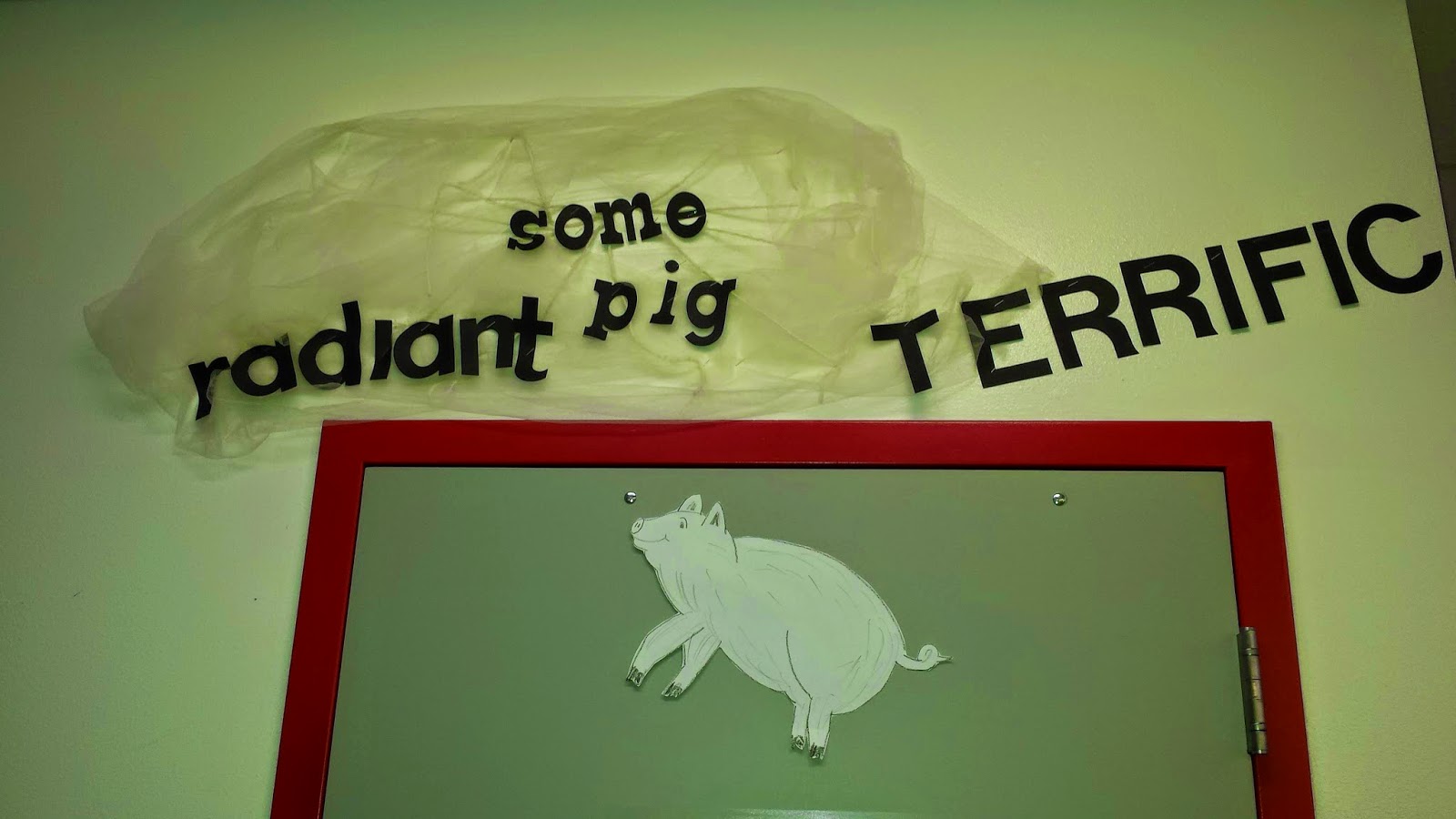
4) The classroom staff also made a web (tulle and yarn) for Charlotte and surprised the kids each morning with the words that she wrote in her web for Wilbur.


5) In addition to these "crafty" classroom projects, we also completed several Type 1 writing pieces about what students know about a farm, what they know about a County Fair, what they think will happen to Wilbur, why Fern wasn't paying much attention to Wilbur at the fair etc.  (Our school uses the Collins writing program.  To see more about a Type 1, click here.)


6) Two social skills lessons emerged from this novel study that I wasn't expecting.  One boy had already seen the movie so he knew what the story was all about.  One day he went home and cried.  (Talk about making me feel terrible!)  His mom sent me an e-mail to let me know what was happening.  We talked about 2 options for him: 1) Finding alternative assignments for him so he wouldn't go home crying every day.  2) Watch him closely during lessons and prompt him to take a break if he needed one.  He has very quiet but consistent clues that tell you when he is getting upset.  His cheeks get red and he starts to fidgit.  Watch for these clues and ask him if he is "ok or if he needs a break."  If he chooses a break he could go to the computer and put the headphones on and go on Tumblebooks so he didn't have to hear us.  

We decided to try the second option and mom said she would let me know if he comes home crying anymore.  If he continued to be upset at home, then I would find alternative assignments for him. On one occasion he chose to take a break but out of the 3 or 4 other times I asked him, he chose to stay with the group.  I think giving him some control over whether or not he had to listen to something upsetting made it more manageable for him.

Another little girl, who can be very loud and a bit dramatic, but is also very young and sensitive to sad situations also had a few moments when the story was upsetting.  Her plan was a bit different.  Throughout the year we have had a "safe space" set up for her so that she could manage her own behavior and de-escalate herself.  She also processes information better when she is prepared for it and it is not a surprise.  (We're working on handing unexpected situations, but for this novel with the themes of friendship and life cycles and death, I thought she still needed to be prepped.)  For her, I would warn her when a sad part was coming up and let her choose her safe space or holding my assistant's hand while we read that part.  Interestingly, most of the time in the year when she was upset, she liked to be alone and choose her safe space.  Each time within this story she chose to hold my assistant's hand.  

For these two students, I spoke with their parents about the novel and how it was affecting them emotionally. My goals in the novel study started with the literacy goals of character traits, how characters change throughout a story, remembering details, researching information, etc.  For them, my focused shifted and I really wanted the social skills practice more than I wanted them to gain the literacy skills.  However, in getting at this social skills practice, I didn't want to push them so hard that they were crying or emotionally distraught at school or home.  It was a fine line...thank goodness they both have very actively involved parents who let me know how they were doing at home too!  

I wanted the boy to learn to speak up and request a break when he felt like he was getting to the "overload" point.  While he only took the break once and he needed prompting, this novel gave me some good information to share with his teacher next year so she can continue with this.

For the little girl, I wanted her to remember that she had solutions and choices that she could use to help her manage her emotions.  I also wanted her to be able to attempt to do this without yelling and disrupting the whole group.

The novel study of Charlotte's Web was a great way to end the year.  It gave the students a great piece of literature to read, fun activities that still had an academic focus, and kept them interested and engaged at the end of the year!


Thursday, February 20, 2014

Memorable Moment #12...Seriously?!??

What do you do when you hear yourself say to the child who is blind, "Gabby, look at me."

 Seriously?!? Did I just say that? Did that just come out of my mouth? Yep, it did!

 Let's think about how ridiculous this was......

 1) I have had countless hours of training and coursework addressing cultural differences. I am well aware that many children do not look adults in the eye.

 2) I have had countless hours of training and coursework in classroom management and social development. I am well aware that when children are being scolded they do not want to look the person doing the scolding in the eye. (....And I was giving Gabby a "what for" because she refused to work for one of my classroom assistants.)

 3) I have been working with this child for a year and a half. I am well aware that she is blind. Did I really just tell her to look at me?

Stick a fork in me, folks.....clearly, I'm done.

On a happy note, there was some good reflection that came about because of this. Sometimes when you catch yourself doing something that "just happens" that is so blatantly not best practice, it raises your level of consciousness or deliberate thinking about that very act or concept. You don't "forget that you know it" again.

I'm pretty confident that I won't be telling ANY other child to look at me when he/she is in trouble because this lovely little incident is firmly embedded in my brain.

Thursday, August 8, 2013

Networking and Socials


For the past few days I have been thinking about the many people who have helped me develop my teaching skills.  Obviously, I have learned from college courses, trainings and observations.  However, I have also learned and developed skills in a more subtle way....simply socializing and talking with others in the field of education.

One of the teachers on my team from five years ago and at a different school e-mailed me to let me know that someone in her hallway was throwing away SRA Reading Mastery teacher presentation kits.  These kits are expensive: $1,200-$1,500.  I was thrilled!  I have access to all of our comprehensive reading materials that the district requires us to use, but I like to have a bank of supplemental materials on hand for those kiddos who need more.

After I went to her school to pick them up, I ran into some other teachers and assistants that I used to work with and they invited me to join them for lunch.  I'm always up for a summer lunch with fun people so of course I agreed.

When I got home I started thinking about this.  We did some talking about school, but lots of talking about summer activities, vacations, families, etc. etc. etc.  However, because of these relationships that were built and then held on to by keeping in touch; my friend gifted me with almost $3,000 worth of materials.

Now I'm not suggesting you go out and make friends so that hopefully you will profit from it!  I'm just saying that sometimes those lunch dates, happy hours, chatting over coffee and socials at conferences help you build up a network of people who are happy to help if they can.  We don't always have to be actively discussing curriculum or Common Core or classroom management.  Sometimes those relationships we build with other colleagues help to support us when we are running on empty or they surprise us with happy gifts in August!


image: http://www.flickr.com/photos/barbro2009/6794743859/sizes/m/in/photolist-bmqQCc-bmqQQe-8m47Hd-8UQZaY-a1JVHd-evwJRX-eyFCwy-aB83Ye-9cegBy-b49LBt-d3nGvo-9qRD6W-ahxwHA-aAh2Yy-8U6HrH-dKEgmh-7CDuM7-8ciyZj-8cfe3g-7Kz4bB-cSYzmA-86qAkr-82WMwF-8EuKUf-dScKU4-9nErEk-dehMfS-dvHvUR-f5TS8k-dehLKr-9evp51-e6BmmY/

Wednesday, October 17, 2012

Differentiating....How do You Explain It?

I'm currently teaching a class for our local college that focuses on an introduction to the exceptional learner.  I love facilitating this class because the questions that are generated from my students often help me to clarify and articulate what I believe and what I practice in my classroom.  Sometimes it's nice to have to formally explain what you do and why you do it.

This week we have been focusing on strategies and differentiating.  There have been quite a few questions along the themes of how do you implement a strategy and not embarrass a child who has difficulty; or how do you do something different for one and not others; or how do you plan for a child with a speech impairment during read alouds.

Since these questions were addressed and clarified my for my class, I thought the information would be of interest for this blog, too. 

To me, these are brilliant questions.  They get to the heart of  "What does that look like in the classroom?" and I'm interested but I don't know how to do that yet.  "How do I do that with all of the other demands?"

The following is what I shared with my class:

".........Not every strategy is going to work with every child. That's why it's important to know how to research strategies and methods. You may come across a child who exhausts your "bag of tricks" and you need to find a new way to teach him/her a skill or concept.

HOWEVER, sometimes a strategy WILL work if you think through the challenges and set your classroom climate to be supportive. When your thinking starts with a problem solving and supportive approach, it will often help the child succeed.

So what does "a problem solving and supportive approach" look like? It can look differently in different classrooms. I'll share with you some of the methods I use.

When I think about a strategy and a specific child I think may have a challenge with it, I try to problem solve by thinking about questions like this:

1) What skill or concept do I want the child to master?
2) Is this strategy going to help him/her master that skill or concept?
3) What is the challenge I think he/she is going to face? Is there a way to adapt or modify the strategy to adress this challenge BUT still help the child master the skill? If so, this is usually the method I try first.

Here are a few things that I do to set a positive classroom climate at the begninning of the year:

1) We hold a class meeting and set our rules for the year. I pose them as "agreements" and explain to the kids that this is like a promise. This year the teachers agree to: be respectful to everyone, make sure everyone is safe, help everyone learn new things. This year the students agreed to: listen to the teachers, be kind to each other, keep hands and feet to ourselves.

Please note: If the students don't generate an idea for an agreement that I think is necessary, I usually try to guide them to it by posing questions and scenarios about if I let someone do something to them. For example, if they didn't generate an idea similar to being kind, I might ask them: What if someone kept calling you names? Would you like that? Would you want me to help you if you couldn't solve that problem by yourself? Is this important to us as a group? If it is,maybe we should come up with an agreement about that.

2) We talk about leaders. The United States has a leader, it's our president. Our school has a leader, it's our principal. Our classroom has a leader, it's the teacher. The leaders job is to make sure that everything works together smoothly. I remind them that I am the leader in our classroom and it's my job to make sure everyone is learning what they need to be learning.

3) We read lots of literature about differences. The books we revisited many times this year are: "It's Okay to Be Different" by Todd Parr; and "Little Louie the Baby Bloomer" by Jose Aruguelo.

These two books were chosen this year for specific reasons.   The first one addresses differences in general, not related to a disability. The second one addresses how a tiger can do things, it's just that the way he does things is a little bit different than how the other animals do things (which in a very indirect way teaches kids about accomodations).

4) We have a class discussion where I explain to them that not everyone is going to be doing the same thing or have the same work. That's okay! (Establishing the role of the leader and then talking about differences establishes a foundation of knowledge for my students to fall back on when I start differentiating lessons and assigning different children different work.) I hold up our books and remind them what we learned from each of those books. Then I simply tell them those are the things we need to remember when we do our work.

5) If you were ever to come into my classroom, you would hear me redirect somone by saying "Try again, please and remember we are a kind class." or "Oh gosh...try that one more time and remember, you are a kind person." I want them to internalize that we treat each other with respect and kindness. We support and encourage each other when we master something that was hard for us (even if it would have been an easy task for someone else).

When children have this kind of positive, supportive climate every day, it becomes a little bit easier to take an academic risk because you know that your classmates are not going to laugh at you and your teacher is going to help you. And when you can do it on your own, you will be proud of yourself and others will celebrate and encourage you.

The way that I believe this relates to the questions my college students generated is that it creates a climate that allows a child to take a risk and not do well; but be able to take that risk again and do better; and finally take that risk again and master a skill. These steps attempt to support the child towards growth both academically and emotionally.

One teaching experience that I remember very vividly didn't happen in a classroom, but I think it illustrates this point.  It happened at a cooking party we had with a chef at my sister-in-law's house.  We were all laughing and socializing and having a great time.  The chef was guiding us in preparing the meal and taught us some basic knife skills.  When it was our turn to try, one of us was chopping and the chef prompted her by saying "That was very good.  Can I show you how to do it better?"  I don't know that anyone else in the room really heard her, but I did and I thought: GENIUS!  What a phenomenal phrase that was non-threatening and encouraging, but also prompted her to do better....I'm so going to steal that.  And of course I have.  

I try to recreate that type of climate.....well, there's not any wine in my classroom, but you get the idea!  :-)  .........  It's safe.  It's supportive.  It's encouraging.   It's okay to make a mistake or not do something perfectly....the people around you will help you do it better!

Sunday, October 14, 2012

Reading Interventions

While browsing on Pinterest, I found this incredible resource from Jen Jones on Teachers Pay Teachers.   (It's free!)  It is a table that pairs a reading problem a teacher may observe with several reading intervention ideas that can address it. 

The ideas are all tried and true strategies we have all probably already used at some point in our teaching careers.  I love this aspect of the document.  We are not reinventing the wheel, we are thinking critically and planning systematically to address a problem.

Click here to check out Jen's If / Then Reading Interventions Menu.

Tuesday, October 9, 2012

Smiles from kids.......

Two things have happened this week that have really made me smile.

The first happened with a little boy I tutor.  We are reading the book Cam Jansen and the Circus Clown.  He's recording one sentence for each chapter to show how his thinking changes throughout the book as he gathers more clues from the story.  In the second chapter, Aunt Molly finds out her wallet is missing.  Most kids take the clues from the title and an incident in the chapter and predict that the wallet was stolen.  This child took the evidence that "her purse was on the ground under the chair, so maybe her wallet fell out and the janitor picked it up for her."  I thought this was so sweet.  He's looking for the good in the characters and people!

Here's the other:


It's bag of crushed tortilla chips.  One of the boys in my class pulled it out of his pocket this morning and gave it to me.  I asked him what it was and he says "I saved this for you because I know you like nachos."  How sweet!


Tuesday, August 28, 2012

First Week of School

In many ways, the first week of school this year was just like any other.  We established classroom rules and procedures.  We talked about respect of teachers and peers.  We identified and practiced ways to solve common problems and conficts.  We read stories.  We went to recess.  We finished beginning of the year tests, etc, etc, etc.

However, this year was quite a bit different for me.  For the first time, I have a student who is blind.  She also has some other exceptionalities, but to be perfectly honest, it's her blindness that has caused so much thinking and reflecting on my part.

I've always known that I rely very heavily on visual supports.  For many children with learning disabilities and language impairments, adding a visual cue provides them another way to access concepts.  I do this deliberatley and systematically with Boardmaker, graphic organizers and simple line drawings on assignments, tests or the white board or Activeboard.  It's become an integral part of my planning and lesson delivery.

What I didn't fully recognize until this charming, engaging, delightful girl who happens to be blind was in my class was how heavily I use and rely on facial expressions and gestures.  Simple things like giving a thumbs up across the room to a child who is working on independent work while I have a group at my table.  Or using the sign language symbol for "stop" in an assembly for someone who is talking to a neighbor. Or smiling to welcome a child who is joining the group from speech therapy or OT without interrupting the flow of the group.  And of course, giving the "evil eye" when a child is doing something he/she knows is inappropriate.

I like this.......facial expressions and gestures give encouragement or redirection in a way that doesn't distract others. 

Not surprisingly, these strategies are completely ineffective for my student who is blind.  I'm in the process of re-thinking how to discretely give these types of cues to her in a way that helps her but doesnt distract the other students. 

She happens to be very affectionate, so we're practicing high fives, pinky hugs and "golf claps"  (quiet clapping that celebrates her successes).   Right now in large group settings, I'm also using a lot of proximity and whispered cues to let her know things that are happening.

In addition to this, I'm modeling talking about pictures and details of things as we pass to her and the class.  I'll have to let you know how this goes...this is one of those "gut" things.  I don't know of any educational theory to back this up.  But, my hope is that in modeling my description of pictures and things we pass, the other students will notice this and start to do it, too.  I hope that this will not only  increase their acceptance of others' with differences, but it will also increase their own skills at recognizing main ideas, important details, clues, descriptive words, feelings, etc.  That verbalizing all of these things for one child will also help the other to more fully understand the importance of them.

This is one of the most exciting parts of teaching children with special needs.  I get a chance to think about problems and hopefully come up with solutions.  Then not only do I think about the potential solutions, but I get a chance to implement it and observe the results.  Whether or not the things that I'm trying right now will work, I don't know.  I do know that the process of thinking and reflecting on this and trying things out and observing the results, which then prompts more thinking is defintitely making me a better teacher.  It's making me more aware of some of the things I do without thinking and it's requiring me to think in new ways.....that can never be be bad. 

I hope by the end of this year I have a few more posts that tell you how excited I am over my students' successes!

Monday, August 13, 2012

The Last Day of Summer

Tomorrow teachers report back to school (in my district.)

This morning it was raining.  The beach excursion that my sisters and mom and I had planned evolved into a shopping excursion.

This afternoon it was pleasant, breezy and sunny!  The shopping excursion evolved into an afternoon on the the deck of one of our favorite bay front spots!

This was our view:


We love it and thoroughly enjoyed the last afternoon of summer with some iced tea or adult beverage of our choice!

This evening it was time to head home.  My husband was already at the house when I arrived.  He greeted me with this song:

"Back to Life Back to Reality"


He's soooo mean!!!!

Although, in all honesty, I am ready to go back.

I've been reading The Daily Five this summer and I'm ready to start implementing some of the new procedures I've been thinking and reflecting about.

Thanks to my sister and sister-in-law, I've also recently become addicted to Pinterest.  I've found a lot of great ideas for supporting reading comprehension and understanding of complex passages, specifically as it supports the Common Core Standards.

However, this summer has primarily been a summer of relaxation!
  •  I've spent time with family visiting local attractions and playing games.  
  • I learned how to crochet and even completed 1 dishrag for the mere cost of $21 ($18 class, $1 crochet needle and $2 yarn). 
  • I've also enjoyed a number of books we term "beach reads"...not a lot of substance and not great literature but very enjoyable none-the-less.  
  • My husband and I have taken a few weekend get-away trips.  
  • And I have 1, yes 1, thing completed off of my "I'm taking summer off so I'll really have time to get some household projects completed list."   (How pathetic!....not that I'm worried about it...I had a great time playing instead!)

However, it is time to "get back to reality"  and I am eager to learn about my new students try out some new ideas and get back into a problem solving frame of mind.

Now I have to go set my alarm....ughhh!  if only I could start my reality at 9:30am instead of 6:30am......


Monday, June 25, 2012

Daily 5 Linky Party, Chapter 2

I'm a little late with my chapter 2 post!  My sisters and I had a fun get-away weekend, so I was playing instead of reading and thinking.

Chapter 2 is all about the Foundations of the Daily Five.  As I was reading this chapter, I didn't find anything that was really "new" or "outstanding" to me as far as reading theory or tips on how to get started with the Daily Five.  What I DID, strongly appreciate about it is the compact overview explaining why I would implement the Daily Five and why some of the procedures are important.

As I think about this, it makes me reflect on how I will communicate some of these policies and procedures to my para professionals who work with me.  When I start working with a new para-professional, I usually give them simple "homework" during pre-planning week.  I ask them to tell me what is the classroom activity or thing the love to do most with the students.  Conversely, I also ask them to tell me what is the worst job I could ask them to do throughout the day.  Then I also share with them, my own personal answers to those two questions.  It helps us to build communication with each other and gives us a little bit of knowledge about things each of us like and don't like so that we can get all of our classroom tasks done.  It also helps me to plan who will lead specific activities or groups based on my para-pros interests and strengths (when possible.)

I think I would like to use chapter 2 as a communication tool for us next year, too.  I'd like to earmark some time during pre-planning so that they can read it and know the foundation of what we will be implementing.  I can't always explain every single instructional decision that I make.  Much of it is based on what I know about children from their individualized testing, what I learn from them through observation, what I learn about them from our STAR and SM reports, what I know from previous experience, what I learned through college and training, etc. etc.

I can't always take the time to explain everything, but chapter 2 does a great job of explaining the habits we want to develop and the ways in which we can go about doing that.  I think it would go a long way into ensuring that all of our classroom staff is on the same page.  After they read chapter 2, I'd like us to have some time to discuss it and explain how it will impact our reading block time and other reading and writing times during the day.

I think this is especially important in a self-contained classroom where I rely on my para-pros to help make our classroom more effective.  They are invaluable!  I think the ides of "trusting the students, building stamina and staying out of the way" are things that we will definitely have to have conversations about.  You'll remember from my previous post about chapter 1, I am trying to figure out in my head how I (personally) will release some of the control to students.  I also have to figure out how to ensure that my para-pros can also release that control. 

It's tough.  Sometimes, I think even more so in special education classrooms because you want to support the child.  Hopefully, we'll be able to come together and re-frame our concept of what it looks like when you are supporting a child.  It doesn't have to be with constant attention and prompting (In fact, I loved the story about how the authors trained they kids to rely on their praise and attention.  Then had to go back and work on it again.)  We can support children by helping them to build their stamina and become independent readers and writers.  I'm hoping our implementation of the Daily Five will help us get there next year.


Friday, June 15, 2012

Daily 5 Linky Party, Chapter 1

This is my first attempt to join a Linky Party, so Mel D. at Seusstastic Classroom Inspirations or Nicole at Teaching with Style, if I'm missing some piece of linky etiquette or rules, please correct me!  I take critical feedback well.  :-)

I am not teaching summer school this year!  This is the first time since my first year of teaching that I have not worked at a summer camp or taught summer school.  I'm into one week of summer without work and I have so many things checked off of my home "to do" list.  :-)

Anyway, since I'm not investing my time into setting up a summer school classroom, setting up a program and learning new children and families; I thought I would take the time to really get into and read the Daily Five.

If you've been to my blog before you know last year I taught a third grade, self-contained class for children with mild to moderate disabilities.  After completing the year, I felt pretty good about our reading gains, our reading procedures and our reading rotation.  However, there are always things that I want to revise and refine.  I thought the Daily Five would be a great book to offer new information and opportunities for reflection.

Daily Five Chapter 1: Reflection

On pages 4-6, the authors present two different pictures of their classroom.  In thinking about and reflecting on your own practice, how would you characterize your literacy block?  Does it look more like the first scenario or the second scenario or in between?  How would you change it?

I think, overall, the reading activities/lessons in my class are somewhere in between.  If you take a look at previous reading posts, you'll see that I have a lot of staff supported lessons in our rotations (between myself and my 2 assistants). Since my class is a self-contained class for children with special needs (and that includes children with behavioral disorders), I could never imagine myself sitting at a reading group with my back to the class.  I always situate my group in an area where my back is to the wall I and I can see the whole room.  I don't see that aspect changing.  These two aspects keep me in that "teacher controlled" part of the continuum.

In reading those previous posts, you'll also see we did a lot of work in building stamina, reading to self and reading to someone.  That puts a little bit closer to the other end of the continuum.  I also spent a lot of time working with the students and my assistants to let them know they DO NOT interrupt reading groups.  Kids do not ask questions about their independent tasks and teachers and aides do not give assistance to kids at the independent area.  This was huge and it took a lot of work to make sure this was a habit for both the students and my assistants. Not only did I have to make the expectation clear for the kids, I had to make sure my assistants knew I did not want them leaving their group to support kids at the independent area.

What I see as potential changes for my class for next year, is refining that stamina to include the writing and word work.  We had a journaling time period during the day and it was ok, we also embedded phonics and word work into the reading lessons and that was pretty good because it gave the kids the support the needed, but I think it could get better.


I also really liked the small group/independent time transition from whole group mini-lessons.  This structure gives a good opportunity for me to make sure that all students are introduced to grade level materials/focus skills.  It also provides a natural opportunity for movement.


The typical teacher is very busy having students do lots of different activities.  How is what you are doing in your classroom now creating quality readers and writers?

I actually don't have a lot of busy work during our reading block.  It's pretty structured between my station of guided reading work, my assistant's station of robust vocabulary and exposure to grade level materials; and my other assistant's station of SRA phonics work.  Our independent area was typically reading choices on the computer: Tumble Books, SuccessMaker, www.FreeRice.com; Hear Builders, etc.  During my actual reading block, I didn't have much of the Daily 5 reflected at all.  I was pretty rigid.  It was during our Individual Instruction Time and our Sustained Silent Reading time that I started to use pieces and parts of the Daily 5.  I think these structures helped children to develop their reading skills.  I'm hoping to make it more cohesive next year and also improve my ability to develop writers!  I don't think I did such a good job with that this year.

I'd like to get better at fostering independence in authentic reading so that my students will view themselves as readers.  By this age they know they are in a "special" class.  They talk about it.  Since they talk about it, I feel like I need to address it with them too.  Most frequently, students are in my class because they were struggling with reading in the general education class.  They remember these struggles and it impacts how they view reading activities and their reading abilities.  I'm hoping that the Daily 5 structure will help me to foster that internal view of themselves as readers.


What sets the Daily 5 structure apart from what you are doing in your classroom?


Right now in my reading block time, I have 3 main stations (teacher, 2 aides) that are controlled by me.  I choose what each assistant will be doing (and consequently the kids at her table) and I choose what I am doing (and consequently the kids at my table).  Within the reading block, the students don't have a lot of control or choice in what they are doing.  

The Daily 5 requires a release of this control.  I'm going to have to think more about this.  There are things that I have to do to meet the direct, specialized instruction component of my students' IEPs.  This means they need specific, specialized instruction at their instructional levels.  I also have to expose them to grade level materials.  However, many of them don't have grade level skills.  This means they need support for this.  I am going to need to figure out how to do the things I'm required to do that require support, but still embed that student choice and independence components that I"m longing for to help them view themselves as readers.


Tuesday, June 12, 2012

The Last Month of School


School's out for summer!

As I reflect on the year, I've realized some of my favorite memories of the year happened in the last month of school.  Two of my favorite didn't even relate to all of the hard work we did on academics, but they are (in my opinion) important none-the-less:


Adam redirecting another student who said something that was rather mild, but not very nice.  "You know, you really shouldn't say that because it's not kind and we are a kind class."  (I didn't say a word.  Adam handled it beautifully and the other child stopped.)


A group of students making up a table hockey game on the last day of school.  On the last day of school I gave them some extended "choice time."  (It's similar to "free time" but I won't let them call it that because if they don't make a choice, then I make one for them.)  They made up the rules, figured out how to keep score, took turns playing and had fun playing.  It was great!  (If you teach a self-contained class, you know that some year's you need to work on cooperative skills all the way up to the last minute of the last day.  This group "got it" and it was wonderful to see and hear.


photos courtesy MicroSoft Office ClipArt

Thursday, May 24, 2012

My heart is breaking......


My heart is breaking for my students.  We received our FCAT (Florida Comprehensive Assessment Test) scores back today.  In my self-contained class of thirteen third grade students with special needs, one student participated in the alternate assessment, two students passed the FCAT (yay!) and the other ten failed the FCAT reading portion. 

My heart is breaking for them because they have worked so hard this year.  My assistants and I spent the entire year talking to them about their:
  • gains in our SuccessMaker Computer Lab
  • successes in being able to take AR tests independently
  • sight words they knew at the beginning of the year versus the number of sight words they know now
  • gains in their oral reading fluency probes and how many words correct per minute they can read
  • reading selection tests and how they have improved
  • robust vocabulary grades and how they have improved 
  • ability to read by themselves for twenty minutes without any help
I have all of this data that shows their growth and their progress towards IEP goals, but none of it is reflected or documented on FCAT.   In my heart I know it matters.  I know that data is important and it keeps my students and me going.  It gives us the proof that they are learning and moving forward.  But as it relates to FCAT, it feels as if it doesn't matter.

Tomorrow I have to sit down with ten students and tell them they failed. Six of those ten students now face a mandatory retention in third grade.  (Of course I won't use the word failed, keep reading to see how I plan to explain this to the kids.)  The other four who don't face mandatory retention had already been retained once and have intensive instruction in reading, so they meet the eligibility criteria to waive the mandatory retention and can move on to fourth grade.

This is such a frustration for me!  All of my students have been through a comprehensive, individualized series of standardized assessments to show their academic levels and their processing strengths and challenges.  Many of the students in my self-contained class are significantly below grade level norms.  If they were not, they would probably not need my setting.  Since I have a whole year of classroom data and a whole stack of individualized, standardized  assessments that document their current levels of performance, why do we continue to force them to take grade level standardized tests?

I do not have a problem with FCAT.  I think it gathers an important piece of information for us.  And to be perfectly honest, if I had a choice, I would have recommended six of my students take the FCAT because these students were systematically moving through and showing success on below level third grade materials.  I thought they deserved a shot at it (and of those six, two passed and the other four who failed, actually came pretty close to the cut score for passing.  They might be able to pass the Stanford 10 when they get a chance at that next week.)

However, I do have a problem repetitively administering a test that continues to document failure rather than success.  I had six other students who just do not yet have the skills to pass a third grade level skills test.  I don't have the answer to this problem.  If we never give them the opportunity to test in the actual testing situation, we seem to be tracking them for a special diploma. 

How would they be able to pass the high school test if they never experience it in elementary or middle school?  But, if all of a student's experiences with a test result in failure, how confident will s/he be going into the high school test?  What are those failing experiences teaching?  Are they really preparing a student to pass?

It just seems to me that we should be able to match the standardized testing environment, format and language to a test that is based on the skills a child was actually able to systematically learn and master throughout the year. 

By this I mean, I wish my third graders who are reading at a mid-first grade reading level could take a standardized test that is off-level normed.  I wish they could be assessed on the first grade reading skills.  Over time, this would actually show their growth, rather than continue to show that they have failed a grade level test.  I know, it's a big wish.

So now I'm gearing up for tomorrow.  It's our Reading Celebration Day at school (how ironic!) and at one point during the day, I need to have individual conferences with all of my students to discuss their FCAT results. 

My plan is to show them their developmental score and explain this to them. 
  • I'll remind them that tests give teachers more information about what we need to teach.  
  • I'll remind them that this was their first time taking FCAT and now next year we will really be able to see how their developmental score improves.  Just like we saw how their SM score improved throughout the year and their mastered sight words improved throughout the year.  
  • I'll remind them how proud I am of their hard work and all of the goals they have mastered this year.  
  • I'll remind them that they are readers!  
But, my heart will be breaking just a little bit with each student conference.........


photo courtesy of MicroSoft Clip Art


Monday, May 14, 2012

Silent Reading Procedures


I like having my students practice sustained silent reading.  So often in special education classes we are so focused on providing direct instruction and therapies, managing interventions or collecting data; it seems like we forget that students need to be able to choose their own literature and read on their own!

My goal for my students this year was for them to be able to choose their own book and read silently (or at least quietly in a whisper) and independently for 20 minutes.  Since three of my third grade students started the school year with reading levels below beginning first grade, we obviously had to provide some structure and scaffolding to help them reach this goal.

The first thing you see labeled in this picture is the "book bucket."  It is a simple plastic box purchased at Big Lots for about $2.  Each student in my room has their own personal book bucket.  Within this book bucket we store the child's whisper phone, their sight word rings and Reading A-Z books at their individual levels.

I chose to start our sustained silent reading with book buckets because it was an organizational system that we had previously taught the students in my class.  They all had their book buckets and had spent individual reading time with my assistants and me reading the material within.  I knew that every child could independently read more than 90% of the material in their book bucket.

The first day I introduced silent reading time, I didn't give them many choices.  I asked them all to get their book buckets out on their desks.  They were allowed to read anything that was in their book bucket.  I then set a screen timer for 5 minutes on the Active Board.  We use a free download like this.  I challenged them to see if the entire class could read silently until the timer beeped and cut this grid so that it showed only 10 squares and glued it to a piece of green construction paper with the phrase "We can read silently for 5 minutes."  They were all required to read for 5 minutes out of their book buckets.  When they successfully read for 5 minutes, we put a sticker towards the class goal.  After they reached that goal of reading silently for 5 minutes on ten different opportunities, we congratulated them and told them how proud we were of them and that they were ready for a new goal.

After we met that goal, I made another simple grid and set the screen timer for 7 minutes.  When we met that goal, I bumped them progressively to 10 minutes, 12 minutes, 15 minutes and then finally 20 minutes.

As they showed they could manage the silent reading, I loosened up on the control a little bit.  I would let them choose three books from our classroom library or their library books.  (Remember while some of my students are reading chapter books, I still have a group reading first grade level books.  I needed them to have enough material that would keep them reading for the full 20 minutes.)

A little bit after that, I loosened up the control even more and allowed them to find personal space in the classroom with a laundry basket, a throw pillow or a throw blanket.

Through each little step, I wanted them to maintain their sustained reading but gradually have it become something that they enjoyed and got to choose rather than something I imposed on them.  I'm hoping that this will help them to view themselves as readers and ultimately read for leisure rather than just for work.


Monday, March 12, 2012

Individual Instruction

Do you ever have a chance for individual instruction with your students?  I've always tried to "fit" it in somewhere, but was more worried about systematically scheduling my groups and seeing every instructional group every day.

This year a block of time for individual instruction evolved during the time that our speech pathologist comes in to do "push in" language therapy groups.  I started off trying to have a group opposite her group, but for a variety of reasons that just didn't work out.  Over the first month of school, we tried a few different things during this time and finally settled into a pattern.

We have 4 adults in the room during this time: the SLP, my two assistants and me.  Here's how we organize the time now:

11:45-12:30 Speech/Language Therapy and Individual Instruction

The students come back into the room from specials, get drinks, go to the bathroom and then get their journals out. 

If the students are not working with one of the adults in the room, they are expected to be writing in their journals.  At the beginning of the month, I create a journal prompt menu.  The students tape this to the inside of their journals and "x" out the prompts as they write about them.  I use the word walls from www.ABCTeach.com and an individual word bank to help them with their writing too.  I do this so that the students who are at their desks writing have the support of materials when they don't have the support of the classroom staff.  This helps them to be more independent.  (In fact, if one the students calls my name while I am working with another student during this time, you'll probably hear a peer saying "You know she's going to ignore you because it's not your turn."  It took us a long time to get to this point, but they know what they are supposed to do and they know that they have strategies to be able to do it on their own.)

At the beginning of this time, one assistant takes a student to the clinic for meds and the other assistant takes her break.  I get the students transitioned and started on their journals and the SLP calls the students she needs for the day.  Once we get going here's how we are organized:

1) Students not with an adult write in journals at desks.

2) Students scheduled for speech/language go to group work.

3) Assistant #1: Helps students with AR tests.  I have 7 students who can read and take AR tests independently.  However, that leaves 6 who still need support.  This assistant pulls students 1:1.  They read her an AR book and then she helps them log on and complete the test.  We have a laminated folder for each student and tape a quarterly AR goal inside.  With the AR goal is a sticker chart so they can record their progress towards the goal.  I've also included guidelines for the adult helping (so that it's clear to the person not to help too much!)

4) Assistant #2: Has students read individually to her from their book buckets or chapter books.  In the "book buckets" students have a reading log with leveled readers from www.readinga-z.com.  Some of my students have started chapter books, but still need some support with them.  This is a perfect time for them to read  a chapter to my assistant.

5: Teacher: Students read their sight words to me and I record data towards mastery. (I'm fussy about the data recording so I don't like others to do this.)  This is also a time for me to read their journals and have a mini-writer's conference.  On some days I have also used this time to record Oral Reading Fluency scores.  If someone is stuck on a particular skill, I can pull that child during this time and work on it too.  (Again, just like with the reading block organization, I like to have systems set for my assistants and the students, so that I can think about how my time is best spent during this block of time.  My activities change the most, but I always fall back to sight word practice and mastery when there is not something else that needs to be addressed.)

I've enjoyed this individual time this year and I think the students have too (except for the journal writing, most of them still don't like that.)  They enjoy seeing their progress and their skills improve.  Each station has a progress monitoring piece embedded into it.  At the AR station, they see their stickers tracking progress towards their quarterly goal.  At the book buckets station, they see their reading log fill up and the level of their leveled readers go up too.  At my station the see their mastery of the sight words turning into "star words" and then speed words.  At the SLP's station she always tells them how many they got correct in their previous session and encourages them to go for more correct this time.

Not only do the students like to see their progress towards their learning, I think they really enjoy the one on one time they get with an adult.  I have lots of data to show how their academic skills have improved but not very much about how this time impacts the climate of our classroom.  However, I really do believe that it makes a positive difference in the relationships that are developed between the adults and the students too.