Showing posts with label digital photos. Show all posts

Monday, December 21, 2020

Holiday Gift

 I like to have my preschoolers directly DOING something to particiapte in the gift we send to their parents in the holiday season.  We always have a wide range of abilities and skill sets in my class, so I usually pick something simple that everyone can complete.  This year I chose to have the kids glue pom poms to a frame and included a picture of them standing in the gingerbread house center we made.  Cute right?

One student came to the table to complete his project and picked up the pom poms and said "What is this? A virus?"

There you go.  Merry Christmas 2020....I guess I sent all of our families a virus frame.


Tuesday, July 14, 2015

Bubbles and Problem Solving

I have 2 year old twin nephews.  They both love bubbles right now and have a lawn mower bubble maker as well as several no-spill bubble containers.  We ran out of re-fill bubbles one day when I was watching them and one of the boys really wanted his lawn mower to have more bubbles.

He kept saying "more bubbles?"  I had to tell him "bubbles all gone.  no more."  He cried (he is 2) and then was able to be redirected to his train for a bit and then went back to the bubbles.

The next thing I knew, he was attempting to fill his lawn mower with the no-spill container.  He knew he had bubbles left in the no spill container and he was doing his best to get them where he wanted them.  I thought that was pretty good thinking and problem solving for a 2 year old! (even if it didn't work.....I loved the process of his thinking.)

(The little guy in the picture has delays in the communication and social/personal domains.  So fun to see his strengths clearly evident, too!)


Thursday, January 5, 2012

Valentine's Activity: Hearts Everywhere

If you are in any way similar to me in how you plan lessons for activities you've seen online, you need some time to read about the idea, think about how you would use it with your group, prepare your materials and then implement it.  One of the teacher's on my team this year says he likes to let concepts have a chance to "marinate."  We've all adopted his lingo.  We like to let kids have the chance to have repeated exposure to concepts, but sometimes we also need some marinating time for ourselves. 

In an effort to give everyone some time to "marinate" the following ideas, I'm sending them out early (or really late considering I took the pictures last February!)

For my pre-schoolers that I've had in the past, this lesson focused on the positional concept "on" as well as identification of common objects.

I started with the interactive book, "Hearts Everywhere",  from the Jefferson Parish AAC link.  I would read the book to my class using the felt board and laminated hearts.  On each page, the students would take turns placing the heart "on" the object identified in the book.

After introducing the book and the vocabulary, the next day before the children came in the classroom, my assistant and I placed construction paper hearts all over the classroom.  During circle time, I would call a few students at a time to go "look for a red heart" and bring it back to the carpet.  When they brought their heart back, I would ask them where they found their heart.  Once they answered the question, we would place it on our chart and I would call the next group of children to go look. 

TIP:  If you are working with pre-school age children, be sure to write on the heart the location that you placed it.  For example, "on the fish tank."  When you have several children looking at the same time, it's easy to miss who picked one up from specific locations.  If you don't have several children looking at the same time, the waiting period gets to be too long for little ones.  And if you have students at levels similar to the students I have taught, when you ask the question, "Where was your heart?" you will inevitable get the answer "over there" a few times.  You want to be sure you can accurately prompt them to answer the question using the positional word "on" and the correct common object where it was.

I love activities that get students actively engaged.  These types of scavenger hunts always produce smiles, laughter and excitement.

Because of that I'm trying to think of a way I can adapt the activity to be appropriate for my current third graders.

I think I will connect it to our writer's workshop lessons.  We have been working on using more descriptive phrases in our paragraphs.  I am going to  place many hearts all over the room with their labels.  Have the students put their heads down with their eyes closed and give each student 10 or 15 seconds (one at a time) to go get a heart from somewhere in the room.  After they collect their hearts, they will describe where they found the heart, but they are not allowed to name the object.  Then they will read their paragraphs to their classmates who will need to guess where the heart was originally.

I'll have to let you know how it goes!  I'd love to see other ideas on how to use a scavenger hunt type activity to support academic goals for older students.  Please post your ideas in the comments section.

Tuesday, February 1, 2011

Play based writing

I have found a lovely, photo based blog entry on supporting writing skills through a play based curriculum.

Check it out. Jenny's preschool classroom writing experiences (indoors and outdoors) are fantastic!

Let the Children Play

Visiting Kindergarten: Social Story

It's the time of year when, in pre-k special needs classes, we begin to think about the process of transitioning children to kindergarten.

This year, there is a little girl in my class with an interesting combination of strengths and challenges.

She has a good cognitive skills and a good ability to learn vocabulary and concepts through incidental learning. She has a solid base of kindergarten pre-academic skills (she knows all of the letters of the alphabet upper and lowercase, she can count to 15, she can identify 11 colors and 6 common shapes. She knows many beginning consonant sounds, has an awareness of rhyming words, can read all of the names of the students in class and reads approximately 10 sight words.)

She gets overwhelmed with new experiences and has difficulty transitioning to new activities (especially if it is in a different location on campus). She still needs staff support for potty training. Her fine motor skills are significantly delayed and she still needs staff support for many tasks that include visual motor planning.

We have decided to try to specifically address an area of strength with an area that is a significant challenge for her while she is still in pre-k. She is going to start going to a shared reading and phonics lesson with a kindergarten class for approximately 20 minutes a day. Since she has good cognitive skills and she does not need any staff support in our pre-k large group circle time, we are going to try to balance this with the challenge of accepting a new experience. We are hoping that she will become familiar with the kindergarten building, the kindergarten classroom and the larger group of kindergarten students. We are also hoping that our pre-k staff can go with her for a short period of time and then fade away so that we increase her independence and comfort in the kindergarten classroom.

To help her prepare for this, we have drafted a simple social story (you can download a generic copy here.) about going to the kindergarten classroom. She has a copy at home that her family has read with her for the past week and there is a copy at school that classroom staff have been reading with her too. We have also started walking past the kindergarten room and having conversations about visiting kindergarten on Monday.

We're hoping by layering in the staff support and also building on her strengths, she will begin to feel comfortable and be able to learn new skills in the kindergarten class.

Tuesday, June 30, 2009

Word Bank and Writing Strategy

This summer I have been working with a group of kindergarten through third grade students who have autism. Several of the students have writing goals that need to be addressed and all of them have expressive language goals that need to be addressed. If you have read any of my previous posts, you know that I am a big fan of digital photos to build play skills, critical thinking skills and oral language skills.

Since I find the digital photos so beneficial, I decided to pair that strategy with a manipulative word bank in the hopes of having my students build sentences that they would copy to create a simple paragraph. My goal was that they would build one topic sentence and two detail sentences. We started with modeling and a lot of physical prompts, but I'm hoping the level of prompting will decrease.

Here's what we did:

1) I printed several photos featuring sea life from www.flickr.com.

2) Each student chose a picture that we glued to a large sheet of construction paper.

3) The students were given a file folder with a word bank targeting words that made sense with their picture. (I met with their SLP and we color coded the post its to correspond with the colors and word categories that they already use on their manual communication boards based on Gail Van Tatenhove's system.)

4) Then the students built a sentence by moving the post its to a sentence strip (the sentence strip is just length of file folder cut down).

5) Next the students copied their sentence on a pre-cut piece of paper. (I did this to to visually define the space of the sentence for them. This way the letter spacing and formation is confined to an area that already "looks" like a sentence. )

6) Then they glued the sentence to the piece of construction paper to which we had previously glued their photo choice.

7) We cleared off the sentence strip and started to build another sentence and repeated the steps.

Here's what our first writing samples look like:

Monday, January 12, 2009

Block Play


Today was a great day. Not only did I get to hear Ron Clark speak this morning, but this afternoon, my assistant and I actually finished a project that has been on our to do list for two years. Hooray for us!

We have have been wanting to create a book that will provide visual support for children playing in the block area.

We have a few students who have difficulty figuring out what to do and how to play in the block area. Often one of us will play with the students and help them make choices and decisions. But just as frequently, we are working in other areas of the classroom and students are independently playing in the block area. By creating the book, we are hoping to make the area more accessible to more students.

We started off with the resource book "Beyond Centers and Circle Time." There is an excellent section on "Construction Play" that includes an observation scale of simple to complex block structures.

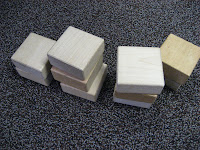
We used this scale to reproduce some similar structures using our classroom materials. We tried to create structures of varying complexity so that children of varying ability levels could use the idea book. We then took pictures with our digital camera and uploaded the images to a PowerPoint. The book was then printed, laminated, bound and placed in the block area. You can download our book here.

We also only used a few pictures within the book. The concept of the book is to help the child get started, not to dictate or direct his/her play. (The pictures on the right are a few that we used in the book.)

Since we haven't used it yet, I'll have to update you on the level of success. Hopefully, we can teach our students how to use the book and then increase levels of self directed play and independence.

Monday, June 9, 2008

Digital Photos and Oral Langauge Samples

I really like having digital photos of students engaged in classroom activites, field trips, or special events.

The digital camera is such a useful piece of technology because we can click away hoping to capture that one moment and not worry about wasting film.

I am very fortunate at my school because we have quite a few digital cameras available for teacher use and a number of color printers that can be used to print photos. We take tons of photos and use them to promote authentic, familiar language building experiences.

We start with photos of students playing or working in classroom tasks. At cirlce time or in small groups my assistant and I model how to talk about the picture. For some groups we work on labeling the objects or people in the picture. The next step is to use a 2-3 word phrase to tell about the picture and the action in the picture (i.e. Susie painting.) We then work to increase the descriptive words and build upon the sequence of the activity.

Our goal is to show students an array of 2-3 pictures, let the child choose one to talk about and record a language sample such as this (although it may be grammatically incorrect) : "I playing water table. I getting the crab a new home. Him like his new home because him it's big for him and him safe there."

The child who told us this story demonstrates his ability to label familiar objects and to use verbs with the "ing " ending. He also demonstrates that he understands the science concept that the crab moves to a new home because it outgrew the old one and for protection. His language sample further shows that we need to continue to work on proper pronoun usage and grammatically using helping verbs such as "am".

Digital photos act as a writing prompt or an idea prompt for young children. They spark many great conversations and opportunities to see what students have learned.

Sunday, April 27, 2008

Social Stories Made Easy

Several of my students have made gains through the use of Social Stories. A social story is designed to teach a student specific details about a social situation so that when the situation naturally occurs, he/she has some strategies and vocabulary to deal with it. For more information on social stories check out wikipedia at http://en.wikipedia.org/wiki/Social_stories

Another special education blog recently posted an article about using comic book formats to create social stories. What a great idea!
http://teachinglearnerswithmultipleneeds.blogspot.com/2008/04/comic-books-for-social-stories.html


The site that I particularly like from this post was: http://www.pikikids.com/ps/home

I was playing with it earlier this week. I already have some digital photos on my computer and just followed the instructions to upload some for a social story on task support. I used pictures of a particular student working with me hand over hand on a fine motor task, working next to my assistant and working in a center by himself. Then there is a place to click on speech bubbles to add text. I just added one sentence to each picture about the work task.

It's relatively easy and only took about 15 minutes to complete. The thing I spent the most time on was trying to figure out how to print it.
scroll on the right and there is a print menu box
click "download"
it will open a jpeg image and then print.

Also...IMPORTANT...when you finish the social story sequence, there is a link that toggles between "make my comic public" and "make my comic private." You most likely want to click the private one.