The University of Minnesota has a website that has great Tip Sheets for addressing challenging behavior in the classroom.
I particularly like the ones on "choice making" and "requesting a break." These are two very powerful strategies that can be embedded into almost any learning task.
Showing posts with label functions of behavior. Show all posts
Showing posts with label functions of behavior. Show all posts
Sunday, July 12, 2009


Tuesday, January 27, 2009
The Bamboo Story and Positive Behavior Support

 I'm currently involved in an intensive Positive Behavior Support (PBS) training. Yesterday was the first day of our training and the facilitators were laying the foundation and the ideas that improving challenging behavior and creating a classroom climate for emotional literacy often takes a long time. There are no quick fixes.
This reminded me of the Bamboo Story. A collegue gave me a copy of this story quite a few years ago. It was hanging behind my desk as a gentle reminder for my assistant and me. I have no idea what happened to it. It probably fell down at some point and accidentally got thrown away. I've tried to find the same story online, but to no avail. Here is what I remember and the message I took from the story I received so long ago.
The Bamboo Story:
Once upon a time there was a farmer who planted some bamboo seeds. Each day he diligently cared for his bamboo seeds in the hope that he would see the fruits of his labor in wonderful bamboo growth.
The first year passed with daily care. And yet nothing happened. No bamboo sprouted.
The farmer was undaunted. He continued his daily watering, weeding and care of his bamboo seeds.
The second year passed and nothing happened.
At this point the farmer was beginning to feel discouraged. He had consistently worked; nurturing and caring for his bamboo seeds, and yet he saw no growth.
The third year passed and suddenly his bamboo was growing a foot each m onth. By the end of the year his bamboo was over 12 feet tall! Finally, the farmer had evidence of his growth.
 onth. By the end of the year his bamboo was over 12 feet tall! Finally, the farmer had evidence of his growth.
So the question is, did the bamboo grow 12 feet in that final year when the growth was evident and measured? Or did the bamboo grow 12 feet in 3 years through the daily care?
It is said that during the first two years the bamboo IS growing. It is said that the bamboo is growing roots below the ground that are a foundation strong enough to support the future growth spurt. It is said that growth was occuring as the farmer was caring for the seeds, the farmer just couldn't see it.
My recent training in PBS strategies made me think of this story again. Often it takes a long time for children with challenging behaviors to demonstrate skills of regulating their own behavior, resolving conflict or problem solving.
So as we begin our journey with positive behavior support, we as teachers must persist as the farmer did. Continually providing the daily care and nurturing of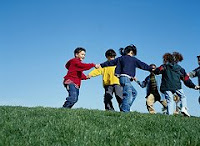 our students' emotional literacy. Those students may leave our classrooms without us seeing evidence of their growth. But perhaps, they grow by leaps and bounds one year. Perhaps those years of daily care including work on emotional vocabulary, directly and indirectly teaching social skills and providing support was a foundation for that growth. And perhaps the child's skills grew over the course of several years, but we just saw evidence of it in one.
 our students' emotional literacy. Those students may leave our classrooms without us seeing evidence of their growth. But perhaps, they grow by leaps and bounds one year. Perhaps those years of daily care including work on emotional vocabulary, directly and indirectly teaching social skills and providing support was a foundation for that growth. And perhaps the child's skills grew over the course of several years, but we just saw evidence of it in one.
Thursday, September 4, 2008
Memorable Moment #5/ Functions of Behavior Revisted
Have you ever had one of those moments in the classroom that could be recorded and published in text book as a classic example?
We had one today. In Memorable Moment #4, we looked at functions of behavior. To re-cap, every behavior that any person exhibits has a function. That means it gets the person something he/she wants or needs. There are four functions of behavior:
Attention: to get someone's attention (positive or negative attention)
Escape: (to get out of something)
Tangible: (to get something tangible)
Sensory: (to get some kind of sensory stimulation)
Trenton is a four year old boy with a developmental delay in the social emotional domain. On Tuesdays and Thursdays we set up a center rotation that includes 5 centers with a staff person at each station. Today's centers were: 1) playing store with my assistant in the dramatic play area, 2) playing in toys and being pulled one-on-one with me for baseline assessment data, 3) playing hopscotch with the assistant next door, 4) speech/language therapy group, 5) playing in blocks and being pulled one-on-one with the teacher next door for baseline assessment data.
Trenton was assigned to start in the dramatic play area. He wanted to start in my center. I reminded him that everyone would get a chance to go to every center, but he had to do "store first and then toys." He told me again that he wanted to come to my center. I reminded him that his job was at the "Store center."
The students all transitioned to their appropriate centers and we began our lessons.
Trenton sat on the floor and howled. Picture a low toned and constantly repeated "no, no, no." He also threw in a few "uhhn, uhhn, uhhn" moans for us.
He was sitting on the floor and wasn't hurting himself or anyone else. All of the other students were engaged and playing in the the appropriate places. I was at my center working, my assistant was at her center playing with children, and the teacher next door was at her center working with students. All of the children were playing except Trenton. He continued with his moaning and howling.
Within 5 minutes, Trenton had stopped moaning and howling and moved to his assigned center. He approached my assistant and said "Please, I can play?" Of course she replied yes and asked him to find some items that he would like to "buy." He entered the center and began playing with the other students and my assistant.
So what do you think? What would you hypothesize was the function of Trenton's behavior?
We hypothesized it was attention seeking. He wanted to start in my center and thought that if he couldn't get there with a request, then maybe I would pay attention to him if he acted out. The aspect that struck the staff as being classic was that he was truly denied ANY attention. All of the children were engaged, all of the staff in the room were busy with other children, and Trenton was just left space to cry on the floor. He eventually figured out that his behavior was not getting what he wanted and he stopped.
We had one today. In Memorable Moment #4, we looked at functions of behavior. To re-cap, every behavior that any person exhibits has a function. That means it gets the person something he/she wants or needs. There are four functions of behavior:
Attention: to get someone's attention (positive or negative attention)
Escape: (to get out of something)
Tangible: (to get something tangible)
Sensory: (to get some kind of sensory stimulation)
Trenton is a four year old boy with a developmental delay in the social emotional domain. On Tuesdays and Thursdays we set up a center rotation that includes 5 centers with a staff person at each station. Today's centers were: 1) playing store with my assistant in the dramatic play area, 2) playing in toys and being pulled one-on-one with me for baseline assessment data, 3) playing hopscotch with the assistant next door, 4) speech/language therapy group, 5) playing in blocks and being pulled one-on-one with the teacher next door for baseline assessment data.
Trenton was assigned to start in the dramatic play area. He wanted to start in my center. I reminded him that everyone would get a chance to go to every center, but he had to do "store first and then toys." He told me again that he wanted to come to my center. I reminded him that his job was at the "Store center."
The students all transitioned to their appropriate centers and we began our lessons.
Trenton sat on the floor and howled. Picture a low toned and constantly repeated "no, no, no." He also threw in a few "uhhn, uhhn, uhhn" moans for us.
He was sitting on the floor and wasn't hurting himself or anyone else. All of the other students were engaged and playing in the the appropriate places. I was at my center working, my assistant was at her center playing with children, and the teacher next door was at her center working with students. All of the children were playing except Trenton. He continued with his moaning and howling.
Within 5 minutes, Trenton had stopped moaning and howling and moved to his assigned center. He approached my assistant and said "Please, I can play?" Of course she replied yes and asked him to find some items that he would like to "buy." He entered the center and began playing with the other students and my assistant.
So what do you think? What would you hypothesize was the function of Trenton's behavior?
We hypothesized it was attention seeking. He wanted to start in my center and thought that if he couldn't get there with a request, then maybe I would pay attention to him if he acted out. The aspect that struck the staff as being classic was that he was truly denied ANY attention. All of the children were engaged, all of the staff in the room were busy with other children, and Trenton was just left space to cry on the floor. He eventually figured out that his behavior was not getting what he wanted and he stopped.
Tuesday, April 29, 2008
Memorable Moment #4: "Bad" Behavior/Communication Tool
We all know that behavior communicates something. The trick is to figure out what the "something" is and then react in a way that does not reward the "bad" behavior but honors what the child needs/wants. Let me tell you...that's a great trick!!!
Behavior analysts will tell you that every behavior supports a person's needs/wants (not just a child, not just a student....adults, too.) Behaviors are exhibited to get us what we need/want. Most of the time we identify the four reasons (functions) for behavior as: to get attention, to escape a demand or task, to get something..tangible, to stimulate our senses...sensory.
My teaching partners and I found the following "bad" behavior to be quite humorous. Of course, we have to deal with the behavior and why the student was doing it, but.....the process of that can be quite funny. (Note: Make sure when "bad" behavior is funny, you don't let your student know that it's funny because they could get conflicting messages. Chances are it's only funny the first or second time....after that it's just "bad.")
See if you can figure out what the following student is telling us.... :-)
Libby is a three year old student with Down's Syndrome. On Tuesdays and Thursdays we set up a 6 center rotation where children travel from center to center according to a timer. We organize this within two classrooms that are connected by a middle door. This can be quite demanding for some students.
Libby reached her 4th or 5th center for the day which happened to be her Language Therapy lesson. In the middle of the lesson she decided she was done!
Libby hopped off of her chair and ran from the Language Therapy room to my classroom. (The speech/language pathologist (SLP) was right on her heels.) She tried to shut the door on the speech pathologist! keep in mind...a 3 yr old, shutting the door on the speech path!
Well, the SLP and I happen to be good friends, so when we saw a 3 year old attempting to shut the door in her face, we both wanted to laugh. :-) Fortunately for us, we had our wits about us. Libby was redirected back to her group with a firm voice and reminded that group was finished when the timer "beeped." (by the way....we laughed later!!!!)
What was Libby telling us through her behavior? What was the reason/function for her behavior?
If you guessed "escape," then your hypothesis matched ours. We suspect that she was telling us that she needed to get away from work at that point.
What did we do? We try to get Libby's group within the first few rotations before she gets fatigued. This way we can ensure that her time at language therapy is time well spent. We follow up her groups with gross motor or low demand activites that support her need/want for escape. In short, we go straight back to the "Pre-mack principle." (see previous post: http://michellespecialeducation.blogspot.com/2008/04/benefits-of-daily-routine.html ).
Behavior analysts will tell you that every behavior supports a person's needs/wants (not just a child, not just a student....adults, too.) Behaviors are exhibited to get us what we need/want. Most of the time we identify the four reasons (functions) for behavior as: to get attention, to escape a demand or task, to get something..tangible, to stimulate our senses...sensory.
My teaching partners and I found the following "bad" behavior to be quite humorous. Of course, we have to deal with the behavior and why the student was doing it, but.....the process of that can be quite funny. (Note: Make sure when "bad" behavior is funny, you don't let your student know that it's funny because they could get conflicting messages. Chances are it's only funny the first or second time....after that it's just "bad.")
See if you can figure out what the following student is telling us.... :-)
Libby is a three year old student with Down's Syndrome. On Tuesdays and Thursdays we set up a 6 center rotation where children travel from center to center according to a timer. We organize this within two classrooms that are connected by a middle door. This can be quite demanding for some students.
Libby reached her 4th or 5th center for the day which happened to be her Language Therapy lesson. In the middle of the lesson she decided she was done!
Libby hopped off of her chair and ran from the Language Therapy room to my classroom. (The speech/language pathologist (SLP) was right on her heels.) She tried to shut the door on the speech pathologist! keep in mind...a 3 yr old, shutting the door on the speech path!
Well, the SLP and I happen to be good friends, so when we saw a 3 year old attempting to shut the door in her face, we both wanted to laugh. :-) Fortunately for us, we had our wits about us. Libby was redirected back to her group with a firm voice and reminded that group was finished when the timer "beeped." (by the way....we laughed later!!!!)
What was Libby telling us through her behavior? What was the reason/function for her behavior?
If you guessed "escape," then your hypothesis matched ours. We suspect that she was telling us that she needed to get away from work at that point.
What did we do? We try to get Libby's group within the first few rotations before she gets fatigued. This way we can ensure that her time at language therapy is time well spent. We follow up her groups with gross motor or low demand activites that support her need/want for escape. In short, we go straight back to the "Pre-mack principle." (see previous post: http://michellespecialeducation.blogspot.com/2008/04/benefits-of-daily-routine.html ).
Subscribe to:
Posts (Atom)