Showing posts with label special education. Show all posts

Friday, August 13, 2021

Easy Interactive Books

My friend Bev came up with this brilliant idea years ago.  I didn't need it for a number of years, but last year I had several students who benefitted from having more interaction during their story time.

We simply took an inexpensive paperback book and cut it apart.  Next we ran the pages through the laminator.  We then took a targeted vocabulary word from each page and created a Boardmaker document with a picture. Next we used the hole punch binding tool that we have in our teacher workroom to bind the book back together.  Finally, we used velcro dots to make each page interactive.

This has been a great way for us to create inexpensive interactive books for circle time.


Monday, December 21, 2020

Holiday Gift

 I like to have my preschoolers directly DOING something to particiapte in the gift we send to their parents in the holiday season.  We always have a wide range of abilities and skill sets in my class, so I usually pick something simple that everyone can complete.  This year I chose to have the kids glue pom poms to a frame and included a picture of them standing in the gingerbread house center we made.  Cute right?

One student came to the table to complete his project and picked up the pom poms and said "What is this? A virus?"

There you go.  Merry Christmas 2020....I guess I sent all of our families a virus frame.


Saturday, September 12, 2020

Covid19 Adjustments for Preschool Housekeeping Center

 We have just finished our first two weeks of school with all of our new re-opening policies for safety, disinfecting, and social distancing.  It's tough!  Last year I started my preschool special needs class with 15 students and ended my year with 17.  This year with all of our new policies, I am so thankful for lower numbers.  We currently have 7 children in the classroom and 4 remote learners that I teach concurrently through zoom lessons for circle time, small groups and therapies.

My last post showed the adjustments we made for our block center.  This center worked great from day one!  The reduced choices, the reduced visual "clutter" by removing the ABC rug, and simple visual supports from the painters tape and Lesson Pix symbols really helped this center to be successful.

Our housekeeping center is functioning well after two weeks of adult support.  Remember, my district has a policy for limiting shared materials, disinfecting after each use, all students must wear masks, and we must attempt to social distance to the best of our ability.  The housekeeping center isn't great for social distancing!  The kids naturally want to play together and be in close proximity.  Most years, this is exactly what we are hoping for, however, as we all know, this year is a bit different.  I wanted the kids to continue to have opportunities for pretend play and natural conflict resolution, but I still have to adhere to my district policies.

We decided to remove the small table and chair set that we typically would have in the housekeeping center.  This created more floor space for distancing.  We also removed many of the props including all of our dress up clothes.  We decided to limit the center to 2 children (typically we would have 4 children playing here) and set up the center as a "store" for our first few weeks.  We have two shopping carts, two cash registers, two sets of keys, and sets of food.  We have enough these categories of toys to either disinfect quickly after each use or rotate toys with our rotation system.


It took a LOT of support initially and I still don't love it.  But at this point, I have not figured out a different way to provide the students with the play opportunities and adhere to the district guidance plan.  So I can live with it.  The students are playing, they are talking and solving problems through the "trade" solution, the "timer" solution, and the "wait and take turns" solution.  Our "solution board" visuals can be found for free at the CSEFEL site under their practical strategies section.  I'll show photos of this in another post!  At this point in time, I feel like this option is at least allowing us to continue with developmentally appropriate play and natural opportunities to work on our social emotional goals.

Thursday, June 11, 2015

Simple Visual for Change of Schedule

Sometimes students just need to "see" how the changes of a schedule will affect them.

During our standardized testing window, specials and lunch changed school-wide, which prompted a change in my reading and math blocks.  I had one student this year who mainstreamed for a large portion of the day, but she started her day with me to organize her schedule and any known changes, and then returned to me in the late afternoon.  Under normal circumstances, she knew when she would have time to "hang out with her BFF."

Although she is very bright, she didn't "see" when she was going to be able to have time with her best friend within all of our schedule changes.  This particular child is very high functioning on the autism spectrum and we have found that often writing things down helps her process information.  She was quite anxious about the multiple schedule changes and started to move into her "whiny" voice. This is usually a pre-cursor for more intense behavior (throwing books, tipping chairs, yelling), so if we can catch her during the "whine," we can usually prevent the major meltdowns.

I loved this intervention because it was "quick and dirty."  There is nothing pretty or fancy about it, but we completed it in about 3 minutes during our morning check in and it resolved her anxiety. When she started to whine about when she was going to have time with her friend, I simply asked her, "Would you like me to write down both afternoon schedules so you can see when you have time together?"  She said yes and then added her comments on when they could "hang out."

Quick and simple but very effective!


Saturday, May 30, 2015

Pre-K Again

As this school year draws to a close, our principal has sent out our "most likely" assignments for next year.  She calls them "most likely" because, as we all know, things can change over the summer.  If the needs of our students change, then staff assignments sometimes have to change too.

My "most likely" assignment for next year is back with the pre-k special needs population.  I'm ready for a change again, but I LOVE my school, so I didn't want to change that!  One of our pre-k teachers retired this May, so an opening came up at our school.  I love the language development and developmental play aspects of pre-k, so I"m excited.

I've started culling through some of my old pre-k files and rediscovered a blog from a pre-k teacher, Christi Seward in Cobb County.

She hasn't posted in a few years, so perhaps her teaching assignment changed or something else in her life changed, but she has a WONDERFUL collection of picture books with essential vocabulary and comprehension questions that she discusses.  She also has created many power points to support her lessons.

One of the books she highlights is "Bear Wants More" by Karma Wilson.


In addition to Christi's resources, there is also a YouTube read aloud with the book, too.  (This version is really sweet.  A boy received this as a birthday present and his family recorded him reading it out loud for the person who gave him the book.)


This has been a busy year and I haven't completed too many posts, but hopefully that will change this next year coming up!


Interrupting Chicken: A Social Skills Lesson

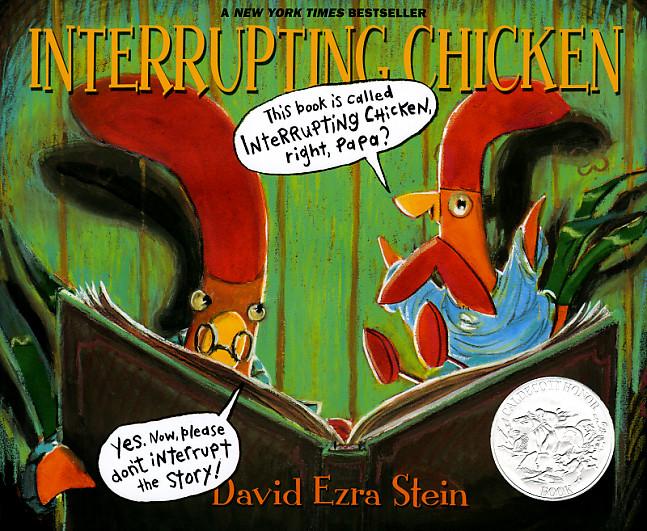
Last week one of our social skills lessons started with a read aloud of "Interrupting Chicken" by David Ezra Stein.

This is a great book to help children learn about controlling those impulsive moments of wanting to interrupt or blurt out during our whole group time.


We completed our read aloud, had a class discussion and then also completed some activities similar to those found at Happy Teacher, Happy Kids.

I can also be a little bit goofy and I want our social skills lessons to be fun, so the kids can really practice the skills and enjoy the results of prosocial behaviors.  Not just dread one more lesson with a bunch of rules that are hard for them to follow.  So as a result of my Pinterest addiction, I found a link to "Chicken Names" from Tilly's Nest and thought it would be fun to pair with this book.


The rules of the activity were pretty simple.  We were going to practice NOT being interrupting chickens.  If we could work on that, we could make a list of everyone's chicken name.  (I'm Yolko Scrambledore, by the way.)  It was fun.  One of the little girls in my class has the same birthday month as my assistant so she dubbed my assistant as her "Chicken Cousin."

There is also a YouTube video that has a read aloud.  I like to use the videos in addition to my read aloud because it gives my students one more way to access the text.


With a simple Google search, you can find many, many online resources and ideas that support this book.  These were just a few of the ones we used.


Thursday, December 4, 2014

Satin Hands and an Intervention....Strange Combination


I never used to need lotion for my hands.  However, ten years ago, I started teaching my varying exceptionalities pre-k class and I found myself washing my hands 100 times a day.  And let's face it....school soap is not gentle on your hands.

About that time, I discovered Satin Hands from Mary Kay and could probably have been their poster child.  (I'm not a Mary Kay consultant, I just happen to really like this product.)  The ladies that I work with found out how much I like it, and it is now a frequent gift for me during the holidays and at my birthday.  So now, I actually have a set a home and at school.

Little did I know that my Satin Hands would become an intervention this year!

I have a little girl in my class who tends to scratch her arms when she perceives work as being too difficult.  It can be pretty bad on occasion and she has picked scabs and opened old scratches.  Bleeding in the classroom is not a good thing!  Interrupting reading groups or math groups 3-4x every week to deal with bleeding is also not a good thing.

One day, I was using the lotion while she was at my table and she asked me what it was.  I told her it was lotion and asked her if she wanted a little squirt.  She said yes and "mmm, smells good."  Then I got my bright idea.  If she likes the smell and the feel of the lotion, maybe we could replace her scratching behavior by asking for some lotion.  I asked her if she would like to do that and of course she said yes.  So I told her she could use the lotion but she was not allowed to scratch.

I now have a tube of lotion at my reading table.  She still sometimes starts to scratch in moments of academic frustration, but with a simple verbal prompt of "Mary, do you want some lotion?"  She will stop and gently rub her arms.  We haven't had a bleeding episode since we started. It is MUCH easier and less distracting to give her a quick squirt of lotion than it is to deal with washing, drying and band-aiding arms when she scratches and draws blood.

Thursday, September 4, 2014

Accountable Talk

As my reading instruction continues to evolve over the years, I keep adding new strategies to my "bag of tricks."  It's funny how I get ideas.  (Honestly, I very rarely have a completely original thought when I start to figure out a new strategy or a lesson I haven't implemented before.)  I recently told a first year teacher that one of the greatest gifts a teacher can have is to be a good synthesizer.  If she can learn to take all of this overload of information we are bombarded with and somehow synthesize it together and use it when it's appropriate and useful; then she will be able to continually add to her bag of tricks.

I'm adding to my bag of tricks.

For the past few years my 1st-3rd grade students have loved having "Nacho Karaoke" day once a month.  On the day the cafeteria serves nachos, I let them all eat in the classroom and we sing karaoke to songs with lyrics that I have saved from YouTube.

I'm reviewing my list of songs before this year's first Nacho Karaoke and was re-introduced to the song "Brave" by Sara Barielles.


As I paid attention to the lyrics, I really noticed the refrain this time: "Say what you wanna say.  I wanna see you be brave!"

I thought this would be a great way to introduce "Accountable Talk" to my students!  For the past few years, it's been challenging to teach children how to agree or disagree with a peer based on text evidence.  It can be hard to raise your hand and speak up during a group, especially if you are disagreeing with a friend.  However, when students DO engage in accountable talk, I have found that they truly start to engage with each other and the text in a purposeful and meaningful way.

My class has already set our essential agreements (rules) including one that states "We will be kind to each other."  With that as a foundation and also practice of the roles of "speaker" and "listener,"  I think we can use this song to talk about how important it is to speak up and "say what you wanna say" during an accountable talk discussion time.

Sunday, August 31, 2014

Fair vs. the Same

This summer, I came across this visual on Pinterest. To me, this shows why we assess and plan for individual differences for our students.

What is FAIR is not always the SAME thing for everyone. At the beginning of the school year, my class has a meeting and we generate our class rules. We call these "agreements" (and sometimes for little kids I call them "promises.") The students agree to follow the rules we generate. Then my assistant and I make agreements with the class too. One of our most important agreements is to help make things fair.

I find the concept of fairness to be one that even my youngest three year olds could understand. When the adults promise to be fair, it sets the stage nicely for differentiating your lessons according to your data. When someone asks me why something is different for one person or one group, I simply reply "Because I promised you all that I would help make things fair; and you have what you need right now, and so do your friends."

Clearly the boy who is tall doesn't need a box to stand on (even if he wants one) and clearly the child who is the shortest needs 2 boxes if he is going to be able to see the game. What is fair, is not always the same thing for everyone.


My Pinterest link led me back to this post by Phil Artman. He found it on Facebook and could not determine the original writer.  If it belongs to you and you do not have a "noncomercial share alike" aspect to it, please leave a comment and I will remove the post.

Tuesday, July 8, 2014

Doll House and Choice Time

At the end of the day this past year, my class enjoyed "Choice Time."

If you were to walk in my classroom, "choice time" looks remarkably similar to "free time."  I don't call it "free time" however, because the children are not "free" to do whatever they want...they have to make a choice from the leisure activities we have available and then stay productively engaged, unless they have asked permission to make a different choice.

Unproductive wandering throughout the classroom is one of my "teacher pet peeves."  It drives me crazy and I have found that unproductive wandering leads to lots of management or behavior issues. Hence, we have "choice time" and not "free time."

One of my older third grade girls wanted me to buy a Barbie doll house for them to play with during choice time.  I explained that Barbie houses cost a lot of money and we didn't have enough to buy one.  She accepted this and went on to play with something else.

A few days later while browsing on Pinterest, I came across this pin that uses a 3 ring binder to make a Barbie doll house from Southern Disposition.  Take a look.  Kendra includes lots of ideas and instructions.


How serendipitous!

When we got to choice time the following day, I asked that little girl if she would be interested in looking at a possible solution to our Barbie doll house problem.  We looked through the website and directions.  She was hooked!

I happen to have lots of scrapbook paper at home that I don't use anymore because I now do most of my photo albums digitally.  I also have a scrap craft bucket of ribbon, lace, beads, etc that I keep for projects at school.  I purchased some scraps of cheap fabric from the scrap bin at Jo-Ann's.

I also happened to know that our bookkeeper has A LOT of old binders that no one wants to use because they aren't perfect.  They were "perfect" for us because they were free!

So for about $8 for fabric scraps and some Stitch Witchery (no sew tape that fuses fabric together), we were in business!

Two girls wanted to make doll houses but they didn't really know where to start.  We talked about how sometimes people use an "inspiration room."  I asked them what colors they wanted their rooms to be.  One chose blue and the other chose pink.  We googled images of girls bedrooms.

One girl choose this blue room from Amecdes as her inspiration.


The other girl chose this pink and green and cream room from Bess.Net as her inspiration.


Our choice time lasts for 15 or 20 minutes at the end of each day.  For about three weeks, the girls spent their choice time creating, figuring things out, problem solving and adding details to their doll house.


Here's one girl making a mirror out of a file folder, aluminum foil, and lace ribbon she cut apart.


Here's her room after she covered up a granola bar box for her bed.


And here is her final product.  The curtain rod is a pipe cleaner with some blue beads we had in our craft bucket (I think they were table scatter beads from the Dollar Tree.)  The curtains are just lengths of lace ribbon she cut and then threaded onto the pipe cleaner.  The rug is a scrap of felt. We printed an image of a dresser off of another Google image search and she glued it to the wall.  The bedspread is a scrap of fabric that she cut.  I helped her make the pillows and the column of fabric that covers the 3 rings with an iron and the Stitch Witchery. (Hot irons and young children are not a good combination!)


Here is the other girl after she finished her mural and began working on her window.


And here is her final room.  She decided to make her bed a daybed.  We used a Girl Scout cookie box for this and scraps of fabric that she cut.  Her curtain rod is a pipe cleaner with some of a pearl strand that she twisted together (the pearls were is my scrap bucket.)  The curtain ties are more of the pearl strand.  The rug is a scrap of felt.  She also cut some mat board to frame her butterfly mural.  Again, I helped with the iron and Stitch Witchery of the column of fabric in the middle and the pillows.  


The two rooms together looked like this (sorry the photo is a little fuzzy!):


The girls had so much fun making their own doll house bedrooms.  They also had a lot of fun playing with them during choice time once they were completed.

I know I can't prove that they practiced their social skills or their problem solving skills and I certainly don't have any data to justify letting them spend 15 or 20 minutes every day making a doll house.  However, these little doll houses have been one of my favorite memories from the year.  To me it shows:

1) Willingness to accept and handle disappointment and the word "no" (We didn't buy their doll house that they wanted.)
2) Willingness to accept a compromise and take responsibility to follow through on the compromise
3) Ability to think in a problem solving process (Watching the one girl work for 2 days to get her mirror to stand up by itself was awesome!)
4) Ability to persist at a long term task (relatively speaking)
5) Thinking creatively
6) Using materials for another purpose other than its intended use

****One little girl is in my class for help with an emotional and behavioral disorder (EBD) and the other is in my room for  help with a severe learning disability.  I'm pretty happy with all of the skills they practiced in an authentic and personally meaningful way.

Many, many thanks to Kendra at Southern Disposition for her great idea!

Tuesday, July 1, 2014

Book Talk Tuesday

Since the summer has been in full swing, I have done a lot of blog hopping and reading links on Twitter streams.

I just found Gladys's blog over at Teaching in High Heels.  She and I have several things in common: like Gladys, I could spend large amounts of time and money investing in children's literature.  And I also agree everything LOOKS better in high heels, but I have to admit, I always have a pair of sparkly flip flops under my desk for when my feet hurt!

At any rate, I'd like to piggyback on Chelsea's "Book Talk Tuesday." Lulu is new to me and I love finding new books.  I can't wait to take a look at her series.

A series that my class has throughly enjoyed this year is Skippyjon Jones.


Skippyjon Jones is a Siamese cat who imagines spectacular adventures for himself as a chihuahua.

There is a whole series of books telling of Skippy's adventures.  They always include a warning from Mama Junebug, Skippy entering his closet as the cue that his imaginative adventures are beginning and poems that get the kiddos in my class clapping their hands and begging for me to repeat it "one more time."

I love to hear kids interacting with books, laughing and enjoying the experience.  I hope its one more step on the path for life long readers.


Friday, June 27, 2014

Math Homework

Within my self-contained varying exceptionalities class, I typically have quite a few students with language impairments.  These students usually need extra support when completing math word problems and multiple step math problems.  They also most frequently need extra time to practice skills and concepts.

I like to have the students practice math skills, but the homework component that is part of the series my district has adopted just didn't work for us this year.  The homework pages were "busy" which made it difficult for the students and families to discern the most important information.  They also moved at a pace and changed skills so quickly, that my students didn't have enough time to truly master some of the computation skills or concepts, let alone apply those to word problems.

I ended up using a combination of resources to make sure each student had math homework that they could independently complete.  Here were some of my most frequently used:

KidZone Free Math Worksheets This site offers several different computation skills and at different levels of difficulty.  The printed pages are "clean" and not visually busy so they were ideal for homework.  (And it's free!)

Calculating Area and Perimeter This site offers a worksheet generator that allows the parent or teacher to pick whether the child will work on simple or complex shapes; metric or English units of measure; or various combinations.

Touch Math This is a program that includes blackline reproducibles that our principal purchased for our special education department.  It is an investment up front, but well worth it.  My school has the Upper Grades program.


Since I'm sharing resources that I use for homework, I will also share my homework philosophy.  I believe that what I send home for homework should be work that the students in my class can complete independently (or with very minimal support.)

I believe this because, I don't want the child going home and practicing a skill incorrectly 2 or 3 nights every week!  I also know that the parents of the children in my class have differing levels of the support they can provide for their children with homework.

I also believe that it is important for children to learn how to become responsible for their own actions. Completion of homework assignments is one of the criteria for the students in my class to earn their "choice time" at the end of the day.  I don't think it would be fair to assign a student to do homework that he/she cannot complete on their own and then also tie their choice time to the completion.  If I know they can independently complete the homework, then I feel comfortable setting the expectation that you must have completed homework before you go to choice time.

This criteria and philosophy has worked for the classes that I have had for the past several years.  It's always possible that I may get a group of students in the future that need a different plan; or an individual within a group that needs something different.  Since I have a full time special education classroom, I also believe it's my responsibility to be willing to change my homework expectations when the children's needs warrant a change.

Friday, June 6, 2014

Charlotte's Web

We ended our school year with a novel study.  Two of the general education teachers and I pulled together a unit on Charlotte's Web for the students.  I'm so glad we did!  After so much emphasis on our standardized testing this quarter, it was refreshing and rejuvenating to go back to great literature and helping children understand and enjoy it.

Here are a few of the lessons we completed:

1) Every student had a novel and was expected to follow along.  I hadn't typically done this in the past when there was such a difference in my students' reading skills and the level of difficulty of the text.  This sounds silly, but it was almost an "A-ha" moment for me.  The brailled book that we had was in contracted braille and Gabby is still reading uncontracted braille.  This book was too hard for her, but she was able to explore the book and track through some of the chapters when she had 1:1 support.  I have 2 students who are also still reading at a beginning first grade level.  When they were given a simple verbal prompt on when to move to the next page, they could inconsistently track with us too.

2) We completed a "following directions" lesson based on the passages in the text to map out and create the barn scene.  We added more details as we learned them throughout the book.  (The white circle is just blocking out all of the kids names.)


3) When Charlotte was finally introduced in the book, the students all picked a spider to research.  They made a spider body and were responsible for finding 8 facts about their spider.  Then they read their planning sheet and facts to me; and I helped them type it into a word document so they could cut out the facts and glue them to the spiders legs.  We started them with 3 facts: all spiders are arachnids, all spiders have 2 body parts, all spiders have 8 legs.


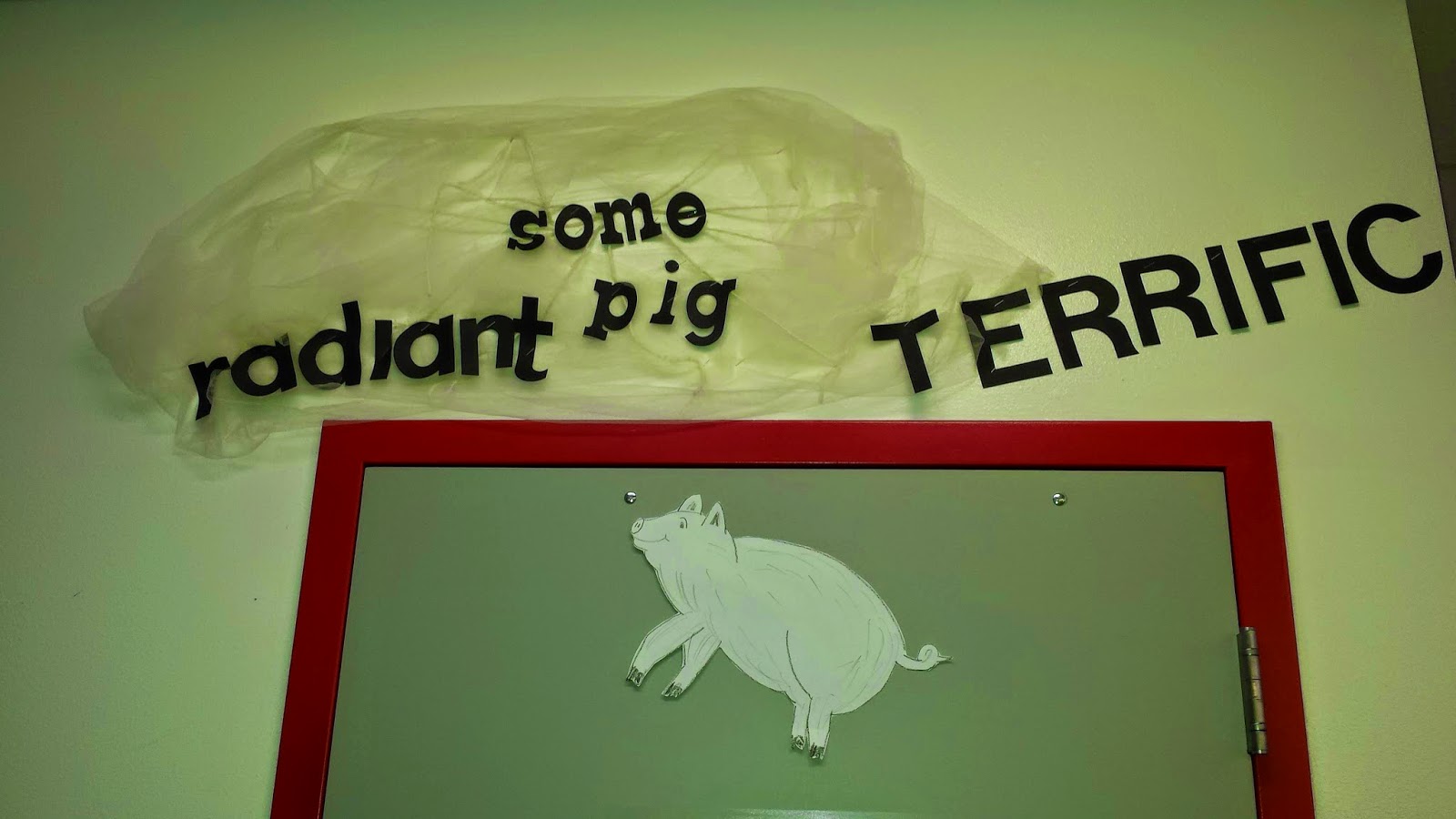
4) The classroom staff also made a web (tulle and yarn) for Charlotte and surprised the kids each morning with the words that she wrote in her web for Wilbur.


5) In addition to these "crafty" classroom projects, we also completed several Type 1 writing pieces about what students know about a farm, what they know about a County Fair, what they think will happen to Wilbur, why Fern wasn't paying much attention to Wilbur at the fair etc.  (Our school uses the Collins writing program.  To see more about a Type 1, click here.)


6) Two social skills lessons emerged from this novel study that I wasn't expecting.  One boy had already seen the movie so he knew what the story was all about.  One day he went home and cried.  (Talk about making me feel terrible!)  His mom sent me an e-mail to let me know what was happening.  We talked about 2 options for him: 1) Finding alternative assignments for him so he wouldn't go home crying every day.  2) Watch him closely during lessons and prompt him to take a break if he needed one.  He has very quiet but consistent clues that tell you when he is getting upset.  His cheeks get red and he starts to fidgit.  Watch for these clues and ask him if he is "ok or if he needs a break."  If he chooses a break he could go to the computer and put the headphones on and go on Tumblebooks so he didn't have to hear us.  

We decided to try the second option and mom said she would let me know if he comes home crying anymore.  If he continued to be upset at home, then I would find alternative assignments for him. On one occasion he chose to take a break but out of the 3 or 4 other times I asked him, he chose to stay with the group.  I think giving him some control over whether or not he had to listen to something upsetting made it more manageable for him.

Another little girl, who can be very loud and a bit dramatic, but is also very young and sensitive to sad situations also had a few moments when the story was upsetting.  Her plan was a bit different.  Throughout the year we have had a "safe space" set up for her so that she could manage her own behavior and de-escalate herself.  She also processes information better when she is prepared for it and it is not a surprise.  (We're working on handing unexpected situations, but for this novel with the themes of friendship and life cycles and death, I thought she still needed to be prepped.)  For her, I would warn her when a sad part was coming up and let her choose her safe space or holding my assistant's hand while we read that part.  Interestingly, most of the time in the year when she was upset, she liked to be alone and choose her safe space.  Each time within this story she chose to hold my assistant's hand.  

For these two students, I spoke with their parents about the novel and how it was affecting them emotionally. My goals in the novel study started with the literacy goals of character traits, how characters change throughout a story, remembering details, researching information, etc.  For them, my focused shifted and I really wanted the social skills practice more than I wanted them to gain the literacy skills.  However, in getting at this social skills practice, I didn't want to push them so hard that they were crying or emotionally distraught at school or home.  It was a fine line...thank goodness they both have very actively involved parents who let me know how they were doing at home too!  

I wanted the boy to learn to speak up and request a break when he felt like he was getting to the "overload" point.  While he only took the break once and he needed prompting, this novel gave me some good information to share with his teacher next year so she can continue with this.

For the little girl, I wanted her to remember that she had solutions and choices that she could use to help her manage her emotions.  I also wanted her to be able to attempt to do this without yelling and disrupting the whole group.

The novel study of Charlotte's Web was a great way to end the year.  It gave the students a great piece of literature to read, fun activities that still had an academic focus, and kept them interested and engaged at the end of the year!


Saturday, January 4, 2014

Writing Haikus

Way back in 2009, I worked with a friend of mine who is an SLP to devise a manipulative word bank to help my summer school students with autism generate their own sentences and write a simple paragraph.  It sounds pretty straightforward, but it was actually quite a bit of work for me because I had never had to provide quite that level of support for students.  You can read about it here.

This year, I used this strategy again.  While my current students, don't have the severe needs of the class I developed the system for, I thought it would be helpful for some of them.

We were working on a unit that focused on different forms of poetry.  One of the lessons for the general education students at grade level was to write a haiku.  I wanted my students to do this too.  So I stole some ideas from my general ed teacher friends and then added some supports to them.  Here is what we did:

1) Each student painted a background of mixed colors with yellow and orange.  My assistants and I used our Elison machine to cut out some "bare trees," spiders, and leaves.  The kids used the black shapes to glue a scene to their previously painted background.  (Sorry I don't have a picture of this! I'll see if I can update this with a "fake" one that I make so you can see what I"m talking about.)

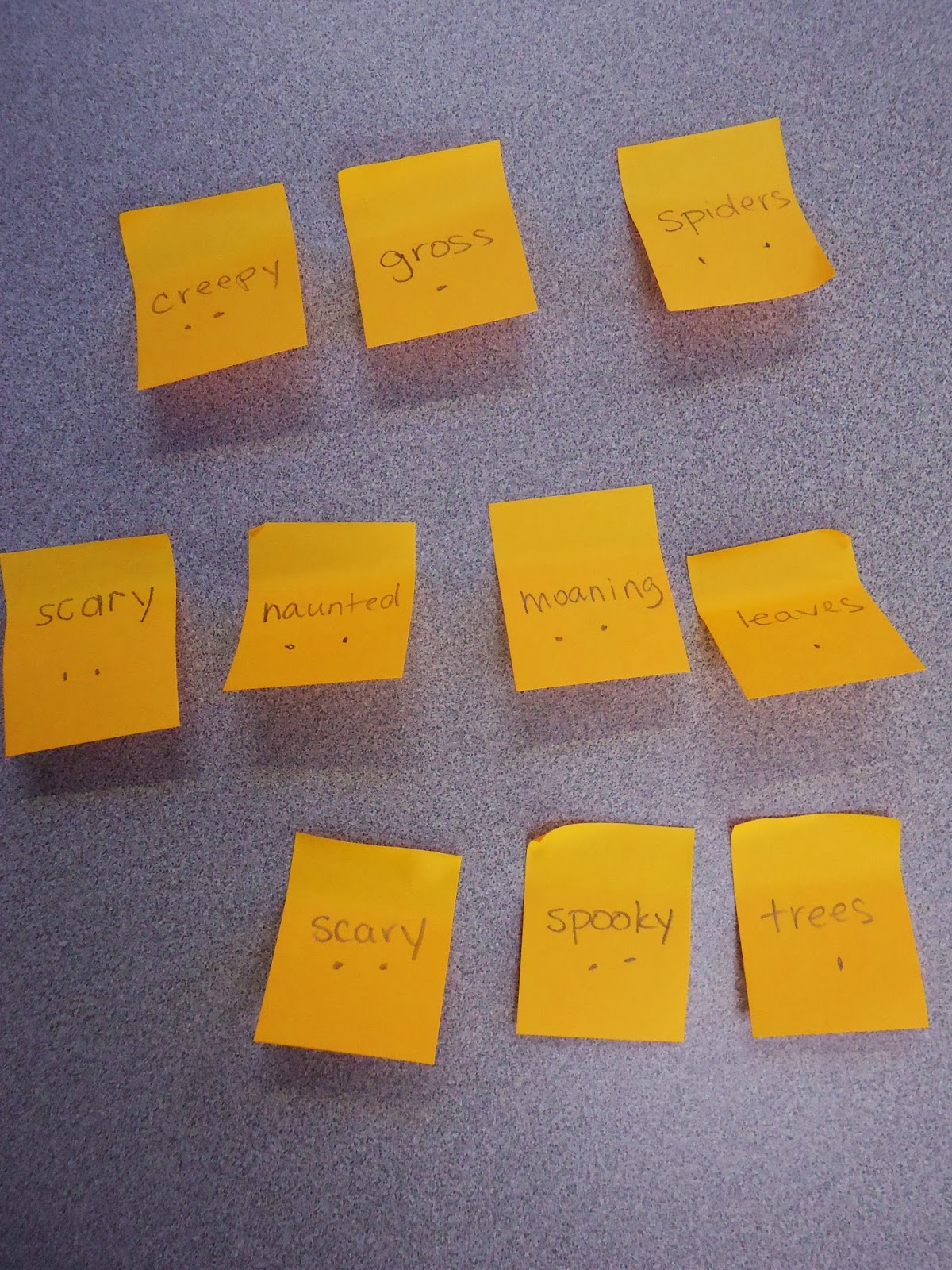
2) As a whole group we looked at the pictures that were created and generated a word bank of words that described our pictures.  I wrote them on the board and the kids copied them.  We also reviewed the rules and syllable pattern for creating a haiku.


3) Two of my students were able to generate their haikus after completing these activities, others needed some more help.

4) I transferred the word bank to post it notes and put dots underneath each word to identify how many syllables the word had.


4) The students moved and manipulated the words to create a phrase that made sense and also fit the syllable pattern for a haiku.


5) When they finished writing their haiku, they read it to me and I typed it on the computer.  We printed their haiku and they used craft scissors to cut the edges of the paper the poem was printed on.  Then they glued their haiku to their picture and we hung it up for display!


When my general education team decided this was going to be one of the "published" pieces we would do for our quarter 2 writing grades, I was a bit worried.  Writing a haiku is very abstract.  I needed to find a way to teach the syllable pattern and the emphasis on nature to my students.  The art project and the post it notes (as well as previous experience with haikus we read aloud) helped them to successfully complete this! It's nice to be "pushed" into doing something that is a bit uncomfortable sometimes. (I never would have chosen haikus as a published writing sample.)   As a teacher, it made my brain stretch and think about how to make this lesson work with my students.


Wednesday, October 17, 2012

Differentiating....How do You Explain It?

I'm currently teaching a class for our local college that focuses on an introduction to the exceptional learner.  I love facilitating this class because the questions that are generated from my students often help me to clarify and articulate what I believe and what I practice in my classroom.  Sometimes it's nice to have to formally explain what you do and why you do it.

This week we have been focusing on strategies and differentiating.  There have been quite a few questions along the themes of how do you implement a strategy and not embarrass a child who has difficulty; or how do you do something different for one and not others; or how do you plan for a child with a speech impairment during read alouds.

Since these questions were addressed and clarified my for my class, I thought the information would be of interest for this blog, too. 

To me, these are brilliant questions.  They get to the heart of  "What does that look like in the classroom?" and I'm interested but I don't know how to do that yet.  "How do I do that with all of the other demands?"

The following is what I shared with my class:

".........Not every strategy is going to work with every child. That's why it's important to know how to research strategies and methods. You may come across a child who exhausts your "bag of tricks" and you need to find a new way to teach him/her a skill or concept.

HOWEVER, sometimes a strategy WILL work if you think through the challenges and set your classroom climate to be supportive. When your thinking starts with a problem solving and supportive approach, it will often help the child succeed.

So what does "a problem solving and supportive approach" look like? It can look differently in different classrooms. I'll share with you some of the methods I use.

When I think about a strategy and a specific child I think may have a challenge with it, I try to problem solve by thinking about questions like this:

1) What skill or concept do I want the child to master?
2) Is this strategy going to help him/her master that skill or concept?
3) What is the challenge I think he/she is going to face? Is there a way to adapt or modify the strategy to adress this challenge BUT still help the child master the skill? If so, this is usually the method I try first.

Here are a few things that I do to set a positive classroom climate at the begninning of the year:

1) We hold a class meeting and set our rules for the year. I pose them as "agreements" and explain to the kids that this is like a promise. This year the teachers agree to: be respectful to everyone, make sure everyone is safe, help everyone learn new things. This year the students agreed to: listen to the teachers, be kind to each other, keep hands and feet to ourselves.

Please note: If the students don't generate an idea for an agreement that I think is necessary, I usually try to guide them to it by posing questions and scenarios about if I let someone do something to them. For example, if they didn't generate an idea similar to being kind, I might ask them: What if someone kept calling you names? Would you like that? Would you want me to help you if you couldn't solve that problem by yourself? Is this important to us as a group? If it is,maybe we should come up with an agreement about that.

2) We talk about leaders. The United States has a leader, it's our president. Our school has a leader, it's our principal. Our classroom has a leader, it's the teacher. The leaders job is to make sure that everything works together smoothly. I remind them that I am the leader in our classroom and it's my job to make sure everyone is learning what they need to be learning.

3) We read lots of literature about differences. The books we revisited many times this year are: "It's Okay to Be Different" by Todd Parr; and "Little Louie the Baby Bloomer" by Jose Aruguelo.

These two books were chosen this year for specific reasons.   The first one addresses differences in general, not related to a disability. The second one addresses how a tiger can do things, it's just that the way he does things is a little bit different than how the other animals do things (which in a very indirect way teaches kids about accomodations).

4) We have a class discussion where I explain to them that not everyone is going to be doing the same thing or have the same work. That's okay! (Establishing the role of the leader and then talking about differences establishes a foundation of knowledge for my students to fall back on when I start differentiating lessons and assigning different children different work.) I hold up our books and remind them what we learned from each of those books. Then I simply tell them those are the things we need to remember when we do our work.

5) If you were ever to come into my classroom, you would hear me redirect somone by saying "Try again, please and remember we are a kind class." or "Oh gosh...try that one more time and remember, you are a kind person." I want them to internalize that we treat each other with respect and kindness. We support and encourage each other when we master something that was hard for us (even if it would have been an easy task for someone else).

When children have this kind of positive, supportive climate every day, it becomes a little bit easier to take an academic risk because you know that your classmates are not going to laugh at you and your teacher is going to help you. And when you can do it on your own, you will be proud of yourself and others will celebrate and encourage you.

The way that I believe this relates to the questions my college students generated is that it creates a climate that allows a child to take a risk and not do well; but be able to take that risk again and do better; and finally take that risk again and master a skill. These steps attempt to support the child towards growth both academically and emotionally.

One teaching experience that I remember very vividly didn't happen in a classroom, but I think it illustrates this point.  It happened at a cooking party we had with a chef at my sister-in-law's house.  We were all laughing and socializing and having a great time.  The chef was guiding us in preparing the meal and taught us some basic knife skills.  When it was our turn to try, one of us was chopping and the chef prompted her by saying "That was very good.  Can I show you how to do it better?"  I don't know that anyone else in the room really heard her, but I did and I thought: GENIUS!  What a phenomenal phrase that was non-threatening and encouraging, but also prompted her to do better....I'm so going to steal that.  And of course I have.  

I try to recreate that type of climate.....well, there's not any wine in my classroom, but you get the idea!  :-)  .........  It's safe.  It's supportive.  It's encouraging.   It's okay to make a mistake or not do something perfectly....the people around you will help you do it better!

Sunday, October 14, 2012

Reading Interventions

While browsing on Pinterest, I found this incredible resource from Jen Jones on Teachers Pay Teachers.   (It's free!)  It is a table that pairs a reading problem a teacher may observe with several reading intervention ideas that can address it. 

The ideas are all tried and true strategies we have all probably already used at some point in our teaching careers.  I love this aspect of the document.  We are not reinventing the wheel, we are thinking critically and planning systematically to address a problem.

Click here to check out Jen's If / Then Reading Interventions Menu.

Tuesday, August 28, 2012

First Week of School

In many ways, the first week of school this year was just like any other.  We established classroom rules and procedures.  We talked about respect of teachers and peers.  We identified and practiced ways to solve common problems and conficts.  We read stories.  We went to recess.  We finished beginning of the year tests, etc, etc, etc.

However, this year was quite a bit different for me.  For the first time, I have a student who is blind.  She also has some other exceptionalities, but to be perfectly honest, it's her blindness that has caused so much thinking and reflecting on my part.

I've always known that I rely very heavily on visual supports.  For many children with learning disabilities and language impairments, adding a visual cue provides them another way to access concepts.  I do this deliberatley and systematically with Boardmaker, graphic organizers and simple line drawings on assignments, tests or the white board or Activeboard.  It's become an integral part of my planning and lesson delivery.

What I didn't fully recognize until this charming, engaging, delightful girl who happens to be blind was in my class was how heavily I use and rely on facial expressions and gestures.  Simple things like giving a thumbs up across the room to a child who is working on independent work while I have a group at my table.  Or using the sign language symbol for "stop" in an assembly for someone who is talking to a neighbor. Or smiling to welcome a child who is joining the group from speech therapy or OT without interrupting the flow of the group.  And of course, giving the "evil eye" when a child is doing something he/she knows is inappropriate.

I like this.......facial expressions and gestures give encouragement or redirection in a way that doesn't distract others. 

Not surprisingly, these strategies are completely ineffective for my student who is blind.  I'm in the process of re-thinking how to discretely give these types of cues to her in a way that helps her but doesnt distract the other students. 

She happens to be very affectionate, so we're practicing high fives, pinky hugs and "golf claps"  (quiet clapping that celebrates her successes).   Right now in large group settings, I'm also using a lot of proximity and whispered cues to let her know things that are happening.

In addition to this, I'm modeling talking about pictures and details of things as we pass to her and the class.  I'll have to let you know how this goes...this is one of those "gut" things.  I don't know of any educational theory to back this up.  But, my hope is that in modeling my description of pictures and things we pass, the other students will notice this and start to do it, too.  I hope that this will not only  increase their acceptance of others' with differences, but it will also increase their own skills at recognizing main ideas, important details, clues, descriptive words, feelings, etc.  That verbalizing all of these things for one child will also help the other to more fully understand the importance of them.

This is one of the most exciting parts of teaching children with special needs.  I get a chance to think about problems and hopefully come up with solutions.  Then not only do I think about the potential solutions, but I get a chance to implement it and observe the results.  Whether or not the things that I'm trying right now will work, I don't know.  I do know that the process of thinking and reflecting on this and trying things out and observing the results, which then prompts more thinking is defintitely making me a better teacher.  It's making me more aware of some of the things I do without thinking and it's requiring me to think in new ways.....that can never be be bad. 

I hope by the end of this year I have a few more posts that tell you how excited I am over my students' successes!

Monday, August 13, 2012

The Last Day of Summer

Tomorrow teachers report back to school (in my district.)

This morning it was raining.  The beach excursion that my sisters and mom and I had planned evolved into a shopping excursion.

This afternoon it was pleasant, breezy and sunny!  The shopping excursion evolved into an afternoon on the the deck of one of our favorite bay front spots!

This was our view:


We love it and thoroughly enjoyed the last afternoon of summer with some iced tea or adult beverage of our choice!

This evening it was time to head home.  My husband was already at the house when I arrived.  He greeted me with this song:

"Back to Life Back to Reality"


He's soooo mean!!!!

Although, in all honesty, I am ready to go back.

I've been reading The Daily Five this summer and I'm ready to start implementing some of the new procedures I've been thinking and reflecting about.

Thanks to my sister and sister-in-law, I've also recently become addicted to Pinterest.  I've found a lot of great ideas for supporting reading comprehension and understanding of complex passages, specifically as it supports the Common Core Standards.

However, this summer has primarily been a summer of relaxation!
  •  I've spent time with family visiting local attractions and playing games.  
  • I learned how to crochet and even completed 1 dishrag for the mere cost of $21 ($18 class, $1 crochet needle and $2 yarn). 
  • I've also enjoyed a number of books we term "beach reads"...not a lot of substance and not great literature but very enjoyable none-the-less.  
  • My husband and I have taken a few weekend get-away trips.  
  • And I have 1, yes 1, thing completed off of my "I'm taking summer off so I'll really have time to get some household projects completed list."   (How pathetic!....not that I'm worried about it...I had a great time playing instead!)

However, it is time to "get back to reality"  and I am eager to learn about my new students try out some new ideas and get back into a problem solving frame of mind.

Now I have to go set my alarm....ughhh!  if only I could start my reality at 9:30am instead of 6:30am......


Thursday, April 26, 2012

How to Eat Fried Worms


My class is currently reading the book, "How to Eat Fried Worms" by Thomas Rockwell.  This is such a fun book that captures the students' interest and imagination.  My students are really connecting to the interactions the four main characters have throughout the book.  Tomorrow, we will be wrapping up our lessons focusing on the book.

I've decided that I and the children who choose to, will get a chance to eat a "fried worm."  While I could probably be convinced to try most anything; and I have eaten snails and haggis, I don't think I could be convinced to eat a real fried worm.  We will be dining on hot dogs with ketchup and mustard!


I took a package of hot dogs and sliced each hot dog in sixths.  I found it easiest to cut them in half first and then cut each half into three parts.  Then I put them in a non-stick skillet for a few minutes to fry them up.  Tomorrow I will heat them up in the microwave I have in the classroom.  My husband and I were laughing tonight at the pile on the cutting board.  I think it really does look like a pile of worms!  :-)


This will be a choice activity.  I have some students who absolutely will not want to eat one of our "fried worms."  However, I suspect those kids will be groaning, giggling and laughing right along with the others who do.  I plan on bringing in some paper plates, ketchup and mustard to serve with our "fried worms."   One of the main characters, Tom, chants a poem to his friend Billy as he eats the worms.  I am going to post that poem on our ActiveBoard.  We can chant it and throw in a little bit of fluency reading work while we are having fun.

As always, whenever we do a choice activity like this, we will vote about whether or not we liked the worms.  I still like to vote with post-it notes (even though I have older students now).  It keeps the students actively engaged and it ensures that they only vote once.  Since we have also had ongoing lessons about graphs and data collection, we will also create a graph of our results.

I have a few more sites and lesson resources that we have done that correlate with this book.  Look for them in a future post!

Tuesday, April 3, 2012

Sight Word Strategy


I love strategies that are "quick and dirty" and cheap!  This is a simple strategy to have children practice one or two sight words that are giving them trouble.

Simply get a washable marker and write the word on the child's hand.  Make sure to write it so that the word faces the child when the child looks down at her hand. Now remind the child that every time she looks at her hand, she needs to read the word. 

This simple strategy gives the child numerous opportunities to target that word throughout the day.  She can practice it on her own.  She can read it in line to specials, she can read it in line from specials, she can read it in line to lunch, etc., etc., etc.  The beauty of it is that it not only prompts the child to remember her sight word, but it also quickly prompts staff to ask her to read the word.   It offers lots and lots of repetition within just one day!

And I have to tell you, it works.  For the life of me, I could not remember my PIN to check out books from the library and our school librarian forever had to look up my number.  The little girl whose hands are pictured here heard us go through it one day and she told me "If you can't remember it, you need to write it on your hand!"  Since I do it for my students, I figured, I'd better be willing to do it for myself, especially since she called me out and it was a situation that mirrored when I use the strategy for them!  Do you know, since then, I have remembered that crazy PIN?

If you are going to use this strategy, you will want to check with parents first to make sure they are okay with you writing on their child's hand.  You also want to make sure to ask the child's permission.  After all, you are writing on THEIR body and it IS pretty blatant. I would never want to use a  strategy that embarrasses a child.  Most of my students this year are okay with it, however, I have 2 students who tell me "no" they don't want me to write on their hands and I respect that.  For those students we don't use this strategy.