Showing posts with label lesson plans. Show all posts

Saturday, May 30, 2015

Interrupting Chicken: A Social Skills Lesson

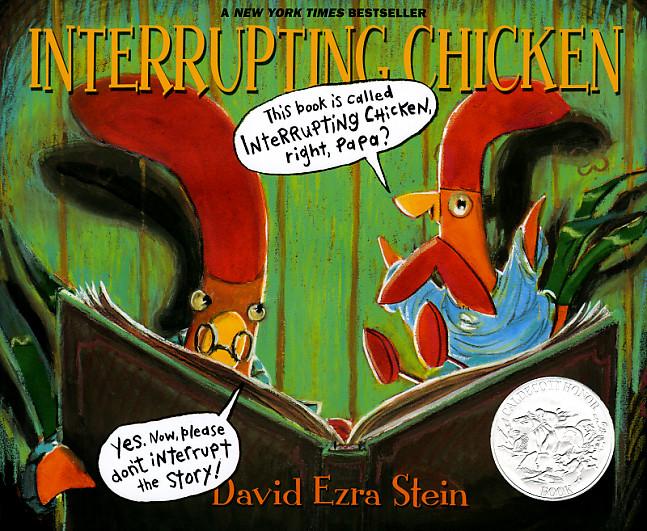
Last week one of our social skills lessons started with a read aloud of "Interrupting Chicken" by David Ezra Stein.

This is a great book to help children learn about controlling those impulsive moments of wanting to interrupt or blurt out during our whole group time.


We completed our read aloud, had a class discussion and then also completed some activities similar to those found at Happy Teacher, Happy Kids.

I can also be a little bit goofy and I want our social skills lessons to be fun, so the kids can really practice the skills and enjoy the results of prosocial behaviors.  Not just dread one more lesson with a bunch of rules that are hard for them to follow.  So as a result of my Pinterest addiction, I found a link to "Chicken Names" from Tilly's Nest and thought it would be fun to pair with this book.


The rules of the activity were pretty simple.  We were going to practice NOT being interrupting chickens.  If we could work on that, we could make a list of everyone's chicken name.  (I'm Yolko Scrambledore, by the way.)  It was fun.  One of the little girls in my class has the same birthday month as my assistant so she dubbed my assistant as her "Chicken Cousin."

There is also a YouTube video that has a read aloud.  I like to use the videos in addition to my read aloud because it gives my students one more way to access the text.


With a simple Google search, you can find many, many online resources and ideas that support this book.  These were just a few of the ones we used.


Wednesday, May 6, 2015

Rainforest Riddles...So Fun!

My class has been working on a unit that revolved around a Rainforest theme.  I chose this particular theme at this time because:

a) Students are usually very interested in the Rainforest theme and can be easily encouraged to read and write.
b) We have an expository text on the Rainforest in our reading series and I am required to base lessons off of our core curriculum materials.  (So I would have to do this anyway.)
c) There are hundreds of free resources and extensions available online.
d) Our school was in the middle of FSA testing.  Although I don't have any students testing this year, the resource teacher next to me is testing every day which means my class needs to be close to silent for the entire morning block.  Brutal (for the kids and me.....so I held out the carrot....if we were super quiet in the morning then we could do some fun, noisy rainforest activities in the afternoon.)

One of my favorite things we did with the unit was to write our own Rainforest Riddles.  I found a free pdf from First Grade Hip Hip Hooray on Teachers Pay Teachers.  The set gives several rainforest riddles already written that the students have to solve.  It has a nice set of graphics for a simple read, then cut and paste activity.  Finally, it also includes graphic organizers to help students write their own riddles.

My class really loved writing their riddles "in secret" and creating their animal from pieces from our arts and crafts scraps/materials.  We then combined all of our animal creations to make a rainforest bulletin board.

Here's our bulletin board.  Sorry!  The picture is a bit fuzzy and I still need to add "forest floor" to our layers.


Below are some close up examples of the writing samples they did.  You can see the different levels within the writing samples, but this was an activity that all of my students could participate in.  I like these types of projects because it brings our class together as "a whole."


Thursday, February 5, 2015

Telling Time

My class is currently working on telling time to the hour, half hour, fifteen minute interval and five minute interval in math.  We always need lots of different ways to practice a skill.  Below are a few of the resources we're using in addition to the materials that came with the unit in our district's math series:

Touch Math Time  (I looked for this on google.  It used to be part of the Upper Grades set, but I can't find it anymore.  I really like it because it's visuals are clean and simple with a lot of white space.  It also integrates time before and time after within each interval.)

Clocks from two paper plates from E Is for Explore


Simple morning work worksheets from Math Fact Cafe.  This site has a worksheet generator that shuffles the problems and you can also set the parameters for what skills you want on the worksheet.  Love that!  Again, the visuals are clean and there's a lot of white space so it's not really busy and overwhelming.

I also have quite a few file folder games that I have made and collected over the years.  Those are coming out too.


Thursday, September 4, 2014

Accountable Talk

As my reading instruction continues to evolve over the years, I keep adding new strategies to my "bag of tricks."  It's funny how I get ideas.  (Honestly, I very rarely have a completely original thought when I start to figure out a new strategy or a lesson I haven't implemented before.)  I recently told a first year teacher that one of the greatest gifts a teacher can have is to be a good synthesizer.  If she can learn to take all of this overload of information we are bombarded with and somehow synthesize it together and use it when it's appropriate and useful; then she will be able to continually add to her bag of tricks.

I'm adding to my bag of tricks.

For the past few years my 1st-3rd grade students have loved having "Nacho Karaoke" day once a month.  On the day the cafeteria serves nachos, I let them all eat in the classroom and we sing karaoke to songs with lyrics that I have saved from YouTube.

I'm reviewing my list of songs before this year's first Nacho Karaoke and was re-introduced to the song "Brave" by Sara Barielles.


As I paid attention to the lyrics, I really noticed the refrain this time: "Say what you wanna say.  I wanna see you be brave!"

I thought this would be a great way to introduce "Accountable Talk" to my students!  For the past few years, it's been challenging to teach children how to agree or disagree with a peer based on text evidence.  It can be hard to raise your hand and speak up during a group, especially if you are disagreeing with a friend.  However, when students DO engage in accountable talk, I have found that they truly start to engage with each other and the text in a purposeful and meaningful way.

My class has already set our essential agreements (rules) including one that states "We will be kind to each other."  With that as a foundation and also practice of the roles of "speaker" and "listener,"  I think we can use this song to talk about how important it is to speak up and "say what you wanna say" during an accountable talk discussion time.

Sunday, August 31, 2014

Fair vs. the Same

This summer, I came across this visual on Pinterest. To me, this shows why we assess and plan for individual differences for our students.

What is FAIR is not always the SAME thing for everyone. At the beginning of the school year, my class has a meeting and we generate our class rules. We call these "agreements" (and sometimes for little kids I call them "promises.") The students agree to follow the rules we generate. Then my assistant and I make agreements with the class too. One of our most important agreements is to help make things fair.

I find the concept of fairness to be one that even my youngest three year olds could understand. When the adults promise to be fair, it sets the stage nicely for differentiating your lessons according to your data. When someone asks me why something is different for one person or one group, I simply reply "Because I promised you all that I would help make things fair; and you have what you need right now, and so do your friends."

Clearly the boy who is tall doesn't need a box to stand on (even if he wants one) and clearly the child who is the shortest needs 2 boxes if he is going to be able to see the game. What is fair, is not always the same thing for everyone.


My Pinterest link led me back to this post by Phil Artman. He found it on Facebook and could not determine the original writer.  If it belongs to you and you do not have a "noncomercial share alike" aspect to it, please leave a comment and I will remove the post.

Tuesday, July 8, 2014

Doll House and Choice Time

At the end of the day this past year, my class enjoyed "Choice Time."

If you were to walk in my classroom, "choice time" looks remarkably similar to "free time."  I don't call it "free time" however, because the children are not "free" to do whatever they want...they have to make a choice from the leisure activities we have available and then stay productively engaged, unless they have asked permission to make a different choice.

Unproductive wandering throughout the classroom is one of my "teacher pet peeves."  It drives me crazy and I have found that unproductive wandering leads to lots of management or behavior issues. Hence, we have "choice time" and not "free time."

One of my older third grade girls wanted me to buy a Barbie doll house for them to play with during choice time.  I explained that Barbie houses cost a lot of money and we didn't have enough to buy one.  She accepted this and went on to play with something else.

A few days later while browsing on Pinterest, I came across this pin that uses a 3 ring binder to make a Barbie doll house from Southern Disposition.  Take a look.  Kendra includes lots of ideas and instructions.


How serendipitous!

When we got to choice time the following day, I asked that little girl if she would be interested in looking at a possible solution to our Barbie doll house problem.  We looked through the website and directions.  She was hooked!

I happen to have lots of scrapbook paper at home that I don't use anymore because I now do most of my photo albums digitally.  I also have a scrap craft bucket of ribbon, lace, beads, etc that I keep for projects at school.  I purchased some scraps of cheap fabric from the scrap bin at Jo-Ann's.

I also happened to know that our bookkeeper has A LOT of old binders that no one wants to use because they aren't perfect.  They were "perfect" for us because they were free!

So for about $8 for fabric scraps and some Stitch Witchery (no sew tape that fuses fabric together), we were in business!

Two girls wanted to make doll houses but they didn't really know where to start.  We talked about how sometimes people use an "inspiration room."  I asked them what colors they wanted their rooms to be.  One chose blue and the other chose pink.  We googled images of girls bedrooms.

One girl choose this blue room from Amecdes as her inspiration.


The other girl chose this pink and green and cream room from Bess.Net as her inspiration.


Our choice time lasts for 15 or 20 minutes at the end of each day.  For about three weeks, the girls spent their choice time creating, figuring things out, problem solving and adding details to their doll house.


Here's one girl making a mirror out of a file folder, aluminum foil, and lace ribbon she cut apart.


Here's her room after she covered up a granola bar box for her bed.


And here is her final product.  The curtain rod is a pipe cleaner with some blue beads we had in our craft bucket (I think they were table scatter beads from the Dollar Tree.)  The curtains are just lengths of lace ribbon she cut and then threaded onto the pipe cleaner.  The rug is a scrap of felt. We printed an image of a dresser off of another Google image search and she glued it to the wall.  The bedspread is a scrap of fabric that she cut.  I helped her make the pillows and the column of fabric that covers the 3 rings with an iron and the Stitch Witchery. (Hot irons and young children are not a good combination!)


Here is the other girl after she finished her mural and began working on her window.


And here is her final room.  She decided to make her bed a daybed.  We used a Girl Scout cookie box for this and scraps of fabric that she cut.  Her curtain rod is a pipe cleaner with some of a pearl strand that she twisted together (the pearls were is my scrap bucket.)  The curtain ties are more of the pearl strand.  The rug is a scrap of felt.  She also cut some mat board to frame her butterfly mural.  Again, I helped with the iron and Stitch Witchery of the column of fabric in the middle and the pillows.  


The two rooms together looked like this (sorry the photo is a little fuzzy!):


The girls had so much fun making their own doll house bedrooms.  They also had a lot of fun playing with them during choice time once they were completed.

I know I can't prove that they practiced their social skills or their problem solving skills and I certainly don't have any data to justify letting them spend 15 or 20 minutes every day making a doll house.  However, these little doll houses have been one of my favorite memories from the year.  To me it shows:

1) Willingness to accept and handle disappointment and the word "no" (We didn't buy their doll house that they wanted.)
2) Willingness to accept a compromise and take responsibility to follow through on the compromise
3) Ability to think in a problem solving process (Watching the one girl work for 2 days to get her mirror to stand up by itself was awesome!)
4) Ability to persist at a long term task (relatively speaking)
5) Thinking creatively
6) Using materials for another purpose other than its intended use

****One little girl is in my class for help with an emotional and behavioral disorder (EBD) and the other is in my room for  help with a severe learning disability.  I'm pretty happy with all of the skills they practiced in an authentic and personally meaningful way.

Many, many thanks to Kendra at Southern Disposition for her great idea!
Tuesday, July 1, 2014

Book Talk Tuesday

Since the summer has been in full swing, I have done a lot of blog hopping and reading links on Twitter streams.

I just found Gladys's blog over at Teaching in High Heels.  She and I have several things in common: like Gladys, I could spend large amounts of time and money investing in children's literature.  And I also agree everything LOOKS better in high heels, but I have to admit, I always have a pair of sparkly flip flops under my desk for when my feet hurt!

At any rate, I'd like to piggyback on Chelsea's "Book Talk Tuesday." Lulu is new to me and I love finding new books.  I can't wait to take a look at her series.

A series that my class has throughly enjoyed this year is Skippyjon Jones.


Skippyjon Jones is a Siamese cat who imagines spectacular adventures for himself as a chihuahua.

There is a whole series of books telling of Skippy's adventures.  They always include a warning from Mama Junebug, Skippy entering his closet as the cue that his imaginative adventures are beginning and poems that get the kiddos in my class clapping their hands and begging for me to repeat it "one more time."

I love to hear kids interacting with books, laughing and enjoying the experience.  I hope its one more step on the path for life long readers.


Wednesday, May 8, 2013

Daily Five Chapter 3

With all the concepts about setting up your room and gathering materials in chapter 3, the thing I most focused on was teaching my studetns the concept of a "good fit" book.

My assistants and I implemented the lesson outlined in the book that shows kids the concept of a good fit compared to the concept of shoes fitting well.  I brought in my husband's golf shoes, my scuba diving fins, my niece's tennis shoes (who is 3), a pair of high heels, etc.  The kids really started to understand that there was a difference to purpose and interest.

We have all of our books in bins and labeled according to their levels.  The students had their individual levels assigned to them and posted in the reading log folders.  I was in for a BIG surprise, however.

Shame on me....because they could pick out books in the library according to their levels and because they could tell me their levels, I assumed they could find them from our classroom library too.  Wrong!  They didn't understand the concept of a range.  So when I pulled out books and was showing them how to return them to our classroom library, I got lots of nods.  When I handed each child a random book and asked them to return it to the classroom library, they couldn't do it.  They didn't know that the bucket labeled 2.0-2.4, included levels 2.0, 2.1, 2.2, 2.3 and 2.4.

When I figured out they couldn't return books to the right spot, I decided to ask them to show me which buckets they would look in if they wanted to find a book at their level....again, they didn't know how to do it!

We had to have several days of practicing cleaning up the books and finding books in their ranges before they understood this.

That was a good wake up call for me.  I didn't really even think about understanding the concept of a range being a prerequisite skill for be able to access books quickly and easily at their levels.

Thursday, April 26, 2012

How to Eat Fried Worms


My class is currently reading the book, "How to Eat Fried Worms" by Thomas Rockwell.  This is such a fun book that captures the students' interest and imagination.  My students are really connecting to the interactions the four main characters have throughout the book.  Tomorrow, we will be wrapping up our lessons focusing on the book.

I've decided that I and the children who choose to, will get a chance to eat a "fried worm."  While I could probably be convinced to try most anything; and I have eaten snails and haggis, I don't think I could be convinced to eat a real fried worm.  We will be dining on hot dogs with ketchup and mustard!


I took a package of hot dogs and sliced each hot dog in sixths.  I found it easiest to cut them in half first and then cut each half into three parts.  Then I put them in a non-stick skillet for a few minutes to fry them up.  Tomorrow I will heat them up in the microwave I have in the classroom.  My husband and I were laughing tonight at the pile on the cutting board.  I think it really does look like a pile of worms!  :-)


This will be a choice activity.  I have some students who absolutely will not want to eat one of our "fried worms."  However, I suspect those kids will be groaning, giggling and laughing right along with the others who do.  I plan on bringing in some paper plates, ketchup and mustard to serve with our "fried worms."   One of the main characters, Tom, chants a poem to his friend Billy as he eats the worms.  I am going to post that poem on our ActiveBoard.  We can chant it and throw in a little bit of fluency reading work while we are having fun.

As always, whenever we do a choice activity like this, we will vote about whether or not we liked the worms.  I still like to vote with post-it notes (even though I have older students now).  It keeps the students actively engaged and it ensures that they only vote once.  Since we have also had ongoing lessons about graphs and data collection, we will also create a graph of our results.

I have a few more sites and lesson resources that we have done that correlate with this book.  Look for them in a future post!

Monday, April 23, 2012

Interactive Worm Sites

Last week and this week we are reading the chapter book "How to Eat Fried Worms" by Thomas Rockwell.

Here are two interactive sites that students can navigate through independently for more information about worms.

Vermi the Worm

Herman the Worm

Thursday, January 5, 2012

Valentine's Activity: Hearts Everywhere

If you are in any way similar to me in how you plan lessons for activities you've seen online, you need some time to read about the idea, think about how you would use it with your group, prepare your materials and then implement it.  One of the teacher's on my team this year says he likes to let concepts have a chance to "marinate."  We've all adopted his lingo.  We like to let kids have the chance to have repeated exposure to concepts, but sometimes we also need some marinating time for ourselves. 

In an effort to give everyone some time to "marinate" the following ideas, I'm sending them out early (or really late considering I took the pictures last February!)

For my pre-schoolers that I've had in the past, this lesson focused on the positional concept "on" as well as identification of common objects.

I started with the interactive book, "Hearts Everywhere",  from the Jefferson Parish AAC link.  I would read the book to my class using the felt board and laminated hearts.  On each page, the students would take turns placing the heart "on" the object identified in the book.

After introducing the book and the vocabulary, the next day before the children came in the classroom, my assistant and I placed construction paper hearts all over the classroom.  During circle time, I would call a few students at a time to go "look for a red heart" and bring it back to the carpet.  When they brought their heart back, I would ask them where they found their heart.  Once they answered the question, we would place it on our chart and I would call the next group of children to go look. 

TIP:  If you are working with pre-school age children, be sure to write on the heart the location that you placed it.  For example, "on the fish tank."  When you have several children looking at the same time, it's easy to miss who picked one up from specific locations.  If you don't have several children looking at the same time, the waiting period gets to be too long for little ones.  And if you have students at levels similar to the students I have taught, when you ask the question, "Where was your heart?" you will inevitable get the answer "over there" a few times.  You want to be sure you can accurately prompt them to answer the question using the positional word "on" and the correct common object where it was.

I love activities that get students actively engaged.  These types of scavenger hunts always produce smiles, laughter and excitement.

Because of that I'm trying to think of a way I can adapt the activity to be appropriate for my current third graders.

I think I will connect it to our writer's workshop lessons.  We have been working on using more descriptive phrases in our paragraphs.  I am going to  place many hearts all over the room with their labels.  Have the students put their heads down with their eyes closed and give each student 10 or 15 seconds (one at a time) to go get a heart from somewhere in the room.  After they collect their hearts, they will describe where they found the heart, but they are not allowed to name the object.  Then they will read their paragraphs to their classmates who will need to guess where the heart was originally.

I'll have to let you know how it goes!  I'd love to see other ideas on how to use a scavenger hunt type activity to support academic goals for older students.  Please post your ideas in the comments section.

Thursday, September 29, 2011

"Dolphin Tale" Ideas and Resources

My class is very excited about the new movie "Dolphin Tale."  In science, we've been discussing how scientists can use a model to help them investigate their questions and variables.

Here are a few resources I've either found or created that you can use to support reading, writing and science through ideas from the movie "Dolphin Tale."

Power Point that can be printed or shown on an Activeboard/SmartBoard

Science Worksheet to go with Scientific Method and Power Point

Writing Prompt to go with Power Point

Scholastic Resources

Winter's Tail


Hope you enjoy!


Tuesday, February 1, 2011

Play based writing

I have found a lovely, photo based blog entry on supporting writing skills through a play based curriculum.

Check it out. Jenny's preschool classroom writing experiences (indoors and outdoors) are fantastic!

Let the Children Play

Visiting Kindergarten: Social Story

It's the time of year when, in pre-k special needs classes, we begin to think about the process of transitioning children to kindergarten.

This year, there is a little girl in my class with an interesting combination of strengths and challenges.

She has a good cognitive skills and a good ability to learn vocabulary and concepts through incidental learning. She has a solid base of kindergarten pre-academic skills (she knows all of the letters of the alphabet upper and lowercase, she can count to 15, she can identify 11 colors and 6 common shapes. She knows many beginning consonant sounds, has an awareness of rhyming words, can read all of the names of the students in class and reads approximately 10 sight words.)

She gets overwhelmed with new experiences and has difficulty transitioning to new activities (especially if it is in a different location on campus). She still needs staff support for potty training. Her fine motor skills are significantly delayed and she still needs staff support for many tasks that include visual motor planning.

We have decided to try to specifically address an area of strength with an area that is a significant challenge for her while she is still in pre-k. She is going to start going to a shared reading and phonics lesson with a kindergarten class for approximately 20 minutes a day. Since she has good cognitive skills and she does not need any staff support in our pre-k large group circle time, we are going to try to balance this with the challenge of accepting a new experience. We are hoping that she will become familiar with the kindergarten building, the kindergarten classroom and the larger group of kindergarten students. We are also hoping that our pre-k staff can go with her for a short period of time and then fade away so that we increase her independence and comfort in the kindergarten classroom.

To help her prepare for this, we have drafted a simple social story (you can download a generic copy here.) about going to the kindergarten classroom. She has a copy at home that her family has read with her for the past week and there is a copy at school that classroom staff have been reading with her too. We have also started walking past the kindergarten room and having conversations about visiting kindergarten on Monday.

We're hoping by layering in the staff support and also building on her strengths, she will begin to feel comfortable and be able to learn new skills in the kindergarten class.

Monday, October 11, 2010

Free Early Literacy Activities

This site has recently been shared with me from our pre-k supervisor.

It has many, free printable activities that support literacy of infants, toddlers and pre-schoolers. They have a link for ideas for parents and another link for teachers. Check it out.

Center for Early Literacy Learning

Tuesday, October 5, 2010

Cheap! Dinosaur Measuring and Science

In the current economy (and as far as being frugal and financially wise at any time!) I am always interested in lessons that can be enhanced as cheaply as possible.

My class has been involved in a inquiry based unit on dinosaurs for the past week. It seems to me that there are always easy ways to integrate language and literacy lessons in every unit, but sometimes it is more difficult to integrate math and science. Since this unit focuses on dinosaurs, science is not a problem either, but how can we integrate math concepts? Here's one idea we used.

I found these dinosaur figures at my local Dollar Tree. (Yes, it cost a whopping $1 for this lesson.)


I explained to my students that these dinosaurs were supposed to get bigger when we put them in water. We decided to measure them with a ruler, predict how big we thought it would get and then measure it after it grew.


Since I wanted to focus on some math skills, we made a big deal out of measuring the dinosaur. I left my finger on the number 4 after we measured and reminded the children that he should get "bigger." I asked them "How big do you think he will get?" as I ran my other pointer finger across the top of the ruler (showing them the most logical choices across the ruler.) They made their predictions as I recorded them and then we observed. The pictures show you where we are so far!


After we measure our dinosaur again tomorrow, we'll take him out of the water and predict what will happen. It will be interesting to see if any of the children will predict that he shrinks back to 4 inches (remember, that's where we started at our first measurement!)

Sunday, September 26, 2010

Missing Pumpkin

One of my favorite lessons was designed to help a kindergarten-second grade class generate questions and improve their writing skills. We called it our "Missing Pumpkin Mystery."

For a week or so in October we had a pumpkin on display in our classroom. We were gearing up for the day we would scoop the insides out, count the seeds and carve it.

This particular group of students really needed to work on generating questions and using descriptive words within their writing. So some of the school staff helped me stage the "Missing Pumpkin Mystery."

One day after their specials period (art, music, phys ed, etc) the pumpkin was missing from the classroom. Once they noticed it, we decided on a plan of action to get our pumpkin back.

The first thing we did was to make "Wanted" posters for our pumpkin. The students took a brown paper grocery bag and drew a picture of our pumpkin on it. They then had to write three statements describing our pumpkin so "others would know if they saw OUR pumpkin."

We then decided to report our missing pumpkin to our principal to see if he could help us. (I had given him, the media specialist, our cafeteria assistant and our day time custodian their scripts so they would lead us to the next person to help us find the pumpkin.)

The children had to explain what happened, ask their questions and then describe out pumpkin to each person. The principal suggested we ask the media specialist "because he saw a lot of pumpkins in the media center." She suggested we ask the cafeteria assistant because "maybe they needed it to make pumpkin pie." The cafeteria assistant suggested we ask the custodian "because he sees the whole school make cleans up all the messes." As it turns out, the custodian "put it in our refrigerator because he was afraid it would get rotten."


We had great fun with this activity and it provided the kids with a real reason to use the skills I wanted them to practice.

Thursday, September 23, 2010

"Post It" Graphs

Here's a simple strategy that we use a lot in my classroom. I write each child's name on a post it. Then I write a question on a piece chart paper and usually add visual supports for each column of the graph. Below is a picture of our most recent graph:


I like to use the post it graphs for lots of reasons:

1) They help children learn literacy skills by reading their name and their peers' names.

2) They help children develop language skills by answering questions and making choices.

3) They help children develop task related skills and focusing skills because they are actively involved and then they physically get to place their own name on the chart.

4) They help children develop social skills by learning how to take turns and wait for their own turn.

5) They help children develop math skills as we count the number of votes in each column and discuss concepts of more, less and the same (equal).

6) They help children develop literacy skills by becoming part of our environmental print in the classroom.

7) They are quick and easy to prep for! That means I don't spend more time preparing the materials than it takes the children to actually engage in the activity.

Monday, August 9, 2010

Free Stories about Anger Management and Impulse Control

This site offers two free books that address social skills.

The first book teaches students a strategy to manage anger using deep breathing and "train yoga." I like how it actually teaches children the words and the actions to take when they are angry and then encourages them to think of a solution. (It's very similar to Tucker Turtle from the CSEFEL site, but it's nice to have another avenue to teach the strategy.)

Jennifer (the author) is planning to add two more books to the site in September.

Free Children's Stories

Monday, July 19, 2010

Free Decodable Books

A friend on one of my Yahoo! listserves just shared this site. I thought it was a great resource for emergent and early readers. It includes free decodable books that are written and shared by teachers.

Free Decodable Books

Enjoy exploring the site!