Showing posts with label reading comprehension. Show all posts

Saturday, May 30, 2015

Pre-K Again

As this school year draws to a close, our principal has sent out our "most likely" assignments for next year.  She calls them "most likely" because, as we all know, things can change over the summer.  If the needs of our students change, then staff assignments sometimes have to change too.

My "most likely" assignment for next year is back with the pre-k special needs population.  I'm ready for a change again, but I LOVE my school, so I didn't want to change that!  One of our pre-k teachers retired this May, so an opening came up at our school.  I love the language development and developmental play aspects of pre-k, so I"m excited.

I've started culling through some of my old pre-k files and rediscovered a blog from a pre-k teacher, Christi Seward in Cobb County.

She hasn't posted in a few years, so perhaps her teaching assignment changed or something else in her life changed, but she has a WONDERFUL collection of picture books with essential vocabulary and comprehension questions that she discusses.  She also has created many power points to support her lessons.

One of the books she highlights is "Bear Wants More" by Karma Wilson.


In addition to Christi's resources, there is also a YouTube read aloud with the book, too.  (This version is really sweet.  A boy received this as a birthday present and his family recorded him reading it out loud for the person who gave him the book.)


This has been a busy year and I haven't completed too many posts, but hopefully that will change this next year coming up!


Monday, August 4, 2014

Chapter Book Read Alouds 2nd and 3rd Grade

My class loves to listen to me read to them.  Since my students are 2nd and 3rd graders now, I like to try to expose them to chapter books as read alouds.  The following is a list of some of the books we read this past year with some brief comments about each.


1) Boxcar Children #1


I chose this book because it was one of the extended complex texts that was recommended to go with our first unit with our reading curriculum, Wonders.  The students liked it and enjoyed the adventure of the children living in the train boxcar.


2) Stuart Little

"Stuart Little" was our next read aloud because of a play we were scheduled to see.  My district is very fortunate to have a lot of support for education for children within the arts.  Part of that is experience at our local theater for live performances.  "Stuart Little" was actually a very difficult book to read to my students. The language and vocabulary that is used actually puts it much higher than a second or third grade level (I think it's more like 5th or 6th grade.)  However, my students loved the story.  We  went through this book pretty slowly and stopped to explain a lot of the words or phrases in the book.  By the time we got to the play, my class loved that they could "see" parts of the story they already knew and we had great discussions about the parts that were different.


3) Horrible Harry and the Drop of Doom

Horrible Harry has a great series of introductory chapter books.  I read this book to my class to introduce Harry and Song Lee to my students.  I have found that once students are familiar with some of the characters they are more likely to make the transition between picture books to chapter books.


4) Santa Clause Doesn't Mop Floors
We read this book as a purely enjoyable read at the holidays.  As we progressed through the story, we had some great conversations for our social skills lessons.


5) The One and Only Ivan
Oh! How I loved this book.  The story is told from Ivan's point of view.  Ivan is a gorilla that was once wild and is now kept in captivity in a shopping mall.  My class loved hearing about Ivan's thoughts and feelings and solutions.  They also loved learning that the story was based on a real gorilla.  This gave us the chance to talk about what they phrase "based on a true story" means (how often the main idea and the theme of the story stay true but frequently the author changes some of the details to make the plot of the story work.)  **This was my favorite read aloud this year.


6) Little Dog Lost
We all enjoyed this story too.  It is written in the style of a poem, even though it is also presented as a chapter book.  This was the first time my class had seen a free verse poem this long.  That was a great way to show them there are many different ways a writer can share their thoughts and ideas with the reader.


7) How to Eat Fried Worms
If you have read any my previous post about "How to Eat Fried Worms," you will know I love this book.  I first was introduced to it when MY second grade teacher read it out loud to my class.  I remember simultaneously loving it and being grossed out by it!


8) Charlotte's Web
My students loved this book...well except for the one who hated it and the one that it stressed out (but she still loved it!)....For more information on this read here.  Overall though, the class really did like this classic!  This was a novel that we had plenty of copies of throughout our school.  I was able to get a copy for every student in my room and the liked tracking our progress in their own book as I read it to them.   We ended our school year with an "old school" thematic until based on this novel.  My class loved that kind of structure to our day.  I wish we could do more of it.


Photo credits:
http://www.amazon.com/The-Boxcar-Children-No-Mysteries/dp/0807508527
http://www.amazon.com/Stuart-Little-E-B-White/dp/0064400565/ref=sr_1_1?s=books&ie=UTF8&qid=1407204457&sr=1-1&keywords=stuart+little
http://www.amazon.com/s/ref=nb_sb_noss_1?url=search-alias%3Dstripbooks&field-keywords=horrible%20harry%20and%20the%20drop%20of%20doom&sprefix=horrible+harry+and+the+d%2Cstripbooks&rh=i%3Astripbooks%2Ck%3Ahorrible%20harry%20and%20the%20drop%20of%20doom
http://www.amazon.com/Santa-Doesnt-Floors-Bailey-School/dp/0590444778/ref=sr_1_1?s=books&ie=UTF8&qid=1407205160&sr=1-1&keywords=santa+clause+doesn%27t+mop+floors
http://www.amazon.com/s/ref=nb_sb_ss_i_0_14?url=search-alias%3Dstripbooks&field-keywords=one%20and%20only%20ivan&sprefix=one+and+only+i%2Cstripbooks%2C167&rh=i%3Astripbooks%2Ck%3Aone%20and%20only%20ivan
http://www.amazon.com/s/ref=nb_sb_ss_i_0_22?url=search-alias%3Dstripbooks&field-keywords=how+to+eat+fried+worms&sprefix=how+to+eat+fried+worms%2Cstripbooks%2C259&rh=n%3A283155%2Ck%3Ahow+to+eat+fried+worms
http://www.amazon.com/s/ref=nb_sb_ss_i_0_12?url=search-alias%3Dstripbooks&field-keywords=charlotte%27s+web&sprefix=Charlotte%27s+%2Cstripbooks%2C259&rh=n%3A283155%2Ck%3Acharlotte%27s+web

Friday, June 6, 2014

Charlotte's Web

We ended our school year with a novel study.  Two of the general education teachers and I pulled together a unit on Charlotte's Web for the students.  I'm so glad we did!  After so much emphasis on our standardized testing this quarter, it was refreshing and rejuvenating to go back to great literature and helping children understand and enjoy it.

Here are a few of the lessons we completed:

1) Every student had a novel and was expected to follow along.  I hadn't typically done this in the past when there was such a difference in my students' reading skills and the level of difficulty of the text.  This sounds silly, but it was almost an "A-ha" moment for me.  The brailled book that we had was in contracted braille and Gabby is still reading uncontracted braille.  This book was too hard for her, but she was able to explore the book and track through some of the chapters when she had 1:1 support.  I have 2 students who are also still reading at a beginning first grade level.  When they were given a simple verbal prompt on when to move to the next page, they could inconsistently track with us too.

2) We completed a "following directions" lesson based on the passages in the text to map out and create the barn scene.  We added more details as we learned them throughout the book.  (The white circle is just blocking out all of the kids names.)


3) When Charlotte was finally introduced in the book, the students all picked a spider to research.  They made a spider body and were responsible for finding 8 facts about their spider.  Then they read their planning sheet and facts to me; and I helped them type it into a word document so they could cut out the facts and glue them to the spiders legs.  We started them with 3 facts: all spiders are arachnids, all spiders have 2 body parts, all spiders have 8 legs.


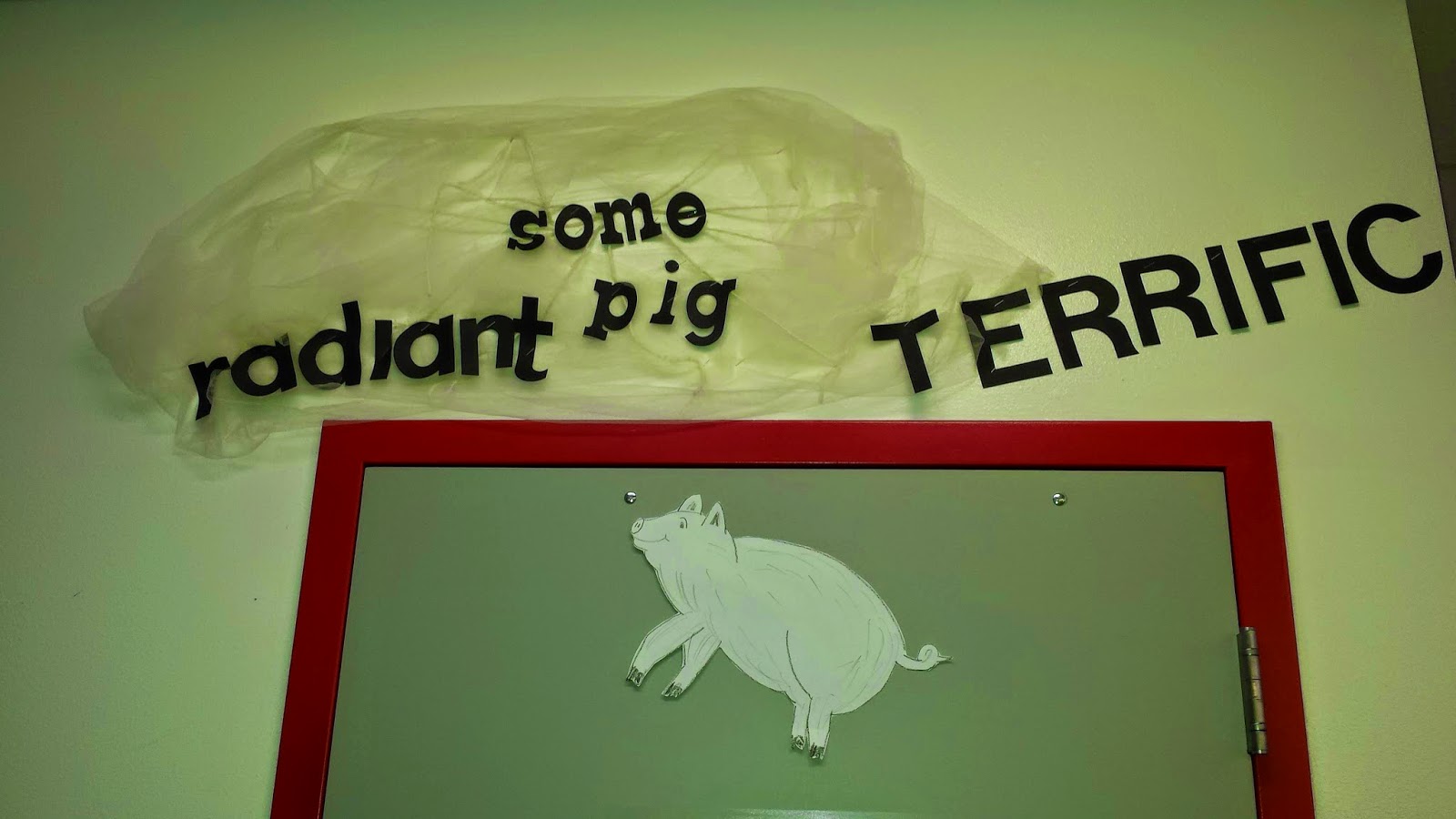
4) The classroom staff also made a web (tulle and yarn) for Charlotte and surprised the kids each morning with the words that she wrote in her web for Wilbur.


5) In addition to these "crafty" classroom projects, we also completed several Type 1 writing pieces about what students know about a farm, what they know about a County Fair, what they think will happen to Wilbur, why Fern wasn't paying much attention to Wilbur at the fair etc.  (Our school uses the Collins writing program.  To see more about a Type 1, click here.)


6) Two social skills lessons emerged from this novel study that I wasn't expecting.  One boy had already seen the movie so he knew what the story was all about.  One day he went home and cried.  (Talk about making me feel terrible!)  His mom sent me an e-mail to let me know what was happening.  We talked about 2 options for him: 1) Finding alternative assignments for him so he wouldn't go home crying every day.  2) Watch him closely during lessons and prompt him to take a break if he needed one.  He has very quiet but consistent clues that tell you when he is getting upset.  His cheeks get red and he starts to fidgit.  Watch for these clues and ask him if he is "ok or if he needs a break."  If he chooses a break he could go to the computer and put the headphones on and go on Tumblebooks so he didn't have to hear us.  

We decided to try the second option and mom said she would let me know if he comes home crying anymore.  If he continued to be upset at home, then I would find alternative assignments for him. On one occasion he chose to take a break but out of the 3 or 4 other times I asked him, he chose to stay with the group.  I think giving him some control over whether or not he had to listen to something upsetting made it more manageable for him.

Another little girl, who can be very loud and a bit dramatic, but is also very young and sensitive to sad situations also had a few moments when the story was upsetting.  Her plan was a bit different.  Throughout the year we have had a "safe space" set up for her so that she could manage her own behavior and de-escalate herself.  She also processes information better when she is prepared for it and it is not a surprise.  (We're working on handing unexpected situations, but for this novel with the themes of friendship and life cycles and death, I thought she still needed to be prepped.)  For her, I would warn her when a sad part was coming up and let her choose her safe space or holding my assistant's hand while we read that part.  Interestingly, most of the time in the year when she was upset, she liked to be alone and choose her safe space.  Each time within this story she chose to hold my assistant's hand.  

For these two students, I spoke with their parents about the novel and how it was affecting them emotionally. My goals in the novel study started with the literacy goals of character traits, how characters change throughout a story, remembering details, researching information, etc.  For them, my focused shifted and I really wanted the social skills practice more than I wanted them to gain the literacy skills.  However, in getting at this social skills practice, I didn't want to push them so hard that they were crying or emotionally distraught at school or home.  It was a fine line...thank goodness they both have very actively involved parents who let me know how they were doing at home too!  

I wanted the boy to learn to speak up and request a break when he felt like he was getting to the "overload" point.  While he only took the break once and he needed prompting, this novel gave me some good information to share with his teacher next year so she can continue with this.

For the little girl, I wanted her to remember that she had solutions and choices that she could use to help her manage her emotions.  I also wanted her to be able to attempt to do this without yelling and disrupting the whole group.

The novel study of Charlotte's Web was a great way to end the year.  It gave the students a great piece of literature to read, fun activities that still had an academic focus, and kept them interested and engaged at the end of the year!


Wednesday, October 23, 2013

Dog's Colorful Day

My niece is expecting her first baby! Yay! So what's an aunt to do? Of course, I am cyber-stalking her "future mommy" page on Pinterest. I was so excited to see her pin and re-pin many felt board and felt play activities. So when it was decided that instead of giving a card at her baby shower, we would give her a children's book; I had to start thinking about which felt board books I loved so I could send her some felt play along with my book. One of my favorites is "Dog's Colorful Day" by Emma Dodd.


Dog has some very exciting, messy and colorful adventures throughout the day. The readers are encouraged to count and describe the spots that start to appear on dog's fur as the evidence of his adventures. For example, dog starts off with one black spot on his left ear, but after passing the painted door he now has two spots. One black spot on his left ear and one blue spot from the paint. The adventures continue throughout Dog's day.
My preschoolers loved interacting with this book with a felt board activity I made. As we read the book, the children would sequence the item that caused the spot on Dog at the top of my felt board in left to right progression. We would also add the appropriate spot to dog. At the end of the story, we put dog in the bath to get clean and then finally in his bed. This is a lesson the kids wanted repeated time and time again. They loved playing with the colors and the sequence of the story through the felt pieces.


Consequently, I got to have lots of conversations about colors, numbers and retelling stories through play. Isn't that the best?


 Photo credit:http://www.google.com/imgres?imgurl=http://heightslibrary.org/wordpress/explorastory/wp-content/uploads/2012/08/dogs-colorful-day.jpg&imgrefurl=http://heightslibrary.org/wordpress/explorastory/?attachment_id%3D887&h=648&w=520&sz=47&tbnid=FZAWTeo3zYglYM:&tbnh=90&tbnw=72&zoom=1&usg=__hMqMXyP36XSG5ETzjcMhWGHbaYo=&docid=xxOX9rSEuAhdaM&sa=X&ei=c1toUuvDIoq-kQeb2IGgAQ&ved=0CDsQ9QEwAQ

Sunday, October 14, 2012

Reading Interventions

While browsing on Pinterest, I found this incredible resource from Jen Jones on Teachers Pay Teachers.   (It's free!)  It is a table that pairs a reading problem a teacher may observe with several reading intervention ideas that can address it. 

The ideas are all tried and true strategies we have all probably already used at some point in our teaching careers.  I love this aspect of the document.  We are not reinventing the wheel, we are thinking critically and planning systematically to address a problem.

Click here to check out Jen's If / Then Reading Interventions Menu.

Thursday, May 24, 2012

My heart is breaking......


My heart is breaking for my students.  We received our FCAT (Florida Comprehensive Assessment Test) scores back today.  In my self-contained class of thirteen third grade students with special needs, one student participated in the alternate assessment, two students passed the FCAT (yay!) and the other ten failed the FCAT reading portion. 

My heart is breaking for them because they have worked so hard this year.  My assistants and I spent the entire year talking to them about their:
  • gains in our SuccessMaker Computer Lab
  • successes in being able to take AR tests independently
  • sight words they knew at the beginning of the year versus the number of sight words they know now
  • gains in their oral reading fluency probes and how many words correct per minute they can read
  • reading selection tests and how they have improved
  • robust vocabulary grades and how they have improved 
  • ability to read by themselves for twenty minutes without any help
I have all of this data that shows their growth and their progress towards IEP goals, but none of it is reflected or documented on FCAT.   In my heart I know it matters.  I know that data is important and it keeps my students and me going.  It gives us the proof that they are learning and moving forward.  But as it relates to FCAT, it feels as if it doesn't matter.

Tomorrow I have to sit down with ten students and tell them they failed. Six of those ten students now face a mandatory retention in third grade.  (Of course I won't use the word failed, keep reading to see how I plan to explain this to the kids.)  The other four who don't face mandatory retention had already been retained once and have intensive instruction in reading, so they meet the eligibility criteria to waive the mandatory retention and can move on to fourth grade.

This is such a frustration for me!  All of my students have been through a comprehensive, individualized series of standardized assessments to show their academic levels and their processing strengths and challenges.  Many of the students in my self-contained class are significantly below grade level norms.  If they were not, they would probably not need my setting.  Since I have a whole year of classroom data and a whole stack of individualized, standardized  assessments that document their current levels of performance, why do we continue to force them to take grade level standardized tests?

I do not have a problem with FCAT.  I think it gathers an important piece of information for us.  And to be perfectly honest, if I had a choice, I would have recommended six of my students take the FCAT because these students were systematically moving through and showing success on below level third grade materials.  I thought they deserved a shot at it (and of those six, two passed and the other four who failed, actually came pretty close to the cut score for passing.  They might be able to pass the Stanford 10 when they get a chance at that next week.)

However, I do have a problem repetitively administering a test that continues to document failure rather than success.  I had six other students who just do not yet have the skills to pass a third grade level skills test.  I don't have the answer to this problem.  If we never give them the opportunity to test in the actual testing situation, we seem to be tracking them for a special diploma. 

How would they be able to pass the high school test if they never experience it in elementary or middle school?  But, if all of a student's experiences with a test result in failure, how confident will s/he be going into the high school test?  What are those failing experiences teaching?  Are they really preparing a student to pass?

It just seems to me that we should be able to match the standardized testing environment, format and language to a test that is based on the skills a child was actually able to systematically learn and master throughout the year. 

By this I mean, I wish my third graders who are reading at a mid-first grade reading level could take a standardized test that is off-level normed.  I wish they could be assessed on the first grade reading skills.  Over time, this would actually show their growth, rather than continue to show that they have failed a grade level test.  I know, it's a big wish.

So now I'm gearing up for tomorrow.  It's our Reading Celebration Day at school (how ironic!) and at one point during the day, I need to have individual conferences with all of my students to discuss their FCAT results. 

My plan is to show them their developmental score and explain this to them. 
  • I'll remind them that tests give teachers more information about what we need to teach.  
  • I'll remind them that this was their first time taking FCAT and now next year we will really be able to see how their developmental score improves.  Just like we saw how their SM score improved throughout the year and their mastered sight words improved throughout the year.  
  • I'll remind them how proud I am of their hard work and all of the goals they have mastered this year.  
  • I'll remind them that they are readers!  
But, my heart will be breaking just a little bit with each student conference.........


photo courtesy of MicroSoft Clip Art


Monday, May 14, 2012

Silent Reading Procedures


I like having my students practice sustained silent reading.  So often in special education classes we are so focused on providing direct instruction and therapies, managing interventions or collecting data; it seems like we forget that students need to be able to choose their own literature and read on their own!

My goal for my students this year was for them to be able to choose their own book and read silently (or at least quietly in a whisper) and independently for 20 minutes.  Since three of my third grade students started the school year with reading levels below beginning first grade, we obviously had to provide some structure and scaffolding to help them reach this goal.

The first thing you see labeled in this picture is the "book bucket."  It is a simple plastic box purchased at Big Lots for about $2.  Each student in my room has their own personal book bucket.  Within this book bucket we store the child's whisper phone, their sight word rings and Reading A-Z books at their individual levels.

I chose to start our sustained silent reading with book buckets because it was an organizational system that we had previously taught the students in my class.  They all had their book buckets and had spent individual reading time with my assistants and me reading the material within.  I knew that every child could independently read more than 90% of the material in their book bucket.

The first day I introduced silent reading time, I didn't give them many choices.  I asked them all to get their book buckets out on their desks.  They were allowed to read anything that was in their book bucket.  I then set a screen timer for 5 minutes on the Active Board.  We use a free download like this.  I challenged them to see if the entire class could read silently until the timer beeped and cut this grid so that it showed only 10 squares and glued it to a piece of green construction paper with the phrase "We can read silently for 5 minutes."  They were all required to read for 5 minutes out of their book buckets.  When they successfully read for 5 minutes, we put a sticker towards the class goal.  After they reached that goal of reading silently for 5 minutes on ten different opportunities, we congratulated them and told them how proud we were of them and that they were ready for a new goal.

After we met that goal, I made another simple grid and set the screen timer for 7 minutes.  When we met that goal, I bumped them progressively to 10 minutes, 12 minutes, 15 minutes and then finally 20 minutes.

As they showed they could manage the silent reading, I loosened up on the control a little bit.  I would let them choose three books from our classroom library or their library books.  (Remember while some of my students are reading chapter books, I still have a group reading first grade level books.  I needed them to have enough material that would keep them reading for the full 20 minutes.)

A little bit after that, I loosened up the control even more and allowed them to find personal space in the classroom with a laundry basket, a throw pillow or a throw blanket.

Through each little step, I wanted them to maintain their sustained reading but gradually have it become something that they enjoyed and got to choose rather than something I imposed on them.  I'm hoping that this will help them to view themselves as readers and ultimately read for leisure rather than just for work.


Thursday, April 26, 2012

How to Eat Fried Worms


My class is currently reading the book, "How to Eat Fried Worms" by Thomas Rockwell.  This is such a fun book that captures the students' interest and imagination.  My students are really connecting to the interactions the four main characters have throughout the book.  Tomorrow, we will be wrapping up our lessons focusing on the book.

I've decided that I and the children who choose to, will get a chance to eat a "fried worm."  While I could probably be convinced to try most anything; and I have eaten snails and haggis, I don't think I could be convinced to eat a real fried worm.  We will be dining on hot dogs with ketchup and mustard!


I took a package of hot dogs and sliced each hot dog in sixths.  I found it easiest to cut them in half first and then cut each half into three parts.  Then I put them in a non-stick skillet for a few minutes to fry them up.  Tomorrow I will heat them up in the microwave I have in the classroom.  My husband and I were laughing tonight at the pile on the cutting board.  I think it really does look like a pile of worms!  :-)


This will be a choice activity.  I have some students who absolutely will not want to eat one of our "fried worms."  However, I suspect those kids will be groaning, giggling and laughing right along with the others who do.  I plan on bringing in some paper plates, ketchup and mustard to serve with our "fried worms."   One of the main characters, Tom, chants a poem to his friend Billy as he eats the worms.  I am going to post that poem on our ActiveBoard.  We can chant it and throw in a little bit of fluency reading work while we are having fun.

As always, whenever we do a choice activity like this, we will vote about whether or not we liked the worms.  I still like to vote with post-it notes (even though I have older students now).  It keeps the students actively engaged and it ensures that they only vote once.  Since we have also had ongoing lessons about graphs and data collection, we will also create a graph of our results.

I have a few more sites and lesson resources that we have done that correlate with this book.  Look for them in a future post!

Friday, December 23, 2011

Reading Chapter Books

Yahooey!  Just before Winter Break, I introduced several of my students to reading chapter books independently.  Like anything else, we started small and built upon the skills that were already in place.

Since the beginning of the school year, we have spent 10-12 minutes each day with a chapter read aloud.  I don't test on it, we don't dissect the book, we don't go crazy if something happens and the chapter is put off until tomorrow.  My purpose in approaching it in this manner was to introduce books that were longer in length and to model reading a chapter book in small increments.  I wanted the kids to see enjoyment of reading a longer book.

When I felt a few kids were ready, I hand picked some beginning chapter books such as "The Fly Guy" and the "Frog and Toad" series.  This introduced the kids to the format of a chapter book but the length and the reading level was still relatively easy for them.


I finally then moved to books in series like "The Magic Treehouse" and "Cam Jansen."  In order to help the kids break up the book into manageable chunks and to also let them see their progress, I stole an idea from another teacher on my team. 

She shared that for some of her kids, she writes down which pages they have to read each night on a bookmark.  Since I am a big fan of post its and I have a lot of them, I used her idea on a post it.  I selected quite a few books and then asked the student to choose a book from my pre-selected group rather than the whole library.  After he/she selected the book, we went through the table of contents together to see how many chapters were in the book.  I then wrote each chapter number on the post it and gave it to them for their bookmark.  As they finished each chapter, they could cross of the chapter they had completed.

It has been working pretty well.  Two "bonuses" of this visual support is that it is 1) cheap, and 2) easy.  As the kids finish the books and successfully pass AR tests, their confidence is growing!  Hopefully, this will help to scaffold their "reading endurance" and help them continue to read longer passages and books successfully.


Tuesday, December 6, 2011

Reading Block

This past week I had a first year teacher and her mentor visit my classroom.  I've finally arrived at the point in my career where I actually enjoy this.  My assistants and I "do what we do" every day and to have some one come in to observe and ask questions often prompts further reflection on what we do and why we do it.  I had one of those moments with this observation.

I'm in a rather unique teaching situation within my district this year.  I have a self contained, varying exceptionalities (cross categorical) of all third graders.  Most of our self contained classes across the district are multi-grade.

The teacher observing teaches a class of students kindergarten to third grade.  She provides direct instruction during the reading block for the first through third graders.

Her question was "How do you expose the students to grade level content in reading but still provide direct instruction at their instructional levels?"  Great question!  We always talk about exposing kids to grade level curriculum, but the reality is that most students in self contained classes are significantly below grade level expectations in their skills.  So HOW do you do that?  How would you organize teaching them at their instructional level, but still provide them exposure to grade level materials?

For my class this year, it is actually quite easy.  All of my students are third graders, so we start reading block with a shared reading lesson from the grade level materials.  Within this time frame we introduce the listening comprehension selection, the focus skill and the robust vocabulary words.  After we complete this, we move into instructional level groups for direction instruction in strategies, phonics and comprehension skills.

However, most of the time, in a self contained class, I would need to expose the children to grade level material at three different grade levels.  For example, all of the third graders need exposure to third grade materials.  All of the second graders need exposure to second grade materials and all of the first graders need exposure to first grade materials.

After thinking and reflecting about it, the following is what I came up with as a structure for accomplishing the balance between grade level exposure and direct instruction at instructional levels for a multi-grade class.  Keep in mind, that this is where I would start.  It might need some tweaking based on student needs, assistant skill sets, school resources, etc.

I would use the two different methods (grade level, instructional level) of grouping during my reading block.

The first set of groups would be based on the child's instructional level.  So no matter what grade the child is in, all the kids that are functioning in a 1.5 grade level for reading would be in one instructional group, etc.  Within these groups we would work on decoding strategies, phonics, fluency, comprehension of passages the child reads himself, and focus skills that go with the INSTRUCTIONAL level rather than the grade level.

The second set of groups would be based on the child's grade level. Within these groups we would work on listening comprehension, robust vocabulary and exposure to grade level materials and focus skills.

I base my lessons on a two week schedule, so I typically have 10 instructional days. 

It is important to note: My district uses StoryTown Materials.  The StoryTown materials are organized into a selection lesson for one week.  They also have a focus skill that crosses over 2 selections and practiced over two weeks. The pace of one story every week (addressing the vocabulary, focus skill, grammar and phonics rule) was too fast for my students.  I have decided to align my lessons with the focus skills and a two week period.  In short, this year, my students are only completing the even numbered selections from StoryTown.  We are not using the odd numbered lessons at all.  I am attempting to systematically teach the focus skills and third grade curriculum, but do so at a pace that my students can handle and master!  I started the year at the pace the curriculum suggests and I had students failing left and right.  Clearly something needed to change.  I wanted the kids to be exposed to all of the focus skills, so I opted for using all of the even numbered lessons instead of using every lesson at a slower pace.

On Day 1 in my reading block, I would spend the time entirely within grade level groups rotating between the teacher, an assistant and an independent center (probably the listening center.)  This would give the students a good long and repeated exposure to the grade level shared reading selection.  As the teacher, I would want to spend this time so that I know I am introducing every child to their selection at the beginning of the unit.  This also tends to be fun for my students.  We act out the vocabulary words, think of pictures that help us remember the meaning and discuss the story.

Then on days 2-9, I would break my reading block into 3 time periods.

1) 60 minutes: rotation with instructional level groups
Instructional group station 1: Teacher led
guided reading and strategy work
To be perfectly honest, this is the station where I spend the bulk of my planning time.  I need to think about what the kids are doing, make changes as necessary, push when they are ready for a push and pull back when content is too frustrating.  I like to get a program in place for my other two stations so that I can spend the majority of my "thinking" time on my direct instruction group.
Instructional group station 2: Assistant led
If you have a scripted phonics program (i.e. SRA Reading Mastery) I would use that, if not, materials such as Explode the Code are a bit more affordable than purchasing an entire scripted program.  If that is not available, I would also look to leveled readers from Science materials, media centers professional library, Scholastic News.  I try to keep this station using materials that are familiar to my assistant.  That way, I can spend less time planning for her and explaining what I want the students to work on.  Just as kids like things to be familiar, adults like things to be familiar too!
Instructional group station 3: Independent
computer programs, independent worksheets, silent reading, TEACCH task baskets, etc.  Find something that you have available that your students can do WITHOUT your help.  This is critical!  If your students cannot independently complete what you assign them, you will never get through your reading instruction with other groups.  Even if you have to decrease the level of difficulty, this center MUST be independent or you will sacrifice your instructional time.

2) 5 minutes: Poem or Choral Read
Pull all of the kids back together at their desks or a carpet and do a poem or a choral read.  This works as an instructional method working towards improving fluency, but also as a management technique.  I find that transitions are easier if the students are moving to a designated place.  And then leaving that designated place to group work.  So the idea is to pull them all together annd then send them off again to different groups.

3) 20-25 minutes: Grade Level Groups
On days 2-9 I would probably only see one grade level group a day.  The grade level groups would move through a similar rotation: teacher group, assistant group, independent group, but would differ in how many times I see them.  I see every instructional group every day.  I would not see every grade level group every day.  Over the course of the 10 days, I would see each group 2 or 3 times, my assistant would see each group 2 or 3 times and they would be independent 2 or 3 times.
The three groups would be as follows:
Teacher led: Shared reading, critical thinking skills and grade level focus skills
Assistant led: Vocabulary bingo or other related games
Independent: Listening center with the targeted selection

On the 10th day, we would rest....oops, I mean test!  I would keep the same structure as days 2-9 and complete the instructional level tests in small groups first.  Then I would figure out how to fit in the listening comprehension and robust vocabulary for the grade level groups somewhere.  I would probably have to steal from another time in the day somewhere!


I would love to hear what others are doing to address this question!  Since I've just moved back into the elementary level this year, I haven't been in on these kinds of academic conversations and troubleshooting in a while.

Tuesday, September 6, 2011

Reading Throughout the Day

Some of you know I've recently switched teaching pre-schoolers with disabilities to teaching third grade students with disabilities.

In Florida, third grade is a "high stakes grade level." Children who do not pass the reading section of our achievement test face a mandatory retention.

My assistants and I are working diligently to help our students develop and improve their reading skills. We have a few systems and procedures that we have in place to help our students maximize reading opportunities throughout the day.

In this post I'll list our systems and procedures, and then in future posts, I'll explain in more detail how we specifically address each item.

1) Guided Reading Groups led by the teacher using district adopted curriculum materials (for my district this is Harcourt StoryTown)

2) Scripted Phonics lesson led by a classroom assistant using SRA Reading Mastery materials

3) "Book Buckets" that include individual leveled readers from ReadingA-Z and a reading log.  Update: In December of 2011, we added some chapter books to this time.  For more information, see this post.

4) Sight word practice. We store this in our book buckets and simply write targeted a sight word on an index card, hole punch it and collect them on a binder ring.

5) Shared poetry using poems from curriculum materials and other supplements.

6) Shared reading focusing on robust vocabulary and focus skills such character, setting, recalling details, etc.

7) Accelerated Reader using individualized goals and reading levels.

8) Read aloud chapter books.

9) Read aloud grade level short stories led by a classroom assistant.

10) Reading "choice time" activities (popular songs with lyrics..karaoke style, Boggle, Boggle Jr, Spell It Puzzles, Bananagrams, Scrabble, Scrabble Jr, etc).

* For more details on how steps 1, 2, 6 and 9 look in the classroom, visit this post.

We've just started our third week of school and I feel as if we are really starting to move with our reading groups and instruction. It took us a bit of time to finish assessments, formulate groups, and teach our students procedures for each of the areas we've attacked.

Hopefully, by the end of the year, we'll be able to report some good growth in our students' reading skills. I say "we" and "our" with intent because it require a team effort between the students, their families, my assistants and me!

Monday, July 19, 2010

Free Decodable Books

A friend on one of my Yahoo! listserves just shared this site. I thought it was a great resource for emergent and early readers. It includes free decodable books that are written and shared by teachers.

Free Decodable Books

Enjoy exploring the site!

Tuesday, June 23, 2009

Monday, May 25, 2009

Reading Activities for the Summer


The Florida Center for Reading Research has a ton of information about teaching reading skills.


As summer is approaching, many parents ask what they can do to help their child with their literacy skills over the summer.


This is one of my favorite activity packets from the website. It includes many easy and printable activities to work on letter recognition.


Wednesday, April 15, 2009

I'm Thinking of a Word....


My pre-k students love this "game."


I start off by saying, "I'm thinking of a word. See if you can use the clues to figure out what I'm thinking about" and then I proceed to give 3 or 4 clues about my word.


For example, one night I pulled into my driveway and there were two very large rabbits in my front yard. I took a picture of them and used it during circle time the following morning. I told my class, "I'm thinking of a word. My word is an animal with very long ears. It has a puffy tail. It likes to eat grass and carrots. My word begins with the /r/ sound."


The beauty of this simple strategy is that it can be used any time of the day and requires very little prep work. We have used toys in the classroom, pictures from our Jack Hartman Learning Letter Sounds song and book, or as an introduction to a new topic.


I'm thinking of a word requires children to think critically about the information they are receiving auditorily. This helps to sharpen their listen skills and their higher order thinking skills. Since it is presented in a game format, the kids enjoy the thinking process!

Friday, March 20, 2009

Free Printable Emergent Readers

On one of my yahoo groups there has recently been a thread talking about sight word readers.

There are many free resources available on the web.

Here are a few:

Carl's Corner
(Kindergarten emergent readers)

Samples from Reading A-Z
(a few free samples, for $50ish access to all of their books)

Hubbards Cupboard
(40 or so free printable books)

Make Learning Fun
(not all sight word based, but a lot of emergent themed printables)

Mrs. Meacham's
(awesome page with printables and more links)

Kinderprintables

Marcia's Lesson Links

Mrs. Jones Room
(lots of links to many other resources)

http://www.childcareland.com/free.html
(scroll through and look for "book" in the item descriptions)

http://mrskilburnkiddos.wordpress.com/reading/sight-words/
(scroll down, there are links to books she created in the middle of the post)

Wednesday, October 1, 2008

Book lists and vocabulary

Have you noticed my Shelfari shelf has changed? (You may have to scroll down the blog and look to the right hand side to see my shelf.)

I was originally playing with the features of Shelfari with the books that I read for myself. Then the Boardmaker listserve on Yahoo had a thread going about favorite books and correlating vocabulary.

That made me think.

Since this blog is really about education and educational strategies, what if I used Shelfari to organize the books that I use in my classroom? So I started playing with the features again.

Here's what I've decided so far:

I will post the book and how many stars I think it deserves for classroom use. Under the review feature (move your cursor over the picture of the book on my Shelfari shelf and you will be able to see my review), I will post:

theme/unit
age/grade level
concept
vocabulary words

I will try to have a blog post with a list of all of the books in a particular theme.

Since I'm still in the "playing with the features stage,"
I reserve the right to change my mind. :-)

Sunday, April 13, 2008

Memorable Moment #2

I was particularly pleased one day when I saw one of my second grade students laughing while reading his Amelia Bedelia book. In this particular passage, Amelia Bedelia was supposed to take attendance at a school, or “call the roll.” If you are familiar with Amelia Bedelia books, you know that Amelia Bedelia frequently gets confused. Rather than “calling the roll,” Amelia Bedelia “called the roll.” She set a dinner roll on the ground and called to it. I asked him what he was laughing at he replied with, “This is so funny, she called the roll” and he pretended to call a dog. I asked him what she should have done and he said she was supposed to call the kids’ names.

Through this qualitative, narrative experience, I learned several things about this child that I may not have learned with a typical reading test. I know that Ky not only was able to effectively decode the words on the page, but he also comprehended the text. Moreover, he applied his comprehension to what he knew about school and understood the joke!

I love to see children enjoying books and literature. When I see children responding emotionally to books, I am hopeful that the personal, emotional connection they are developing will encourage them to be lifelong readers.