Showing posts with label autism. Show all posts

Friday, August 13, 2021

Easy Interactive Books

My friend Bev came up with this brilliant idea years ago.  I didn't need it for a number of years, but last year I had several students who benefitted from having more interaction during their story time.

We simply took an inexpensive paperback book and cut it apart.  Next we ran the pages through the laminator.  We then took a targeted vocabulary word from each page and created a Boardmaker document with a picture. Next we used the hole punch binding tool that we have in our teacher workroom to bind the book back together.  Finally, we used velcro dots to make each page interactive.

This has been a great way for us to create inexpensive interactive books for circle time.


Thursday, June 11, 2015

Simple Visual for Change of Schedule

Sometimes students just need to "see" how the changes of a schedule will affect them.

During our standardized testing window, specials and lunch changed school-wide, which prompted a change in my reading and math blocks.  I had one student this year who mainstreamed for a large portion of the day, but she started her day with me to organize her schedule and any known changes, and then returned to me in the late afternoon.  Under normal circumstances, she knew when she would have time to "hang out with her BFF."

Although she is very bright, she didn't "see" when she was going to be able to have time with her best friend within all of our schedule changes.  This particular child is very high functioning on the autism spectrum and we have found that often writing things down helps her process information.  She was quite anxious about the multiple schedule changes and started to move into her "whiny" voice. This is usually a pre-cursor for more intense behavior (throwing books, tipping chairs, yelling), so if we can catch her during the "whine," we can usually prevent the major meltdowns.

I loved this intervention because it was "quick and dirty."  There is nothing pretty or fancy about it, but we completed it in about 3 minutes during our morning check in and it resolved her anxiety. When she started to whine about when she was going to have time with her friend, I simply asked her, "Would you like me to write down both afternoon schedules so you can see when you have time together?"  She said yes and then added her comments on when they could "hang out."

Quick and simple but very effective!


Saturday, May 30, 2015

Pre-K Again

As this school year draws to a close, our principal has sent out our "most likely" assignments for next year.  She calls them "most likely" because, as we all know, things can change over the summer.  If the needs of our students change, then staff assignments sometimes have to change too.

My "most likely" assignment for next year is back with the pre-k special needs population.  I'm ready for a change again, but I LOVE my school, so I didn't want to change that!  One of our pre-k teachers retired this May, so an opening came up at our school.  I love the language development and developmental play aspects of pre-k, so I"m excited.

I've started culling through some of my old pre-k files and rediscovered a blog from a pre-k teacher, Christi Seward in Cobb County.

She hasn't posted in a few years, so perhaps her teaching assignment changed or something else in her life changed, but she has a WONDERFUL collection of picture books with essential vocabulary and comprehension questions that she discusses.  She also has created many power points to support her lessons.

One of the books she highlights is "Bear Wants More" by Karma Wilson.


In addition to Christi's resources, there is also a YouTube read aloud with the book, too.  (This version is really sweet.  A boy received this as a birthday present and his family recorded him reading it out loud for the person who gave him the book.)


This has been a busy year and I haven't completed too many posts, but hopefully that will change this next year coming up!


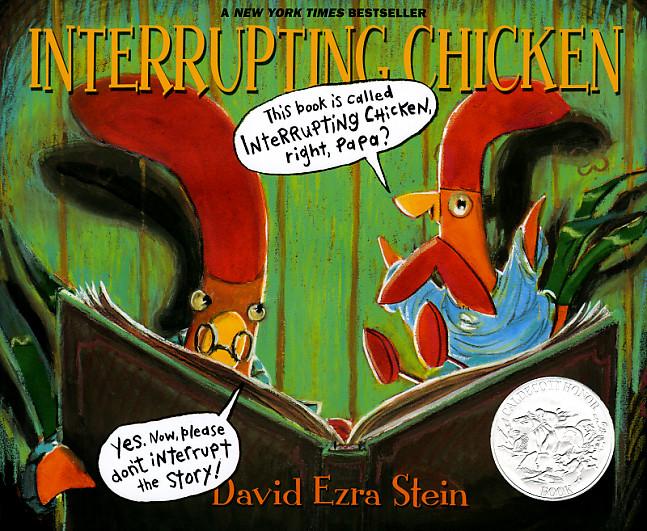
Interrupting Chicken: A Social Skills Lesson

Last week one of our social skills lessons started with a read aloud of "Interrupting Chicken" by David Ezra Stein.

This is a great book to help children learn about controlling those impulsive moments of wanting to interrupt or blurt out during our whole group time.


We completed our read aloud, had a class discussion and then also completed some activities similar to those found at Happy Teacher, Happy Kids.

I can also be a little bit goofy and I want our social skills lessons to be fun, so the kids can really practice the skills and enjoy the results of prosocial behaviors.  Not just dread one more lesson with a bunch of rules that are hard for them to follow.  So as a result of my Pinterest addiction, I found a link to "Chicken Names" from Tilly's Nest and thought it would be fun to pair with this book.


The rules of the activity were pretty simple.  We were going to practice NOT being interrupting chickens.  If we could work on that, we could make a list of everyone's chicken name.  (I'm Yolko Scrambledore, by the way.)  It was fun.  One of the little girls in my class has the same birthday month as my assistant so she dubbed my assistant as her "Chicken Cousin."

There is also a YouTube video that has a read aloud.  I like to use the videos in addition to my read aloud because it gives my students one more way to access the text.


With a simple Google search, you can find many, many online resources and ideas that support this book.  These were just a few of the ones we used.


Sunday, July 12, 2009

Tips for Addressing Challenging Behavior

The University of Minnesota has a website that has great Tip Sheets for addressing challenging behavior in the classroom.

I particularly like the ones on "choice making" and "requesting a break." These are two very powerful strategies that can be embedded into almost any learning task.

Monday, May 19, 2008

Classroom Procedures: Continuation of the Benefits of Daily Routines

In two previous posts, The Benefits of a Daily Routine and Entrance Procedures we discussed the importance of establishing, teaching and maintaining classroom routines and procedures. A routine or procedure is different than a rule in that it teaches a student the steps to complete a task. (i.e. The line up routine teaches students the steps to successfully line up.) Harry Wong is an advocate for only a few classroom rules (i.e hands and feet to self) but supports the widespread use of many classroom routines/procedures.

The following list are some of the routines that I find important and useful. While I cannot give specific advice on how to structure your classroom procedures without knowing details about your class dynamics, your physical layout and your school rules; I can offer some guiding questions that may help you to determine routines for yourself. I can also give examples of routines that I use and you can modify them to fit your teaching situation.

Bathroom
When can students go?
When do they need to wait?
What will I do for students who need help?
Where do they wash and dry hands?
Where is the trash can?
How do I get custodial help for accidents?
Have I shown respect for all students?

My procedure for K-2: Students could go to the bathroom anytime during the following: morning work, independent work, centers, recess, snack or lunch. They were not allowed to go during direct instruction time (i.e reading group, math group, writing). If they asked, I usually asked them if they could wait. Most frequently, they could wait. Sometimes they could not and I would let them go. However, if this became a pattern, then I began to think it was an escape behavior. I would then ask my (meticulously organized) assistant to help me remember to send them before instructional groups started.

Drinks

When can students get a drink?
When do they have to wait?
Is permission required?
How do they request permission?
When during the day can you schedule drinks in your routine?
Have I provided enough opportunities for hydration?

My procedure for K-2: Same procedure as bathrooming. Verbal reminders were given to students to get drinks after recess and physical education activities.

Pencil Sharpening
Provide an opportunity for students:
~during the first 15 minutes in the morning
~during choice time, independent work, centers


Teacher always has sharpened pencils available:
~at the teacher's table
~at the assistant's table
~on the counter for student use
Do I have a system in place to provide materials in a timely manner?

My procedure for K-2: I have to confess, this is one of my pet peeves. My procedure was created out of a need to maintain my sanity. Pencil sharpening is one the of the most distracting and irritating sounds for me. I hate it! No pencils are allowed to be sharpened during my direct instruction time. It is like nails on the chalkboard for me!


Students could sharpen pencils during the first 15 minutes of class or during center time. After that, if they needed a sharpened pencil they had to use one of mine or my assistant's. We always had pencils at our teaching tables and on a counter for students.

Line Up
Do I have a cue to tell students when to line up?
Is there enough physical space for all students to line up?
How will students move to line? (in groups, one at a time, all together?)
How will students know their place in line?
Will I have specific jobs? (line leader, door holder, light monitor)

K-2 procedure: We created a line order. The first person in line was, obviously, the line leader. The last person in line was the door holder. Each week the line leader went to the end of the line and the next person in line moved up. This allowed each child to have a turn at both jobs.

Visual tip: My husband introduced me to painter's tape. Painters tape is blue tape (easily found in the painting department of Home Depot and Lowe's) that does not leave a sticky, gooey mess (like masking tape does). I now use painter's tape as a visual cue on the floor to outline a shape for each child to stand on when lining up.

Transitioning to a new activity
What cue do you use to let students know it's time for a new activity? (timer, verbal cue, chimes)
How much time do students have to move to the next activity?
How do they know when to start the next activity?
How will they move (if required) to the next activity?

K-2 procedure: We transitioned to the next reading or math group according to a timer. When the timer beeped, it was time to move.

These are just some examples of classroom procedures that I have found to be beneficial. Teaching a procdure helps students to understand how you want them to complete a task. Procedures help students to be successful in the classroom and they help to maximize time on task by directly teaching expectations.

Sunday, April 27, 2008

Social Stories Made Easy

Several of my students have made gains through the use of Social Stories. A social story is designed to teach a student specific details about a social situation so that when the situation naturally occurs, he/she has some strategies and vocabulary to deal with it. For more information on social stories check out wikipedia at http://en.wikipedia.org/wiki/Social_stories

Another special education blog recently posted an article about using comic book formats to create social stories. What a great idea!
http://teachinglearnerswithmultipleneeds.blogspot.com/2008/04/comic-books-for-social-stories.html


The site that I particularly like from this post was: http://www.pikikids.com/ps/home

I was playing with it earlier this week. I already have some digital photos on my computer and just followed the instructions to upload some for a social story on task support. I used pictures of a particular student working with me hand over hand on a fine motor task, working next to my assistant and working in a center by himself. Then there is a place to click on speech bubbles to add text. I just added one sentence to each picture about the work task.

It's relatively easy and only took about 15 minutes to complete. The thing I spent the most time on was trying to figure out how to print it.
scroll on the right and there is a print menu box
click "download"
it will open a jpeg image and then print.

Also...IMPORTANT...when you finish the social story sequence, there is a link that toggles between "make my comic public" and "make my comic private." You most likely want to click the private one.

Sunday, April 20, 2008

Memorable Moment #3

My pre-k class and I are very fortunate to be included within our school community. Sometimes pre-k classes are physically located within a school, but function as an independent unit (not wholly integrated into school activities).

At the pre-k level, one of our most important areas of skill development occurs within the social/emotional domain. Positive experiences within the social/emotional domain prepare children to be more successful in learning activities in later years.

One afternoon in January, we went to the cafeteria to participate in the Jog-a-Thon Kick-Off Assembly. One of my students who has autism (Andy), was completely overwhelmed with all of the sensory input, and we needed to leave the assembly. This really bothered me because I thought about how much of his elementary school experience he would miss if he couldn’t enjoy an assembly, school play, guest speaker, performance or concert.

What could I do, as his teacher, to help him organize an overwhelming amount of sensory input?

Throughout the next year, each time there was a class assembly or a grade level assembly, Andy and I would go to the cafeteria early (we were the first to arrive) and wave to our friends as they entered the cafeteria. I would point out people we knew and say "Hi, book buddies. Look, Andy, there's Mrs. Smith. Hi, Mrs. Smith. " We went to everything! We would also sit near the side of the cafeteria, close to a door (just in case we had to make a quick exit.) The idea was to try to point out the things and people that were familiar to him before it was a huge crush. I was hoping that once he realized that in that mess of kids and noise, there were students he knew, teachers he knew, cheers he knew, songs he knew and that he was safe.

As the noise level started to increase, he would sit with me with headphones on and watch the performance. We gradually started to attend bigger and louder assemblies and tried small moments of time without the headphones.

The following year, we had a test. It was time for the school's Winter Concert. Andy and his parents came really early so they would be the first to arrive in the cafeteria. I asked his mom to point out all the people she and Andy knew. Andy stood on the stage with his class, in front of a packed cafeteria and sang Jingle Bells! Smiling and shaking the jingle bells the whole time!

Andy is now in kindergarten and participates in school-wide assemblies without support. We recently had our noisy, stimulating jog-a-thon assembly and Andy sat in the middle of his class participating, smiling and cheering throughout the assembly