Showing posts with label writing. Show all posts

Monday, August 1, 2016

Journals for Pre-K

Last year I started looking for ideas on Pinterest about journaling with preschoolers.  I came across a few pins that helped me get started:

Ten Tips for Keeping a Journal in Preschool

Pre-School Journaling

J is for Journal


After reading about how others started, organized and maintained their journals; I started making the decisions about how I would use the journals in my classroom.

I chose to use simple black and white composition books for our journals.  I used a name label sticker on the front of each child's journal and also made one for myself.

My class typically is most successful when I model expectations for them before they attempt a structured task like this.  Before the kids ever used their journal, I had all of the journals prepped and in a basket and I modeled drawing a picture in my journal.  Since most of the students in my class have language impairments, I wanted the focus of our journals based on increasing their communication skills.  After I drew my picture, I talked about it.  I labeled the picture, told the class a sentence about my picture.  We did this a few times, using the word journal and modeling how to draw, turn pages, choose the next page, etc.  The first time I passed out their journals at circle time, all we did was look at the journal and turn the blank pages.

We used our journals in a small group, structured center with adult support at first.  After all of the students started to understand the purpose and became more proficient at drawing their pictures, I would also put them out for a table activity or "morning work" first thing in the morning in a large group.

Since my goal was to help increase communication, every time the students worked in their journal, they talked to an adult (me, my assistant, a volunteer) about it and we wrote their exact words on the paper.  Through this, we also had ongoing documentation showing how their language skills improved over time.  You can see the length of utterance increases, use of age appropriate vocabulary, use of pronouns and use of action words.  This became a great way for  me to show parents what language skill I might be working on with a child and how they could help.

I also found that our science center was a great inspiration spot for lots of writing and observation.

Here are some photos of some of  our journal work:


And here are some from a different student:


Wednesday, May 6, 2015

Rainforest Riddles...So Fun!

My class has been working on a unit that revolved around a Rainforest theme.  I chose this particular theme at this time because:

a) Students are usually very interested in the Rainforest theme and can be easily encouraged to read and write.
b) We have an expository text on the Rainforest in our reading series and I am required to base lessons off of our core curriculum materials.  (So I would have to do this anyway.)
c) There are hundreds of free resources and extensions available online.
d) Our school was in the middle of FSA testing.  Although I don't have any students testing this year, the resource teacher next to me is testing every day which means my class needs to be close to silent for the entire morning block.  Brutal (for the kids and me.....so I held out the carrot....if we were super quiet in the morning then we could do some fun, noisy rainforest activities in the afternoon.)

One of my favorite things we did with the unit was to write our own Rainforest Riddles.  I found a free pdf from First Grade Hip Hip Hooray on Teachers Pay Teachers.  The set gives several rainforest riddles already written that the students have to solve.  It has a nice set of graphics for a simple read, then cut and paste activity.  Finally, it also includes graphic organizers to help students write their own riddles.

My class really loved writing their riddles "in secret" and creating their animal from pieces from our arts and crafts scraps/materials.  We then combined all of our animal creations to make a rainforest bulletin board.

Here's our bulletin board.  Sorry!  The picture is a bit fuzzy and I still need to add "forest floor" to our layers.


Below are some close up examples of the writing samples they did.  You can see the different levels within the writing samples, but this was an activity that all of my students could participate in.  I like these types of projects because it brings our class together as "a whole."


Saturday, January 4, 2014

Writing Haikus

Way back in 2009, I worked with a friend of mine who is an SLP to devise a manipulative word bank to help my summer school students with autism generate their own sentences and write a simple paragraph.  It sounds pretty straightforward, but it was actually quite a bit of work for me because I had never had to provide quite that level of support for students.  You can read about it here.

This year, I used this strategy again.  While my current students, don't have the severe needs of the class I developed the system for, I thought it would be helpful for some of them.

We were working on a unit that focused on different forms of poetry.  One of the lessons for the general education students at grade level was to write a haiku.  I wanted my students to do this too.  So I stole some ideas from my general ed teacher friends and then added some supports to them.  Here is what we did:

1) Each student painted a background of mixed colors with yellow and orange.  My assistants and I used our Elison machine to cut out some "bare trees," spiders, and leaves.  The kids used the black shapes to glue a scene to their previously painted background.  (Sorry I don't have a picture of this! I'll see if I can update this with a "fake" one that I make so you can see what I"m talking about.)

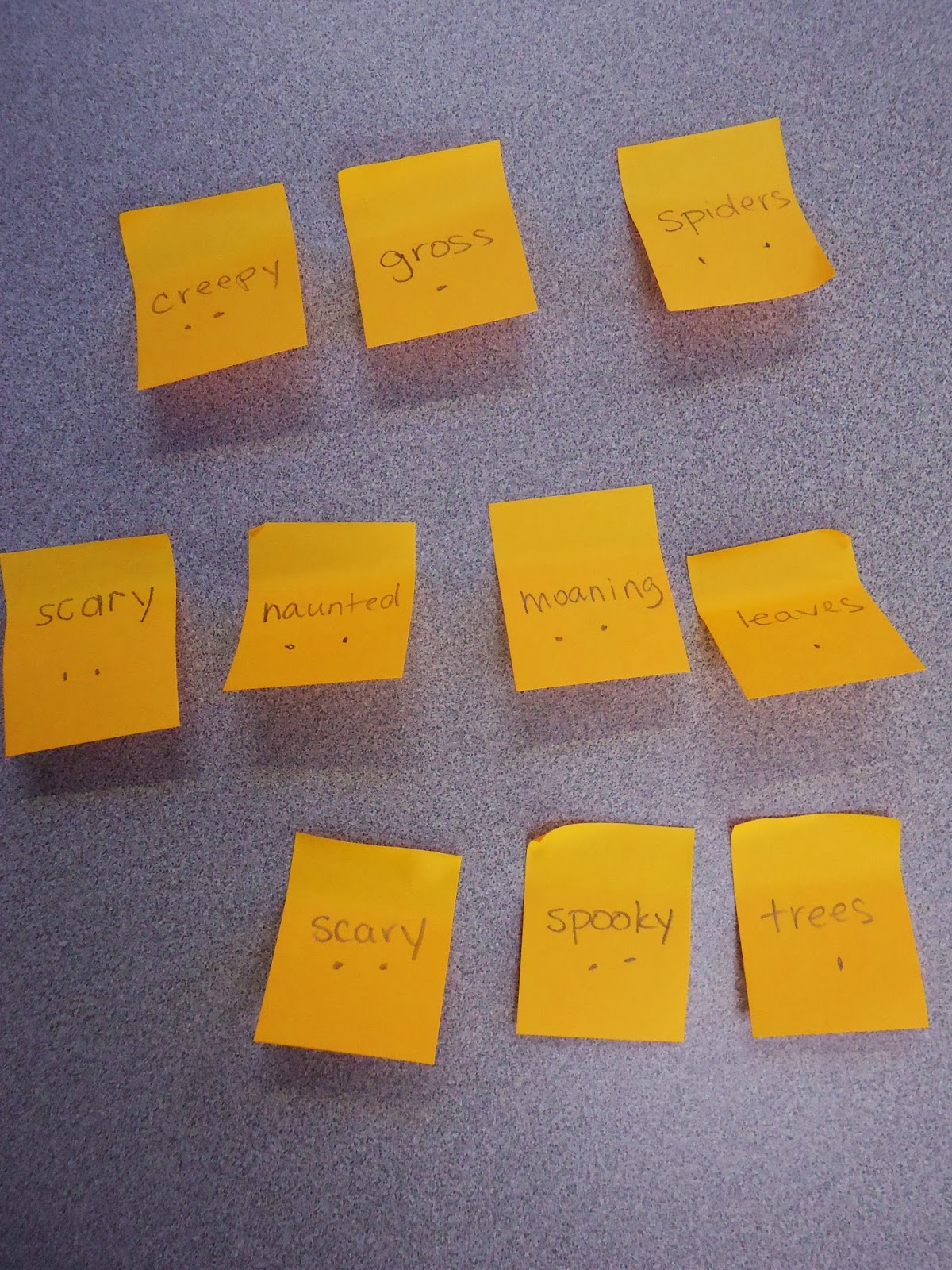
2) As a whole group we looked at the pictures that were created and generated a word bank of words that described our pictures.  I wrote them on the board and the kids copied them.  We also reviewed the rules and syllable pattern for creating a haiku.


3) Two of my students were able to generate their haikus after completing these activities, others needed some more help.

4) I transferred the word bank to post it notes and put dots underneath each word to identify how many syllables the word had.


4) The students moved and manipulated the words to create a phrase that made sense and also fit the syllable pattern for a haiku.


5) When they finished writing their haiku, they read it to me and I typed it on the computer.  We printed their haiku and they used craft scissors to cut the edges of the paper the poem was printed on.  Then they glued their haiku to their picture and we hung it up for display!


When my general education team decided this was going to be one of the "published" pieces we would do for our quarter 2 writing grades, I was a bit worried.  Writing a haiku is very abstract.  I needed to find a way to teach the syllable pattern and the emphasis on nature to my students.  The art project and the post it notes (as well as previous experience with haikus we read aloud) helped them to successfully complete this! It's nice to be "pushed" into doing something that is a bit uncomfortable sometimes. (I never would have chosen haikus as a published writing sample.)   As a teacher, it made my brain stretch and think about how to make this lesson work with my students.