Showing posts with label materials. Show all posts

Tuesday, July 8, 2014

Doll House and Choice Time

At the end of the day this past year, my class enjoyed "Choice Time."

If you were to walk in my classroom, "choice time" looks remarkably similar to "free time."  I don't call it "free time" however, because the children are not "free" to do whatever they want...they have to make a choice from the leisure activities we have available and then stay productively engaged, unless they have asked permission to make a different choice.

Unproductive wandering throughout the classroom is one of my "teacher pet peeves."  It drives me crazy and I have found that unproductive wandering leads to lots of management or behavior issues. Hence, we have "choice time" and not "free time."

One of my older third grade girls wanted me to buy a Barbie doll house for them to play with during choice time.  I explained that Barbie houses cost a lot of money and we didn't have enough to buy one.  She accepted this and went on to play with something else.

A few days later while browsing on Pinterest, I came across this pin that uses a 3 ring binder to make a Barbie doll house from Southern Disposition.  Take a look.  Kendra includes lots of ideas and instructions.


How serendipitous!

When we got to choice time the following day, I asked that little girl if she would be interested in looking at a possible solution to our Barbie doll house problem.  We looked through the website and directions.  She was hooked!

I happen to have lots of scrapbook paper at home that I don't use anymore because I now do most of my photo albums digitally.  I also have a scrap craft bucket of ribbon, lace, beads, etc that I keep for projects at school.  I purchased some scraps of cheap fabric from the scrap bin at Jo-Ann's.

I also happened to know that our bookkeeper has A LOT of old binders that no one wants to use because they aren't perfect.  They were "perfect" for us because they were free!

So for about $8 for fabric scraps and some Stitch Witchery (no sew tape that fuses fabric together), we were in business!

Two girls wanted to make doll houses but they didn't really know where to start.  We talked about how sometimes people use an "inspiration room."  I asked them what colors they wanted their rooms to be.  One chose blue and the other chose pink.  We googled images of girls bedrooms.

One girl choose this blue room from Amecdes as her inspiration.


The other girl chose this pink and green and cream room from Bess.Net as her inspiration.


Our choice time lasts for 15 or 20 minutes at the end of each day.  For about three weeks, the girls spent their choice time creating, figuring things out, problem solving and adding details to their doll house.


Here's one girl making a mirror out of a file folder, aluminum foil, and lace ribbon she cut apart.


Here's her room after she covered up a granola bar box for her bed.


And here is her final product.  The curtain rod is a pipe cleaner with some blue beads we had in our craft bucket (I think they were table scatter beads from the Dollar Tree.)  The curtains are just lengths of lace ribbon she cut and then threaded onto the pipe cleaner.  The rug is a scrap of felt. We printed an image of a dresser off of another Google image search and she glued it to the wall.  The bedspread is a scrap of fabric that she cut.  I helped her make the pillows and the column of fabric that covers the 3 rings with an iron and the Stitch Witchery. (Hot irons and young children are not a good combination!)


Here is the other girl after she finished her mural and began working on her window.


And here is her final room.  She decided to make her bed a daybed.  We used a Girl Scout cookie box for this and scraps of fabric that she cut.  Her curtain rod is a pipe cleaner with some of a pearl strand that she twisted together (the pearls were is my scrap bucket.)  The curtain ties are more of the pearl strand.  The rug is a scrap of felt.  She also cut some mat board to frame her butterfly mural.  Again, I helped with the iron and Stitch Witchery of the column of fabric in the middle and the pillows.  


The two rooms together looked like this (sorry the photo is a little fuzzy!):


The girls had so much fun making their own doll house bedrooms.  They also had a lot of fun playing with them during choice time once they were completed.

I know I can't prove that they practiced their social skills or their problem solving skills and I certainly don't have any data to justify letting them spend 15 or 20 minutes every day making a doll house.  However, these little doll houses have been one of my favorite memories from the year.  To me it shows:

1) Willingness to accept and handle disappointment and the word "no" (We didn't buy their doll house that they wanted.)
2) Willingness to accept a compromise and take responsibility to follow through on the compromise
3) Ability to think in a problem solving process (Watching the one girl work for 2 days to get her mirror to stand up by itself was awesome!)
4) Ability to persist at a long term task (relatively speaking)
5) Thinking creatively
6) Using materials for another purpose other than its intended use

****One little girl is in my class for help with an emotional and behavioral disorder (EBD) and the other is in my room for  help with a severe learning disability.  I'm pretty happy with all of the skills they practiced in an authentic and personally meaningful way.

Many, many thanks to Kendra at Southern Disposition for her great idea!

Thursday, September 29, 2011

"Dolphin Tale" Ideas and Resources

My class is very excited about the new movie "Dolphin Tale."  In science, we've been discussing how scientists can use a model to help them investigate their questions and variables.

Here are a few resources I've either found or created that you can use to support reading, writing and science through ideas from the movie "Dolphin Tale."

Power Point that can be printed or shown on an Activeboard/SmartBoard

Science Worksheet to go with Scientific Method and Power Point

Writing Prompt to go with Power Point

Scholastic Resources

Winter's Tail


Hope you enjoy!


Monday, October 11, 2010

Free Early Literacy Activities

This site has recently been shared with me from our pre-k supervisor.

It has many, free printable activities that support literacy of infants, toddlers and pre-schoolers. They have a link for ideas for parents and another link for teachers. Check it out.

Center for Early Literacy Learning

Tuesday, June 23, 2009

Tuesday, May 19, 2009

Summer Reading Ideas

Our data and literacy coach just shared this site with us.

After looking at it, it really has a lot of great literacy suggestions for summer reading.

Check out the book suggestions organized according to age groups at James Patterson's

ReadKiddoRead.

Saturday, March 21, 2009

Spring Babies PowerPoint


My classroom has the luxury of being equipped with an ActiveBoard. I am planning on using this powerpoint to teach new vocabulary about spring babies. If you don't have a projection screen, Smart Board or ActiveBoard; you can just print, laminate and bind the book for use at circle time or in your library center.


Friday, March 20, 2009

Free Printable Emergent Readers

On one of my yahoo groups there has recently been a thread talking about sight word readers.

There are many free resources available on the web.

Here are a few:

Carl's Corner
(Kindergarten emergent readers)

Samples from Reading A-Z
(a few free samples, for $50ish access to all of their books)

Hubbards Cupboard
(40 or so free printable books)

Make Learning Fun
(not all sight word based, but a lot of emergent themed printables)

Mrs. Meacham's
(awesome page with printables and more links)

Kinderprintables

Marcia's Lesson Links

Mrs. Jones Room
(lots of links to many other resources)

http://www.childcareland.com/free.html
(scroll through and look for "book" in the item descriptions)

http://mrskilburnkiddos.wordpress.com/reading/sight-words/
(scroll down, there are links to books she created in the middle of the post)

Monday, January 12, 2009

Block Play


Today was a great day. Not only did I get to hear Ron Clark speak this morning, but this afternoon, my assistant and I actually finished a project that has been on our to do list for two years. Hooray for us!

We have have been wanting to create a book that will provide visual support for children playing in the block area.

We have a few students who have difficulty figuring out what to do and how to play in the block area. Often one of us will play with the students and help them make choices and decisions. But just as frequently, we are working in other areas of the classroom and students are independently playing in the block area. By creating the book, we are hoping to make the area more accessible to more students.

We started off with the resource book "Beyond Centers and Circle Time." There is an excellent section on "Construction Play" that includes an observation scale of simple to complex block structures.

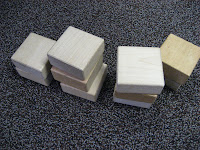
We used this scale to reproduce some similar structures using our classroom materials. We tried to create structures of varying complexity so that children of varying ability levels could use the idea book. We then took pictures with our digital camera and uploaded the images to a PowerPoint. The book was then printed, laminated, bound and placed in the block area. You can download our book here.

We also only used a few pictures within the book. The concept of the book is to help the child get started, not to dictate or direct his/her play. (The pictures on the right are a few that we used in the book.)

Since we haven't used it yet, I'll have to update you on the level of success. Hopefully, we can teach our students how to use the book and then increase levels of self directed play and independence.

Wednesday, October 1, 2008

Book lists and vocabulary

Have you noticed my Shelfari shelf has changed? (You may have to scroll down the blog and look to the right hand side to see my shelf.)

I was originally playing with the features of Shelfari with the books that I read for myself. Then the Boardmaker listserve on Yahoo had a thread going about favorite books and correlating vocabulary.

That made me think.

Since this blog is really about education and educational strategies, what if I used Shelfari to organize the books that I use in my classroom? So I started playing with the features again.

Here's what I've decided so far:

I will post the book and how many stars I think it deserves for classroom use. Under the review feature (move your cursor over the picture of the book on my Shelfari shelf and you will be able to see my review), I will post:

theme/unit
age/grade level
concept
vocabulary words

I will try to have a blog post with a list of all of the books in a particular theme.

Since I'm still in the "playing with the features stage,"
I reserve the right to change my mind. :-)

Sunday, September 21, 2008

Teaching Rhyming

One of my listservs has been pretty active lately on the topic of teaching rhyme. It has been an interesting topic, because the person interested in ideas has already tried many strategies to help her particular student master the concept.

So it made me think...how many different strategies and different materials would help teach the concept of rhyming.


Ideas for parents and teachers about how to teach rhyming:

Rhyming at Succeed to Read

Rhyming Ball Game


Rhyme Time

You Tube: Teaching Rhyme with Songs


You Tube: Teaching Rhyme


Free Downloads for teaching rhyming:

Using Nursery Rhymes: Free Printables


Raffi: Down by the Bay Song

Kelly's Kindergarten Rhyming Pictures


Erase A Rhymes

More Erase A Rhymes (scroll down 2 or 3 sections)


Free Online games/videos for practicing rhyming:

You Tube: Chicka Chicka Boom Boom

You Tube: Sesame Street "et" Rhyme


You Tube: Becka and the Big Bubble


Interactive Game: Oobi Rhyme

Interactive Game: Gus and Inky Rhyme

Interactive Game: Rhyme Time Picture Match Up

Interactive Game: Scholastic Reggie Loves to Rhyme

Interactive Game: Elmo Rhymes


Products to purchase:

Jack Hartmann: Shake Rattle and Read

Lakeshore Rhyming Books


Lakeshore Rhyming Tubs


Super Duper: Rhyme Deck


These are just a few of the many resources that are out there. Have fun exploring!

Thursday, August 7, 2008

Free Online Books

I've been reading more and more about Universal Design for Learning in the past few months. I found a site that was new to me, UDL Wikispace.

As I was navigating my way through all of the cool resources, I hit on one in the Literacy Tools. There are many links to help students of all ages access literacy.

I browsed several sites with free online books that were familiar to me, but it made me wonder if there were other sites and resources that were similar.

Yes! There are tons!

Here are a few that I liked:

LookyBook

TarHeel Reader

Starfall

Literactive
(You have to create an account, but it is free.)

E-Books for Young Readers

Reading A-Z Interactive Books; RAZ Kids
(Click on free samples. A subscription to the complete library is $29-$59).

Clifford Books

Magic Keys


This one would be for older kids and adults....Mark Twain, Jane Austen, Jules Verne....wow!
Read Print

Saturday, May 10, 2008

Favorite Materials

It's that time of year to think about.....

Transitioning students to the next grade level? (yes, but not in this post.)

Progress reports? (yes, but again, not in this post)

Graduation and end of the year celebrations? (yes, but yet again, not in this post)

Preparing summer vacation travel plans? (yes, yes , yes! but, alas, not in this post)

Now is the time to prepare materials orders and purchase orders for next year. (Even if you still have a list of things that need to be completed for this year. ughh!).

The following is a list of materials that I use year after year. They are primarily supplementary materials (not core curriculum materials). Most of the items on the list are under $50 and could be paid for out of a classroom budget.

Materials for any grade level:

Velcro and lamination Velcro and lamination make teacher created materials durable and interactive. They help to make the materials individualized to the strengths/needs of the student. I prefer velcro dots for most materials. They reduce the amount of cutting and make creating materials more time efficient. I order velcro dots from http://www.feinersupply.com/
Fortunately, my school has a laminating machine and the laminating film comes out of the school's budget. However, I like to have some pieces laminated in thicker film to make them more durable. When I purchase my own lamination film, I typically buy from Sam's Club.

Boardmaker Boardmaker is a software program that has thousands of visual cues stored in an easy to use database. The initial cost is approximately $300, but is well worth it. I use my Boardmaker program on a daily basis to create home/school questions, visual schedules, recipes, classroom rules and procedures, interactive books, etc. Visit http://www.mayerjohnson.com/ for more information.

Scholastic Book Clubs No cost to the teacher or school! Just register and this is an easy sytematic way for families to purchase inexpensive books for home. As families purchase books, that classroom earns "bonus points" that can be spent on new materials for the classroom. This is also an inexpensive way for a new teacher to build up a classroom library. http://teacher.scholastic.com/clubs/

Reading A-Z This is website of thousands of leveled readers. I use http://www.readinga-z.com/ with my current pre-k students, as well as the 2 intermediate students I tutor. I have used it in the past with my K-2nd grade class and also my 3rd-5th grade class. The website is user friendly and is a valuable resource in providing students with reading material at their instructional level. The books can be printed and sent home, so it is also a great way to get instructional/independent level passages for students to read at home. It costs about $50 per year.


Materials for primary grades or pre-kindergarten:

Matt and Molly This series includes a set of simple stories paired with 4 visual cues that sequence the story. The teacher's guide includes a set of yes/no questions and a set of "wh" (who, what, where) questions for each story. It was created to work on language skills for students with autism, however, I have found that the structure and the simplicity of the visual cues are beneficial for all of my students (especially those with autism or language impairments). There are 5 sets in the series and each set is $31.95. http://www.linguisystems.com/searchResults.php?action=search&search_term=matt+and+molly

Jack Hartman CDs Jack Hartman has many, many, many CDs that incorporate music and movement to promote skill mastery and understanding of concepts. I like all of the CDs. If you are just starting out, I would recommend I've Got Music in Me, Vol. 1. or Shake, Rattle and Read. http://www.jackhartmann.com/cds.htm