Showing posts with label classroom materials. Show all posts

Friday, August 13, 2021

Easy Interactive Books

My friend Bev came up with this brilliant idea years ago.  I didn't need it for a number of years, but last year I had several students who benefitted from having more interaction during their story time.

We simply took an inexpensive paperback book and cut it apart.  Next we ran the pages through the laminator.  We then took a targeted vocabulary word from each page and created a Boardmaker document with a picture. Next we used the hole punch binding tool that we have in our teacher workroom to bind the book back together.  Finally, we used velcro dots to make each page interactive.

This has been a great way for us to create inexpensive interactive books for circle time.


Tuesday, July 8, 2014

Doll House and Choice Time

At the end of the day this past year, my class enjoyed "Choice Time."

If you were to walk in my classroom, "choice time" looks remarkably similar to "free time."  I don't call it "free time" however, because the children are not "free" to do whatever they want...they have to make a choice from the leisure activities we have available and then stay productively engaged, unless they have asked permission to make a different choice.

Unproductive wandering throughout the classroom is one of my "teacher pet peeves."  It drives me crazy and I have found that unproductive wandering leads to lots of management or behavior issues. Hence, we have "choice time" and not "free time."

One of my older third grade girls wanted me to buy a Barbie doll house for them to play with during choice time.  I explained that Barbie houses cost a lot of money and we didn't have enough to buy one.  She accepted this and went on to play with something else.

A few days later while browsing on Pinterest, I came across this pin that uses a 3 ring binder to make a Barbie doll house from Southern Disposition.  Take a look.  Kendra includes lots of ideas and instructions.


How serendipitous!

When we got to choice time the following day, I asked that little girl if she would be interested in looking at a possible solution to our Barbie doll house problem.  We looked through the website and directions.  She was hooked!

I happen to have lots of scrapbook paper at home that I don't use anymore because I now do most of my photo albums digitally.  I also have a scrap craft bucket of ribbon, lace, beads, etc that I keep for projects at school.  I purchased some scraps of cheap fabric from the scrap bin at Jo-Ann's.

I also happened to know that our bookkeeper has A LOT of old binders that no one wants to use because they aren't perfect.  They were "perfect" for us because they were free!

So for about $8 for fabric scraps and some Stitch Witchery (no sew tape that fuses fabric together), we were in business!

Two girls wanted to make doll houses but they didn't really know where to start.  We talked about how sometimes people use an "inspiration room."  I asked them what colors they wanted their rooms to be.  One chose blue and the other chose pink.  We googled images of girls bedrooms.

One girl choose this blue room from Amecdes as her inspiration.


The other girl chose this pink and green and cream room from Bess.Net as her inspiration.


Our choice time lasts for 15 or 20 minutes at the end of each day.  For about three weeks, the girls spent their choice time creating, figuring things out, problem solving and adding details to their doll house.


Here's one girl making a mirror out of a file folder, aluminum foil, and lace ribbon she cut apart.


Here's her room after she covered up a granola bar box for her bed.


And here is her final product.  The curtain rod is a pipe cleaner with some blue beads we had in our craft bucket (I think they were table scatter beads from the Dollar Tree.)  The curtains are just lengths of lace ribbon she cut and then threaded onto the pipe cleaner.  The rug is a scrap of felt. We printed an image of a dresser off of another Google image search and she glued it to the wall.  The bedspread is a scrap of fabric that she cut.  I helped her make the pillows and the column of fabric that covers the 3 rings with an iron and the Stitch Witchery. (Hot irons and young children are not a good combination!)


Here is the other girl after she finished her mural and began working on her window.


And here is her final room.  She decided to make her bed a daybed.  We used a Girl Scout cookie box for this and scraps of fabric that she cut.  Her curtain rod is a pipe cleaner with some of a pearl strand that she twisted together (the pearls were is my scrap bucket.)  The curtain ties are more of the pearl strand.  The rug is a scrap of felt.  She also cut some mat board to frame her butterfly mural.  Again, I helped with the iron and Stitch Witchery of the column of fabric in the middle and the pillows.  


The two rooms together looked like this (sorry the photo is a little fuzzy!):


The girls had so much fun making their own doll house bedrooms.  They also had a lot of fun playing with them during choice time once they were completed.

I know I can't prove that they practiced their social skills or their problem solving skills and I certainly don't have any data to justify letting them spend 15 or 20 minutes every day making a doll house.  However, these little doll houses have been one of my favorite memories from the year.  To me it shows:

1) Willingness to accept and handle disappointment and the word "no" (We didn't buy their doll house that they wanted.)
2) Willingness to accept a compromise and take responsibility to follow through on the compromise
3) Ability to think in a problem solving process (Watching the one girl work for 2 days to get her mirror to stand up by itself was awesome!)
4) Ability to persist at a long term task (relatively speaking)
5) Thinking creatively
6) Using materials for another purpose other than its intended use

****One little girl is in my class for help with an emotional and behavioral disorder (EBD) and the other is in my room for  help with a severe learning disability.  I'm pretty happy with all of the skills they practiced in an authentic and personally meaningful way.

Many, many thanks to Kendra at Southern Disposition for her great idea!

Tuesday, July 1, 2014

Book Talk Tuesday

Since the summer has been in full swing, I have done a lot of blog hopping and reading links on Twitter streams.

I just found Gladys's blog over at Teaching in High Heels.  She and I have several things in common: like Gladys, I could spend large amounts of time and money investing in children's literature.  And I also agree everything LOOKS better in high heels, but I have to admit, I always have a pair of sparkly flip flops under my desk for when my feet hurt!

At any rate, I'd like to piggyback on Chelsea's "Book Talk Tuesday." Lulu is new to me and I love finding new books.  I can't wait to take a look at her series.

A series that my class has throughly enjoyed this year is Skippyjon Jones.


Skippyjon Jones is a Siamese cat who imagines spectacular adventures for himself as a chihuahua.

There is a whole series of books telling of Skippy's adventures.  They always include a warning from Mama Junebug, Skippy entering his closet as the cue that his imaginative adventures are beginning and poems that get the kiddos in my class clapping their hands and begging for me to repeat it "one more time."

I love to hear kids interacting with books, laughing and enjoying the experience.  I hope its one more step on the path for life long readers.


Tuesday, March 11, 2014

Braille: Minute to Win It

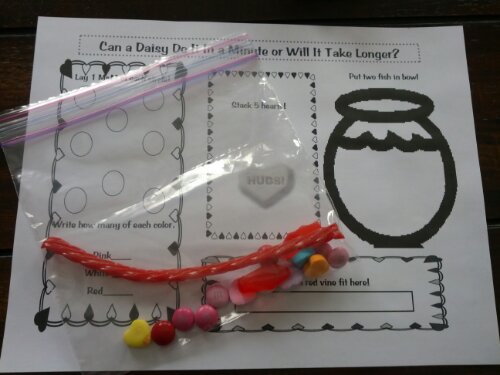
I know it's way past Valentine's Day, but hey, St. Patrick's Day is coming up.  I thought I'd share how I modified a Minute to Win It Board so that Gabby (the child in my class who is blind and has CP) could play with the class on Valentine's Day.  Maybe, this might spark an idea for someone else for a St. Patrick's Day idea or an upcoming Easter idea.

I found this board on Pinterest.  It came from Teaching Heart Blog.

image


I wanted my class to be able to play the game, but I needed to change it a bit for Gabby.  Here's what we came up with.


We just took some cafeteria straws and glued them to vellum to created a raised space for Gabby to put all of her candy items.  Then we brailled the amount and the item name so she would know what belonged in each area.  (Since Gabby has limited motor control, I also didn't have her stack or try to place things within small isolated areas.  If she got it into the right section, it counted.)  There's nothing fancy or pretty about this board, but it did give Gabby access to the game and allowed her to play! Can you tell we took the pictures AFTER she played with it and got chocolate smudges everywhere?  :-)

Finally, for the class as a whole, I told them we were going to see if we could all complete this in one minute.  If one child finished, she was encouraged to cheer on her classmates.  (I still have some very young students in my room, so I try to limit the competitive aspect of games and focus on the participation and teamwork.)

Many thanks to Colleen at Teaching Heart Blog for her awesome freebie!

Note to Colleen:  I tried to leave a comment on your original page on your blog  to ask permission if I could publish this post with attribution back to you.  For some crazy reason, it kept giving me an error message and wouldn't submit.  If this post in anyway makes you uncomfortable, please let me know I will take it down!

Wednesday, May 30, 2012

Tough Puzzle!


My class, my assistants and I have dubbed this the "hardest puzzle in the world."  It's not, of course.  But it IS a very challenging 750 piece puzzle.

I like to have a puzzle table with an ongoing puzzle set up in my room.  It's a nice anchor activity for my students when they finish work and it also lets me integrate some team building and cooperation conversations throughout the day.  It's also nice to hear the students start to compliment each other when they find pieces and the picture starts to come together.

This particular puzzle was intended to be finished by December.  We finished it the first of May!  There was a period of time when they students really weren't motivated or interested in going back to it because it was so hard.

I was stuck.  Do I take it down and start a new one or push through it?

Luckily, I have the most wonderful paraprofessionals in the world! One day one of them encouraged a student to go over and put one piece in "the hardest puzzle in the world."   He did and then was congratulated for helping us with the "hardest puzzle in the world."  That threw down the challenge and regained the kids' interest in the puzzle.  They started talking about finishing the "hardest puzzle in the world" and actually started to enjoy the challenge of it again.  The crazy thing had been up for so long in the classroom all kinds of pieces were now missing (which made it even harder!)

I'm glad we finished it (to the best of our ability with all those missing pieces.)  It gave them a sense of accomplishment and pride.  They even asked if I would take their picture by "the hardest puzzle in the world."  It also gave us some funny conversation and teasing....they asked me to "Please, never buy another puzzle from Goodwill."  :-)


Monday, March 12, 2012

Individual Instruction

Do you ever have a chance for individual instruction with your students?  I've always tried to "fit" it in somewhere, but was more worried about systematically scheduling my groups and seeing every instructional group every day.

This year a block of time for individual instruction evolved during the time that our speech pathologist comes in to do "push in" language therapy groups.  I started off trying to have a group opposite her group, but for a variety of reasons that just didn't work out.  Over the first month of school, we tried a few different things during this time and finally settled into a pattern.

We have 4 adults in the room during this time: the SLP, my two assistants and me.  Here's how we organize the time now:

11:45-12:30 Speech/Language Therapy and Individual Instruction

The students come back into the room from specials, get drinks, go to the bathroom and then get their journals out. 

If the students are not working with one of the adults in the room, they are expected to be writing in their journals.  At the beginning of the month, I create a journal prompt menu.  The students tape this to the inside of their journals and "x" out the prompts as they write about them.  I use the word walls from www.ABCTeach.com and an individual word bank to help them with their writing too.  I do this so that the students who are at their desks writing have the support of materials when they don't have the support of the classroom staff.  This helps them to be more independent.  (In fact, if one the students calls my name while I am working with another student during this time, you'll probably hear a peer saying "You know she's going to ignore you because it's not your turn."  It took us a long time to get to this point, but they know what they are supposed to do and they know that they have strategies to be able to do it on their own.)

At the beginning of this time, one assistant takes a student to the clinic for meds and the other assistant takes her break.  I get the students transitioned and started on their journals and the SLP calls the students she needs for the day.  Once we get going here's how we are organized:

1) Students not with an adult write in journals at desks.

2) Students scheduled for speech/language go to group work.

3) Assistant #1: Helps students with AR tests.  I have 7 students who can read and take AR tests independently.  However, that leaves 6 who still need support.  This assistant pulls students 1:1.  They read her an AR book and then she helps them log on and complete the test.  We have a laminated folder for each student and tape a quarterly AR goal inside.  With the AR goal is a sticker chart so they can record their progress towards the goal.  I've also included guidelines for the adult helping (so that it's clear to the person not to help too much!)

4) Assistant #2: Has students read individually to her from their book buckets or chapter books.  In the "book buckets" students have a reading log with leveled readers from www.readinga-z.com.  Some of my students have started chapter books, but still need some support with them.  This is a perfect time for them to read  a chapter to my assistant.

5: Teacher: Students read their sight words to me and I record data towards mastery. (I'm fussy about the data recording so I don't like others to do this.)  This is also a time for me to read their journals and have a mini-writer's conference.  On some days I have also used this time to record Oral Reading Fluency scores.  If someone is stuck on a particular skill, I can pull that child during this time and work on it too.  (Again, just like with the reading block organization, I like to have systems set for my assistants and the students, so that I can think about how my time is best spent during this block of time.  My activities change the most, but I always fall back to sight word practice and mastery when there is not something else that needs to be addressed.)

I've enjoyed this individual time this year and I think the students have too (except for the journal writing, most of them still don't like that.)  They enjoy seeing their progress and their skills improve.  Each station has a progress monitoring piece embedded into it.  At the AR station, they see their stickers tracking progress towards their quarterly goal.  At the book buckets station, they see their reading log fill up and the level of their leveled readers go up too.  At my station the see their mastery of the sight words turning into "star words" and then speed words.  At the SLP's station she always tells them how many they got correct in their previous session and encourages them to go for more correct this time.

Not only do the students like to see their progress towards their learning, I think they really enjoy the one on one time they get with an adult.  I have lots of data to show how their academic skills have improved but not very much about how this time impacts the climate of our classroom.  However, I really do believe that it makes a positive difference in the relationships that are developed between the adults and the students too.


Sunday, April 10, 2011

National Geographic Website

My school is inundated with caterpillars right now. With so many natural, incidental learning experiences available, this is a perfect time to implement our life cycles unit.

National Geographic Kids has many great resources to also support this theme. Of course, in addition to bugs and butterflies National Geographic also has many other topics addressed too. Check them out!

Creature Feature: Monarch Butterflies

What in the World: Bugging Out!

Thursday, September 23, 2010

"Post It" Graphs

Here's a simple strategy that we use a lot in my classroom. I write each child's name on a post it. Then I write a question on a piece chart paper and usually add visual supports for each column of the graph. Below is a picture of our most recent graph:


I like to use the post it graphs for lots of reasons:

1) They help children learn literacy skills by reading their name and their peers' names.

2) They help children develop language skills by answering questions and making choices.

3) They help children develop task related skills and focusing skills because they are actively involved and then they physically get to place their own name on the chart.

4) They help children develop social skills by learning how to take turns and wait for their own turn.

5) They help children develop math skills as we count the number of votes in each column and discuss concepts of more, less and the same (equal).

6) They help children develop literacy skills by becoming part of our environmental print in the classroom.

7) They are quick and easy to prep for! That means I don't spend more time preparing the materials than it takes the children to actually engage in the activity.

Thursday, August 12, 2010

Counting Backwards and Subtraction

I'm working with a little girl who is learning how to subtract.

The touch math strategies were very successful in helping her learn to add, so we are continuing with those materials and cues. However, when she was learning to add, she
had already mastered the skill of counting up. She has not yet learned how to consistently and accurately count backwards from 20. So while she is learning the concept of subtraction with differences from 5 and manipulatives, we are also working on counting backwards from 20.

I created a simple power point that she likes to "play" when we practice. I have her manually click to forward the slides. You can download the manual click power point here. I also added an automatic slide transition for those of you who may want to use this in the classroom. You can download the automatic transition power point here.

In addition to using the power points during our tutoring session, her mom is also helping her count backwards during the many opportunities to wait during the day. They count backwards in the grocery store line, while waiting for her brothers at baseball practice, while the microwave is heating something, while a DVD is loading, etc. She has found lots of times during the day to practice with her!

Monday, July 19, 2010

Free Decodable Books

A friend on one of my Yahoo! listserves just shared this site. I thought it was a great resource for emergent and early readers. It includes free decodable books that are written and shared by teachers.

Free Decodable Books

Enjoy exploring the site!

Monday, June 7, 2010

Memorable Moment # 8: Building Structures

Here's one of my recent memorable moments:

During the last week of school, I took a look in my storage room to see what materials we had not used yet this year and came across a bucket of plastic building materials. They have white lines and white curves and colorful couplings to join them together. I got them out and asked one of my assistants if she would support that center during our center time.

She and the kids ran with it! It was so much fun to watch.

For the first 20 minutes or so, they really explored and experimented with how the pieces fit together and what they could do with them. Then they decided to get a little bit more complex and I hear one of the kids say, "Can we have some paper and markers?"

Naturally, any time a child wants to write, I say yes. So they got the markers and paper and brought them over to the area they were playing. My assistant ended up showing them that you can make a plan for building structures. One little boy in particular really understood the relationship between the drawing and the structure. Here's what he came up with:


The first picture is the picture of his plan. The second picture is a picture of what he started building off of his plan.

My personal learning experience from this is a confirmation and gentle reminder to respect and seek the contributions and ideas of the assistants with whom you work. I didn't have a lesson plan for the children to talk about blueprints, architects, and builders. She introduced some really sophisticated vocabulary that they understood through their play and their plans. The lesson plan evolved as she responded to the children and was better for it!

My other take away is an appreciation for the personal interests and aptitudes of young children. While the plan does not look very sophisticated, it was drawn and then implemented by a 4 year old boy.

The level of symbolic representation of a concrete product that isn't even built yet is actually quite sophisticated! I wouldn't have expected this child to be able to do this, but his natural interest, his visual spatial skills and the support of an adult who was engaged with him helped him to reach a level of thinking and problem solving that surprised and delighted us!

Wednesday, July 29, 2009

My Dining Room.....


Does this look familiar to anyone? I bet I'm not the only one!

This is what my dining room has looked like for the past two weeks. A few things have contributed to this disaster. I boxed up materials I would need for ESY for myself and let 2 other friends borrow materials for their ESY classes, too. I'm moving to a new elementary school in the fall and although ESY has ended, now I need to wait a little bit longer to give the custodians a chance to do their "deep clean" on my new room.

Thank goodness I have an understanding husband and a table in our breakast nook!

Monday, May 25, 2009

Reading Activities for the Summer


The Florida Center for Reading Research has a ton of information about teaching reading skills.


As summer is approaching, many parents ask what they can do to help their child with their literacy skills over the summer.


This is one of my favorite activity packets from the website. It includes many easy and printable activities to work on letter recognition.


Saturday, March 21, 2009

Spring Babies PowerPoint


My classroom has the luxury of being equipped with an ActiveBoard. I am planning on using this powerpoint to teach new vocabulary about spring babies. If you don't have a projection screen, Smart Board or ActiveBoard; you can just print, laminate and bind the book for use at circle time or in your library center.


Sunday, October 12, 2008

Hot Pumpkin

Shelley Lovett at Childcareland has started posting YouTube videos about the lessons she teaches with the materials she creates and gathers.

This month she posted a lesson about playing a game "Hot Pumpkin" (similar to hot potato) during her large group time.


Here are the features that I think Shelley does exceptionally well with her site and her pumpkin video:

  • She provides and models the materials.
  • She gives suggestions for alternative materials.
  • When she purchases materials, she tells where they are purchased and the cost.
  • She identifies potential problems and provides cautions against them.
  • She creates a lesson that can be naturally differentiated!
  • She demonstrates how she differentiates with different skill levels.
  • She explains how she makes her teacher decisions.
  • She tells where she gets her music and offers alternatives.

Check out more of the videos of Shelley's Lessons and explore all of the creations on her site.

Wednesday, October 1, 2008

Book lists and vocabulary

Have you noticed my Shelfari shelf has changed? (You may have to scroll down the blog and look to the right hand side to see my shelf.)

I was originally playing with the features of Shelfari with the books that I read for myself. Then the Boardmaker listserve on Yahoo had a thread going about favorite books and correlating vocabulary.

That made me think.

Since this blog is really about education and educational strategies, what if I used Shelfari to organize the books that I use in my classroom? So I started playing with the features again.

Here's what I've decided so far:

I will post the book and how many stars I think it deserves for classroom use. Under the review feature (move your cursor over the picture of the book on my Shelfari shelf and you will be able to see my review), I will post:

theme/unit
age/grade level
concept
vocabulary words

I will try to have a blog post with a list of all of the books in a particular theme.

Since I'm still in the "playing with the features stage,"
I reserve the right to change my mind. :-)

Saturday, May 10, 2008

Favorite Materials

It's that time of year to think about.....

Transitioning students to the next grade level? (yes, but not in this post.)

Progress reports? (yes, but again, not in this post)

Graduation and end of the year celebrations? (yes, but yet again, not in this post)

Preparing summer vacation travel plans? (yes, yes , yes! but, alas, not in this post)

Now is the time to prepare materials orders and purchase orders for next year. (Even if you still have a list of things that need to be completed for this year. ughh!).

The following is a list of materials that I use year after year. They are primarily supplementary materials (not core curriculum materials). Most of the items on the list are under $50 and could be paid for out of a classroom budget.

Materials for any grade level:

Velcro and lamination Velcro and lamination make teacher created materials durable and interactive. They help to make the materials individualized to the strengths/needs of the student. I prefer velcro dots for most materials. They reduce the amount of cutting and make creating materials more time efficient. I order velcro dots from http://www.feinersupply.com/
Fortunately, my school has a laminating machine and the laminating film comes out of the school's budget. However, I like to have some pieces laminated in thicker film to make them more durable. When I purchase my own lamination film, I typically buy from Sam's Club.

Boardmaker Boardmaker is a software program that has thousands of visual cues stored in an easy to use database. The initial cost is approximately $300, but is well worth it. I use my Boardmaker program on a daily basis to create home/school questions, visual schedules, recipes, classroom rules and procedures, interactive books, etc. Visit http://www.mayerjohnson.com/ for more information.

Scholastic Book Clubs No cost to the teacher or school! Just register and this is an easy sytematic way for families to purchase inexpensive books for home. As families purchase books, that classroom earns "bonus points" that can be spent on new materials for the classroom. This is also an inexpensive way for a new teacher to build up a classroom library. http://teacher.scholastic.com/clubs/

Reading A-Z This is website of thousands of leveled readers. I use http://www.readinga-z.com/ with my current pre-k students, as well as the 2 intermediate students I tutor. I have used it in the past with my K-2nd grade class and also my 3rd-5th grade class. The website is user friendly and is a valuable resource in providing students with reading material at their instructional level. The books can be printed and sent home, so it is also a great way to get instructional/independent level passages for students to read at home. It costs about $50 per year.


Materials for primary grades or pre-kindergarten:

Matt and Molly This series includes a set of simple stories paired with 4 visual cues that sequence the story. The teacher's guide includes a set of yes/no questions and a set of "wh" (who, what, where) questions for each story. It was created to work on language skills for students with autism, however, I have found that the structure and the simplicity of the visual cues are beneficial for all of my students (especially those with autism or language impairments). There are 5 sets in the series and each set is $31.95. http://www.linguisystems.com/searchResults.php?action=search&search_term=matt+and+molly

Jack Hartman CDs Jack Hartman has many, many, many CDs that incorporate music and movement to promote skill mastery and understanding of concepts. I like all of the CDs. If you are just starting out, I would recommend I've Got Music in Me, Vol. 1. or Shake, Rattle and Read. http://www.jackhartmann.com/cds.htm