Showing posts with label pre-planning. Show all posts

Saturday, September 12, 2020

Covid19 Adjustments for Preschool Housekeeping Center

 We have just finished our first two weeks of school with all of our new re-opening policies for safety, disinfecting, and social distancing.  It's tough!  Last year I started my preschool special needs class with 15 students and ended my year with 17.  This year with all of our new policies, I am so thankful for lower numbers.  We currently have 7 children in the classroom and 4 remote learners that I teach concurrently through zoom lessons for circle time, small groups and therapies.

My last post showed the adjustments we made for our block center.  This center worked great from day one!  The reduced choices, the reduced visual "clutter" by removing the ABC rug, and simple visual supports from the painters tape and Lesson Pix symbols really helped this center to be successful.

Our housekeeping center is functioning well after two weeks of adult support.  Remember, my district has a policy for limiting shared materials, disinfecting after each use, all students must wear masks, and we must attempt to social distance to the best of our ability.  The housekeeping center isn't great for social distancing!  The kids naturally want to play together and be in close proximity.  Most years, this is exactly what we are hoping for, however, as we all know, this year is a bit different.  I wanted the kids to continue to have opportunities for pretend play and natural conflict resolution, but I still have to adhere to my district policies.

We decided to remove the small table and chair set that we typically would have in the housekeeping center.  This created more floor space for distancing.  We also removed many of the props including all of our dress up clothes.  We decided to limit the center to 2 children (typically we would have 4 children playing here) and set up the center as a "store" for our first few weeks.  We have two shopping carts, two cash registers, two sets of keys, and sets of food.  We have enough these categories of toys to either disinfect quickly after each use or rotate toys with our rotation system.


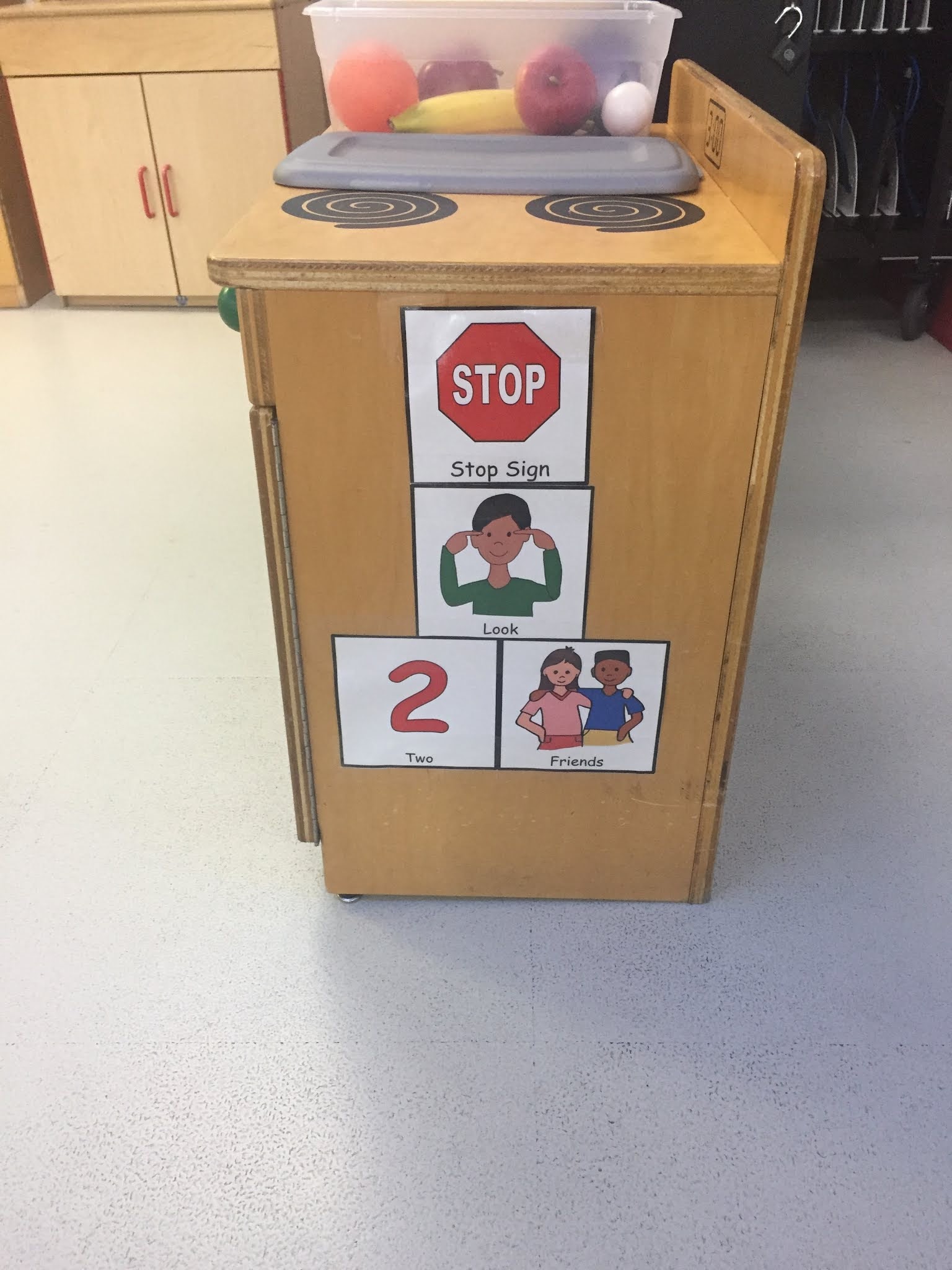


It took a LOT of support initially and I still don't love it.  But at this point, I have not figured out a different way to provide the students with the play opportunities and adhere to the district guidance plan.  So I can live with it.  The students are playing, they are talking and solving problems through the "trade" solution, the "timer" solution, and the "wait and take turns" solution.  Our "solution board" visuals can be found for free at the CSEFEL site under their practical strategies section.  I'll show photos of this in another post!  At this point in time, I feel like this option is at least allowing us to continue with developmentally appropriate play and natural opportunities to work on our social emotional goals.

Saturday, August 29, 2020

Covid19 Adjustments for Preschool Block Center

 As I was setting up my classroom this year, I felt as if I were a beginning teacher.  There were so many new issues to think about and plan for.  One of the things that was central to my planning was figuring out a safe way for my young pre-k students to continue to have opportunities to play!

In my district, any child over the age of two must wear a mask when on a school campus.  My students are all ages 3-5, so this includes my class.  We also are required to meet social distancing requirements to the greatest extent possible.  This was the biggest challenge in planning my center time this year.

I have referenced the TATS site, my district's guidance plan and of course my knowledge of the benefits of visual supports and the importance of developmentally appropriate practice.  My students start Monday, so this is not kid tested yet!  I may come back next week with a new plan.


In previous years, I had a colorful ABC carpet in this center and would typically have enough materials and space for 4 children to play productively.  This year I rolled up the carpet and am storing it because I felt like it would be too visually distracting.  We have reduced the amount of blocks and supplemental toys in the center and have reduced the center to two students.  I want the students to learn a new procedure of entering the center, so I wanted the visuals and the painters tape to be prominently seen. 

The materials in the center are two bins of lightweight foam blocks and some cars and trucks.  One child will be able to play on one side of the painter's tape while another child can play on the other side.  This is not supporting cooperative play, but at this moment, it was the best I could come up with and still meet the social distancing guidelines I must adhere to.

I chose the foam blocks over the unit blocks because I have a ton of them!  I also chose them because our toy storage rotation system is on top of cabinets and it will be much easier to lift the lightweight foam blocks than the heavy wooden unit blocks.  

My current plan is to only allow the two children who choose blocks to play with these toys.  When they are finished, they will go in a laundry bin to be sprayed with our disinfectant and then sit out of the rotation for 3 days.  If the student does not want to stay in blocks for the entire center time, he or she will be able to choose another available center, or chose a personal play bucket that we set up for each child.

I will post more pictures on the toy rotation system we are planning, other centers, and the individual play buckets later!


Wednesday, August 26, 2020

It's Been A Long Time......

The R Family - 2

It's been a long time since I've posted here.  There have been many changes over the years.  My Mom got sick and passed away, my husband's Mom needed helping moving to an assisted living facility, and of course we have all been living the reality of our current pandemic adjusted world for the last 5 months.

I'm hoping to come back to this blog and share ideas again.  I'm working on digital resources for my remote learners and setting up my special needs preschool classroom to support our current climate.  Photos and ideas to come!  In the meantime, check out the amazing resources at TATS.  They have been a "go to" site for me for the last several weeks.

https://tats.ucf.edu/links-to-topics-pages-of-resources-resources-information/


photo:https://ccsearch.creativecommons.org/photos/4cae8414-f754-4481-99e6-f2f304768b0a


Thursday, August 12, 2010

Moving Before and After

Last year my pre-k program was moved to another elementary school in my district. I had a choice to move with my program or teach a different grade level at the current school. I chose to move.

Since it was a district decision to move the program, they provided staff to physically move all of the boxes and furniture, but I was responsible for the packing and the unpacking.

When I walked into my classroom after the movers had all of the boxes placed, I knew I had my work cut out for me. This is one of the before shots:


Clearly, I had to figure out a plan of attack to get everything organized and ready for the first day of school. I started with my necessities: iPod, coffee and Gatorade and then got to work.


I organized my actions by prioritizing what HAD to be in place for the first day of school and what materials I would be using. I keep most of my units of study in large Rubbermaid tubs with labels. You don't see it in the picture, but in one corner of the classroom is a storage room.

I needed to to get some space in the room to move the furniture, so I started by taking all of the tubs for my units and organizing them in the storage room. Once that was done, I could push the tables to the middle of the room, put all of the other materials on and under the tables and start working on the physical layout of the perimeter of the room. Here's the start of that:

Thinking about the physical layout is HUGE! Your physical layout in the classroom can either help you diffuse problems or can actually make the problems worse. The following are some of the things I think about as I set up a new room:

What is age/grade appropriate?
What areas need to be included?
Where are materials stored for the teacher, assistant, students?
How are materials accessed? Does it support independence?
Is there a quiet space when needed?
Where are the electrical outlets and computer drops?
Traffic patterns to and from:
  • bathroom and fountain
  • backpacks and lunchboxes
  • time out, chill out chair, etc (if needed)
  • teaching tables and support materials
  • fire exit and alternate routes
  • line up
And most importantly,
  • Do I have visual supervision of all areas at all times?
At this point, I started moving centers around, figuring out how to address all of those questions regarding the physical layout and then unpacking materials that belong in each center.

It finally came together like this:


After living with it for a year, there are some changes that I'll make when I go back into school next week. But, I have found by thinking about the physical layout questions, I can address the most important issues first and do so efficiently....without having to do tasks twice because I "forgot" I needed to have a computer table near the computer drop or that I needed a wall for my housekeeping unit because it is too high to see over.

Moving and organizing a new room takes an enormous amount of energy and time. (That's why this post did not get posted last year when I actually moved! I was too busy attending to other things.) Make sure to ask your principal, department chair or mentor what is your responsibility and what the school/district provides. In the course of fifteen years of teaching I probably had to move classrooms 6 or 7 times before I found out that the district would provide boxes and I earned a comp day for moving. It took 3 days to organize my classroom last year. While the district didn't pay me for every bit of time I spent in there, it sure was nice to enjoy that day off that I did earn!

If you are moving or re-organizing your classroom this year good luck!

Thursday, August 28, 2008

Pre-Planning Prioritizing

For years and years, I always went into my classroom early because I couldn't get everything done during my pre-planning week. A few years ago, I finally figured it out.

I'm NEVER going to get everything done that I want to get done. There will ALWAYS be things that I could do or would like to do.

I finally learned that it was a matter of prioritizing.

There are some tasks/meetings that my district says I MUST attend.

There are some tasks that I MUST get finished within the pre-planning week or I am uncomfortable as a teacher.

There are some things that I WANT done before the first day of school but its not the end of the world if I don't get to it.

And of course, there are things that are on my never ending list of materials I would like to prepare but if I get it done this week, this semester or next summer, I will still have students who are safe and learning.

I have also found that some of the "must do's" are procedural tasks from the school or district. I have finally figured out that my assistant and I are a team. She is happy to take care of some of those tasks, if I let her! I learned to delegate and share tasks.

The following are my lists and their respective categories of importance to me:

MUST DO:

Not my choice:
1) Attend annual policy and procedure welcome back meeting for the school.
2) Attend the superintendent's video meeting and welcome back.
3) Create take home packets including: student code of conduct, emergency medical forms, room mother forms, etc. (I ask my assistant to do this.)
4) Call the families of all of the students in my class and invite them to "Meet Your Teacher."
5) Attend team meeting at my school.
6) Attend depratment meeting (pre-k teachers) at the district level.

My Choice:
1) Try to schedule any initial IEPs and staffings that have been added to my caseload over the summer. (I like to get these done during pre-planning because then I can start with students on day 1. It doesn't always work out, but I try my hardest to get it done.)
2) Get the physical layout of my room organized and ready for children.
3) Have a welcoming bulletin board outside my class (my assistant does this for me).
4) Set up my anecdotal record notebook (my assistant does this for me).
5) Set up a folder/list of IEP due dates for students for the year.
6) Lesson plans for the first week of school. (I plan and my assistant helps me gather materials or prep materials for lessons.)
7) Take my assistant out to lunch! (We frequently go with other teachers and staff, but during the school year, we rarely get the chance to have lunch together. It's nice to carve out some time during the pre-planning week to spend some time together.)

I have found, that if I complete all of the tasks that the district requires of me and I have all of the things done that make me comforatble as a teacher, then I usually have an afternoon or two to take care of some of the special tasks that I enjoy (creating new visual supports, surfing the internet for new lesson ideas, visiting other classrooms and "stealing" other teachers' ideas).

Prioritizing what the district requires and what I need helps me to stay focused on the most important tasks and complete them. As a bonus, it reduces the stress and anxiety of completing numerous tasks in a short period of time. When the stress is reduced, I'm much more productive.