It's the time of year when, in pre-k special needs classes, we begin to think about the process of transitioning children to kindergarten.
This year, there is a little girl in my class with an interesting combination of strengths and challenges.
She has a good cognitive skills and a good ability to learn vocabulary and concepts through incidental learning. She has a solid base of kindergarten pre-academic skills (she knows all of the letters of the alphabet upper and lowercase, she can count to 15, she can identify 11 colors and 6 common shapes. She knows many beginning consonant sounds, has an awareness of rhyming words, can read all of the names of the students in class and reads approximately 10 sight words.)
She gets overwhelmed with new experiences and has difficulty transitioning to new activities (especially if it is in a different location on campus). She still needs staff support for potty training. Her fine motor skills are significantly delayed and she still needs staff support for many tasks that include visual motor planning.
We have decided to try to specifically address an area of strength with an area that is a significant challenge for her while she is still in pre-k. She is going to start going to a shared reading and phonics lesson with a kindergarten class for approximately 20 minutes a day. Since she has good cognitive skills and she does not need any staff support in our pre-k large group circle time, we are going to try to balance this with the challenge of accepting a new experience. We are hoping that she will become familiar with the kindergarten building, the kindergarten classroom and the larger group of kindergarten students. We are also hoping that our pre-k staff can go with her for a short period of time and then fade away so that we increase her independence and comfort in the kindergarten classroom.
To help her prepare for this, we have drafted a simple social story (you can download a generic copy here.) about going to the kindergarten classroom. She has a copy at home that her family has read with her for the past week and there is a copy at school that classroom staff have been reading with her too. We have also started walking past the kindergarten room and having conversations about visiting kindergarten on Monday.
We're hoping by layering in the staff support and also building on her strengths, she will begin to feel comfortable and be able to learn new skills in the kindergarten class.
Tuesday, February 1, 2011


Sunday, December 5, 2010
Homecoming Queen: Teenager with Down Syndrome
This story recently came to me from two sources: A CEC SmartBrief and the parent of a child I tutor.
I think it's worth sharing again!
Homecoming Queen: Teenager with Down Syndrome
I think it's worth sharing again!
Homecoming Queen: Teenager with Down Syndrome
Free Interactive Holiday Sites
I found this site a few years ago. It was challenging to navigate and then go back and find the activities you wanted repeatedly. They have re-organized and uploaded many free interactive boards and activities. They have many that are appropriate for December holidays. They've done a great job! It's so much easier to navigate and find activities appropriate to skill or grade level.
TES iboard player
Here's a link to a post from a few years ago too. My students still enjoy these links!
Interactive Holiday Sites
TES iboard player
Here's a link to a post from a few years ago too. My students still enjoy these links!
Interactive Holiday Sites
Friday, November 5, 2010
Thursday, October 28, 2010
Embedding Literacy
I'm wrapping up facilitating a very fast paced and intense course on language and literacy. Because of this, I have been engaged in a lot of thinking and reflecting about embedding language and literacy into daily lesson plans and routines.
I'd like to take a moment to share an idea that illustrates how a parent has embedded language and literacy into her child's day.
I drive through 3 school zones and countless bus stops on my way to work each morning. I often see parents waiting with their children at the bus stops.
One mom and her son (who appears to be 5 or 6 years old) used to wait for the bus each day in the manner that you would typically see....the boy had his backpack on, mom was next to him and they stood on the corner waiting for the bus.
For the past few weeks, as I have driven by, I have noticed that she now brings a camp chair (one of those canvas chairs that folds up and has a sleeve that it fits in...you can buy them at Wal Mart for about $10) and a book to the bus stop.
Now, each morning her son sits on her lap as she is reading a story to him.
Wow! So maybe they wait 5-10 minutes for the bus each day. That means her son is getting and extra 25-50 minutes of literacy and language experiences a week. If you multiply that times 36 weeks in a school year that is between 900-1800 minutes a year (or an extra 15-30 hours).
I think this is just so cool! She has figured out how to take a "waiting" period and has turned it into a language and literacy experience.
Sometimes we go nuts trying to figure out when to fit everything "in." This mom has found a way to give her child more literacy and language experiences within a routine that already exists.
How many other ways could we, as teachers or parents also do this? I bet the ways are quite creative and the number is countless!
Monday, October 11, 2010
Free Early Literacy Activities
This site has recently been shared with me from our pre-k supervisor.
It has many, free printable activities that support literacy of infants, toddlers and pre-schoolers. They have a link for ideas for parents and another link for teachers. Check it out.
Center for Early Literacy Learning
It has many, free printable activities that support literacy of infants, toddlers and pre-schoolers. They have a link for ideas for parents and another link for teachers. Check it out.
Center for Early Literacy Learning
Friday, October 8, 2010
Tuesday, October 5, 2010
Cheap! Dinosaur Measuring and Science
In the current economy (and as far as being frugal and financially wise at any time!) I am always interested in lessons that can be enhanced as cheaply as possible.
My class has been involved in a inquiry based unit on dinosaurs for the past week. It seems to me that there are always easy ways to integrate language and literacy lessons in every unit, but sometimes it is more difficult to integrate math and science. Since this unit focuses on dinosaurs, science is not a problem either, but how can we integrate math concepts? Here's one idea we used.
I found these dinosaur figures at my local Dollar Tree. (Yes, it cost a whopping $1 for this lesson.)

I explained to my students that these dinosaurs were supposed to get bigger when we put them in water. We decided to measure them with a ruler, predict how big we thought it would get and then measure it after it grew.

Since I wanted to focus on some math skills, we made a big deal out of measuring the dinosaur. I left my finger on the number 4 after we measured and reminded the children that he should get "bigger." I asked them "How big do you think he will get?" as I ran my other pointer finger across the top of the ruler (showing them the most logical choices across the ruler.) They made their predictions as I recorded them and then we observed. The pictures show you where we are so far!

After we measure our dinosaur again tomorrow, we'll take him out of the water and predict what will happen. It will be interesting to see if any of the children will predict that he shrinks back to 4 inches (remember, that's where we started at our first measurement!)
My class has been involved in a inquiry based unit on dinosaurs for the past week. It seems to me that there are always easy ways to integrate language and literacy lessons in every unit, but sometimes it is more difficult to integrate math and science. Since this unit focuses on dinosaurs, science is not a problem either, but how can we integrate math concepts? Here's one idea we used.
I found these dinosaur figures at my local Dollar Tree. (Yes, it cost a whopping $1 for this lesson.)

I explained to my students that these dinosaurs were supposed to get bigger when we put them in water. We decided to measure them with a ruler, predict how big we thought it would get and then measure it after it grew.

Since I wanted to focus on some math skills, we made a big deal out of measuring the dinosaur. I left my finger on the number 4 after we measured and reminded the children that he should get "bigger." I asked them "How big do you think he will get?" as I ran my other pointer finger across the top of the ruler (showing them the most logical choices across the ruler.) They made their predictions as I recorded them and then we observed. The pictures show you where we are so far!

After we measure our dinosaur again tomorrow, we'll take him out of the water and predict what will happen. It will be interesting to see if any of the children will predict that he shrinks back to 4 inches (remember, that's where we started at our first measurement!)
Sunday, September 26, 2010
Missing Pumpkin
One of my favorite lessons was designed to help a kindergarten-second grade class generate questions and improve their writing skills. We called it our "Missing Pumpkin Mystery."
For a week or so in October we had a pumpkin on display in our classroom. We were gearing up for the day we would scoop the insides out, count the seeds and carve it.
This particular group of students really needed to work on generating questions and using descriptive words within their writing. So some of the school staff helped me stage the "Missing Pumpkin Mystery."
One day after their specials period (art, music, phys ed, etc) the pumpkin was missing from the classroom. Once they noticed it, we decided on a plan of action to get our pumpkin back.
The first thing we did was to make "Wanted" posters for our pumpkin. The students took a brown paper grocery bag and drew a picture of our pumpkin on it. They then had to write three statements describing our pumpkin so "others would know if they saw OUR pumpkin."
We then decided to report our missing pumpkin to our principal to see if he could help us. (I had given him, the media specialist, our cafeteria assistant and our day time custodian their scripts so they would lead us to the next person to help us find the pumpkin.)
The children had to explain what happened, ask their questions and then describe out pumpkin to each person. The principal suggested we ask the media specialist "because he saw a lot of pumpkins in the media center." She suggested we ask the cafeteria assistant because "maybe they needed it to make pumpkin pie." The cafeteria assistant suggested we ask the custodian "because he sees the whole school make cleans up all the messes." As it turns out, the custodian "put it in our refrigerator because he was afraid it would get rotten."
We had great fun with this activity and it provided the kids with a real reason to use the skills I wanted them to practice.
For a week or so in October we had a pumpkin on display in our classroom. We were gearing up for the day we would scoop the insides out, count the seeds and carve it.
This particular group of students really needed to work on generating questions and using descriptive words within their writing. So some of the school staff helped me stage the "Missing Pumpkin Mystery."
One day after their specials period (art, music, phys ed, etc) the pumpkin was missing from the classroom. Once they noticed it, we decided on a plan of action to get our pumpkin back.
The first thing we did was to make "Wanted" posters for our pumpkin. The students took a brown paper grocery bag and drew a picture of our pumpkin on it. They then had to write three statements describing our pumpkin so "others would know if they saw OUR pumpkin."
We then decided to report our missing pumpkin to our principal to see if he could help us. (I had given him, the media specialist, our cafeteria assistant and our day time custodian their scripts so they would lead us to the next person to help us find the pumpkin.)
The children had to explain what happened, ask their questions and then describe out pumpkin to each person. The principal suggested we ask the media specialist "because he saw a lot of pumpkins in the media center." She suggested we ask the cafeteria assistant because "maybe they needed it to make pumpkin pie." The cafeteria assistant suggested we ask the custodian "because he sees the whole school make cleans up all the messes." As it turns out, the custodian "put it in our refrigerator because he was afraid it would get rotten."
We had great fun with this activity and it provided the kids with a real reason to use the skills I wanted them to practice.
Thursday, September 23, 2010
"Post It" Graphs
Here's a simple strategy that we use a lot in my classroom. I write each child's name on a post it. Then I write a question on a piece chart paper and usually add visual supports for each column of the graph. Below is a picture of our most recent graph:

I like to use the post it graphs for lots of reasons:
1) They help children learn literacy skills by reading their name and their peers' names.
2) They help children develop language skills by answering questions and making choices.
3) They help children develop task related skills and focusing skills because they are actively involved and then they physically get to place their own name on the chart.
4) They help children develop social skills by learning how to take turns and wait for their own turn.
5) They help children develop math skills as we count the number of votes in each column and discuss concepts of more, less and the same (equal).
6) They help children develop literacy skills by becoming part of our environmental print in the classroom.
7) They are quick and easy to prep for! That means I don't spend more time preparing the materials than it takes the children to actually engage in the activity.

I like to use the post it graphs for lots of reasons:
1) They help children learn literacy skills by reading their name and their peers' names.
2) They help children develop language skills by answering questions and making choices.
3) They help children develop task related skills and focusing skills because they are actively involved and then they physically get to place their own name on the chart.
4) They help children develop social skills by learning how to take turns and wait for their own turn.
5) They help children develop math skills as we count the number of votes in each column and discuss concepts of more, less and the same (equal).
6) They help children develop literacy skills by becoming part of our environmental print in the classroom.
7) They are quick and easy to prep for! That means I don't spend more time preparing the materials than it takes the children to actually engage in the activity.
Wednesday, September 1, 2010
PBS: "All" means all
When I was in college and learning about the social foundations of education, I remember being surprised to learn that the word "all" meant different things to different historical / theoretical contributors. Sometimes "all" included landowning men, sometimes it included women, sometimes it included children and sometimes it include people with disabilities, but very rarely did it mean "all."
A few weeks ago I attended a train-the-trainer workshop to teach PBS strategies to families. As I reflect more on the tenets of PBS and begin to schedule our family workshops, I came back to a slide that a friend and I created when we were training new teachers how to set up their V.E. classrooms. We came to the conclusion that when implementing positive behavior support systems and philosophies, "all" should really mean "all."
the kids who raise their hand and the kids who yell out
the kids who bathe every night and the kids who need to
the kids who write with their pencil and the kids who throw their pencil
the kids who say “I love you!” and the kids who say “ $#@% you!”
the kids who use a tissue and the kids who wipe their snot on you
the kids you’d take home in a heartbeat and the kids you hope are absent
the kids with parents that support you and the kids with parents that challenge you
the kids who respond to your interventions and the kids that exhaust your bag of tricks
the kids who consistently get their meds and the kids who don’t
Our main purpose of posing the above statements was to encourage teachers to reflect upon the following question:
Am I providing a safe learning environment for all learners?
A few weeks ago I attended a train-the-trainer workshop to teach PBS strategies to families. As I reflect more on the tenets of PBS and begin to schedule our family workshops, I came back to a slide that a friend and I created when we were training new teachers how to set up their V.E. classrooms. We came to the conclusion that when implementing positive behavior support systems and philosophies, "all" should really mean "all."
the kids who raise their hand and the kids who yell out
the kids who bathe every night and the kids who need to
the kids who write with their pencil and the kids who throw their pencil
the kids who say “I love you!” and the kids who say “ $#@% you!”
the kids who use a tissue and the kids who wipe their snot on you
the kids you’d take home in a heartbeat and the kids you hope are absent
the kids with parents that support you and the kids with parents that challenge you
the kids who respond to your interventions and the kids that exhaust your bag of tricks
the kids who consistently get their meds and the kids who don’t
Our main purpose of posing the above statements was to encourage teachers to reflect upon the following question:
Am I providing a safe learning environment for all learners?
Monday, August 23, 2010
Memorable Moment # 9: I Need the Keys

Today was the first day of school for students. Since I learned my Harry Wong lessons on the importance of procedures long, long ago, the first few weeks of my pre-k classroom are spent on learning the centers, how to play in the centers and how to clean up the centers. That means I don't open every center every day at the beginning of the year.
Today one of the new students in the class asked if he could play in our puzzle center today. My assistant told him that "puzzles are closed." He stood for a second or two and then replied to her, "Ok, I need the keys."
I thought that was a pretty clever response. :-)
image from stopnlook@ flickr.com
Monday, August 16, 2010
Positive Behavior Support: Solution Board
Throughout my district (as with many others) there is a large push for the implementation of school-wide positive behavior support (PBS). I am also fortunate enough to work in a community that has received a large grant to support strategies that increase mental health for children in early childhood settings. One of the initiatives funded through this grant is PBS training and materials.
Our early childhood PBS training is based on the pyramid model and training modules from CSEFEL.
One of my favorite strategies that I learned from my PBS training is the "Solution Kit." The solution kit is a strategy that teaches young children the options they may try when a conflict or disagreement arises. It helps them to learn how to independently (or with less prompting) solve problems.
You can watch a video of a teacher modeling the "solution kit" here.
Two years ago, I started using the solution kit with my pre-schoolers. I had a small plastic suitcase very similar to the one in the video and housed the kit at child level near my circle time area. While I loved the concept of the solution kit, I found the implementation to be difficult for my students. The suitcase with the clips was difficult for some of them to manage with fine motor deficits and the solutions all in a pile became quickly disorganized and overwhelming for them. I didn't want to give up on the positive aspects of using the solution kit, so I had to figure out a way to make it work for my population. Our solution kit evolved into a "solution board."
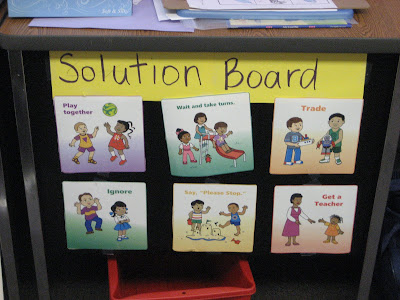
I simply printed and laminated the visuals from the solution kit and then taped them to the side of my desk. They became a permanent fixture in the classroom. The board allowed me to organize the solutions in a manner that was easier for my students to track visually and also eliminated the need for them to be able to open the kit. Towards the end of the year, for many of my students getting ready to transition to kindergarten, I could be across the room and just verbally prompt them to try using the solution board. I even had two parents who saw us using the solution board in the class and asked for the visuals to use at home!
I think the power of the solution board or solution kit (however the concept evolves for you) is that it teaches the children skills for managing their own conflicts. It gives children a measure of control over the resolution to the conflict and does not require an adult to intervene and "fix" the problem. And, ultimately, that's what we want.....for children to independently be able to come to a peaceful solution to a conflict.
Our early childhood PBS training is based on the pyramid model and training modules from CSEFEL.
One of my favorite strategies that I learned from my PBS training is the "Solution Kit." The solution kit is a strategy that teaches young children the options they may try when a conflict or disagreement arises. It helps them to learn how to independently (or with less prompting) solve problems.
You can watch a video of a teacher modeling the "solution kit" here.
Two years ago, I started using the solution kit with my pre-schoolers. I had a small plastic suitcase very similar to the one in the video and housed the kit at child level near my circle time area. While I loved the concept of the solution kit, I found the implementation to be difficult for my students. The suitcase with the clips was difficult for some of them to manage with fine motor deficits and the solutions all in a pile became quickly disorganized and overwhelming for them. I didn't want to give up on the positive aspects of using the solution kit, so I had to figure out a way to make it work for my population. Our solution kit evolved into a "solution board."

I simply printed and laminated the visuals from the solution kit and then taped them to the side of my desk. They became a permanent fixture in the classroom. The board allowed me to organize the solutions in a manner that was easier for my students to track visually and also eliminated the need for them to be able to open the kit. Towards the end of the year, for many of my students getting ready to transition to kindergarten, I could be across the room and just verbally prompt them to try using the solution board. I even had two parents who saw us using the solution board in the class and asked for the visuals to use at home!
I think the power of the solution board or solution kit (however the concept evolves for you) is that it teaches the children skills for managing their own conflicts. It gives children a measure of control over the resolution to the conflict and does not require an adult to intervene and "fix" the problem. And, ultimately, that's what we want.....for children to independently be able to come to a peaceful solution to a conflict.
Thursday, August 12, 2010
Moving Before and After
Last year my pre-k program was moved to another elementary school in my district. I had a choice to move with my program or teach a different grade level at the current school. I chose to move.
Since it was a district decision to move the program, they provided staff to physically move all of the boxes and furniture, but I was responsible for the packing and the unpacking.
When I walked into my classroom after the movers had all of the boxes placed, I knew I had my work cut out for me. This is one of the before shots:

Clearly, I had to figure out a plan of attack to get everything organized and ready for the first day of school. I started with my necessities: iPod, coffee and Gatorade and then got to work.

I organized my actions by prioritizing what HAD to be in place for the first day of school and what materials I would be using. I keep most of my units of study in large Rubbermaid tubs with labels. You don't see it in the picture, but in one corner of the classroom is a storage room.
I needed to to get some space in the room to move the furniture, so I started by taking all of the tubs for my units and organizing them in the storage room. Once that was done, I could push the tables to the middle of the room, put all of the other materials on and under the tables and start working on the physical layout of the perimeter of the room. Here's the start of that:
 Thinking about the physical layout is HUGE! Your physical layout in the classroom can either help you diffuse problems or can actually make the problems worse. The following are some of the things I think about as I set up a new room:
What is age/grade appropriate?
What areas need to be included?
Where are materials stored for the teacher, assistant, students?
How are materials accessed? Does it support independence?
Is there a quiet space when needed?
Where are the electrical outlets and computer drops?
Traffic patterns to and from:
It finally came together like this:

After living with it for a year, there are some changes that I'll make when I go back into school next week. But, I have found by thinking about the physical layout questions, I can address the most important issues first and do so efficiently....without having to do tasks twice because I "forgot" I needed to have a computer table near the computer drop or that I needed a wall for my housekeeping unit because it is too high to see over.
Moving and organizing a new room takes an enormous amount of energy and time. (That's why this post did not get posted last year when I actually moved! I was too busy attending to other things.) Make sure to ask your principal, department chair or mentor what is your responsibility and what the school/district provides. In the course of fifteen years of teaching I probably had to move classrooms 6 or 7 times before I found out that the district would provide boxes and I earned a comp day for moving. It took 3 days to organize my classroom last year. While the district didn't pay me for every bit of time I spent in there, it sure was nice to enjoy that day off that I did earn!
If you are moving or re-organizing your classroom this year good luck!
Since it was a district decision to move the program, they provided staff to physically move all of the boxes and furniture, but I was responsible for the packing and the unpacking.
When I walked into my classroom after the movers had all of the boxes placed, I knew I had my work cut out for me. This is one of the before shots:

Clearly, I had to figure out a plan of attack to get everything organized and ready for the first day of school. I started with my necessities: iPod, coffee and Gatorade and then got to work.

I organized my actions by prioritizing what HAD to be in place for the first day of school and what materials I would be using. I keep most of my units of study in large Rubbermaid tubs with labels. You don't see it in the picture, but in one corner of the classroom is a storage room.
I needed to to get some space in the room to move the furniture, so I started by taking all of the tubs for my units and organizing them in the storage room. Once that was done, I could push the tables to the middle of the room, put all of the other materials on and under the tables and start working on the physical layout of the perimeter of the room. Here's the start of that:
 Thinking about the physical layout is HUGE! Your physical layout in the classroom can either help you diffuse problems or can actually make the problems worse. The following are some of the things I think about as I set up a new room:
What is age/grade appropriate?
What areas need to be included?
Where are materials stored for the teacher, assistant, students?
How are materials accessed? Does it support independence?
Is there a quiet space when needed?
Where are the electrical outlets and computer drops?
Traffic patterns to and from:
- bathroom and fountain
- backpacks and lunchboxes
- time out, chill out chair, etc (if needed)
- teaching tables and support materials
- fire exit and alternate routes
- line up
- Do I have visual supervision of all areas at all times?
It finally came together like this:

After living with it for a year, there are some changes that I'll make when I go back into school next week. But, I have found by thinking about the physical layout questions, I can address the most important issues first and do so efficiently....without having to do tasks twice because I "forgot" I needed to have a computer table near the computer drop or that I needed a wall for my housekeeping unit because it is too high to see over.
Moving and organizing a new room takes an enormous amount of energy and time. (That's why this post did not get posted last year when I actually moved! I was too busy attending to other things.) Make sure to ask your principal, department chair or mentor what is your responsibility and what the school/district provides. In the course of fifteen years of teaching I probably had to move classrooms 6 or 7 times before I found out that the district would provide boxes and I earned a comp day for moving. It took 3 days to organize my classroom last year. While the district didn't pay me for every bit of time I spent in there, it sure was nice to enjoy that day off that I did earn!
If you are moving or re-organizing your classroom this year good luck!
Counting Backwards and Subtraction
I'm working with a little girl who is learning how to subtract.

The touch math strategies were very successful in helping her learn to add, so we are continuing with those materials and cues. However, when she was learning to add, she
had already mastered the skill of counting up. She has not yet learned how to consistently and accurately count backwards from 20. So while she is learning the concept of subtraction with differences from 5 and manipulatives, we are also working on counting backwards from 20.

I created a simple power point that she likes to "play" when we practice. I have her manually click to forward the slides. You can download the manual click power point here. I also added an automatic slide transition for those of you who may want to use this in the classroom. You can download the automatic transition power point here.
In addition to using the power points during our tutoring session, her mom is also helping her count backwards during the many opportunities to wait during the day. They count backwards in the grocery store line, while waiting for her brothers at baseball practice, while the microwave is heating something, while a DVD is loading, etc. She has found lots of times during the day to practice with her!

The touch math strategies were very successful in helping her learn to add, so we are continuing with those materials and cues. However, when she was learning to add, she
had already mastered the skill of counting up. She has not yet learned how to consistently and accurately count backwards from 20. So while she is learning the concept of subtraction with differences from 5 and manipulatives, we are also working on counting backwards from 20.

I created a simple power point that she likes to "play" when we practice. I have her manually click to forward the slides. You can download the manual click power point here. I also added an automatic slide transition for those of you who may want to use this in the classroom. You can download the automatic transition power point here.
In addition to using the power points during our tutoring session,
 her mom is also helping her count backwards during the many opportunities to wait during the day. They count backwards in the grocery store line, while waiting for her brothers at baseball practice, while the microwave is heating something, while a DVD is loading, etc. She has found lots of times during the day to practice with her!
Subscribe to:
Posts (Atom)