The University of Minnesota has a website that has great Tip Sheets for addressing challenging behavior in the classroom.
I particularly like the ones on "choice making" and "requesting a break." These are two very powerful strategies that can be embedded into almost any learning task.
Sunday, July 12, 2009


Tuesday, June 30, 2009
Word Bank and Writing Strategy
This summer I have been working with a group of kindergarten through third grade students who have autism. Several of the students have writing goals that need to be addressed and all of them have expressive language goals that need to be addressed. If you have read any of my previous posts, you know that I am a big fan of digital photos to build play skills, critical thinking skills and oral language skills.
Since I find the digital photos so beneficial, I decided to pair that strategy with a manipulative word bank in the hopes of having my students build sentences that they would copy to create a simple paragraph. My goal was that they would build one topic sentence and two detail sentences. We started with modeling and a lot of physical prompts, but I'm hoping the level of prompting will decrease.
Here's what we did:
1) I printed several photos featuring sea life from www.flickr.com.
2) Each student chose a picture that we glued to a large sheet of construction paper.
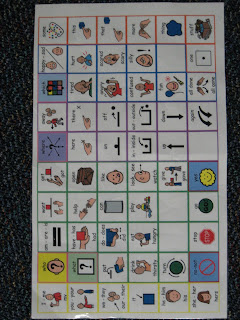
3) The students were given a file folder with a word bank targeting words that made sense with their picture. (I met with their SLP and we color coded the post its to correspond with the colors and word categories that they already use on their manual communication boards based on Gail Van Tatenhove's system.)
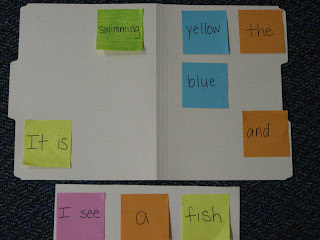
4) Then the students built a sentence by moving the post its to a sentence strip (the sentence strip is just length of file folder cut down).
5) Next the students copied their sentence on a pre-cut piece of paper. (I did this to to visually define the space of the sentence for them. This way the letter spacing and formation is confined to an area that already "looks" like a sentence. )
6) Then they glued the sentence to the piece of construction paper to which we had previously glued their photo choice.
7) We cleared off the sentence strip and started to build another sentence and repeated the steps.
Here's what our first writing samples look like:


Since I find the digital photos so beneficial, I decided to pair that strategy with a manipulative word bank in the hopes of having my students build sentences that they would copy to create a simple paragraph. My goal was that they would build one topic sentence and two detail sentences. We started with modeling and a lot of physical prompts, but I'm hoping the level of prompting will decrease.

Here's what we did:
1) I printed several photos featuring sea life from www.flickr.com.
2) Each student chose a picture that we glued to a large sheet of construction paper.
3) The students were given a file folder with a word bank targeting words that made sense with their picture. (I met with their SLP and we color coded the post its to correspond with the colors and word categories that they already use on their manual communication boards based on Gail Van Tatenhove's system.)

4) Then the students built a sentence by moving the post its to a sentence strip (the sentence strip is just length of file folder cut down).
5) Next the students copied their sentence on a pre-cut piece of paper. (I did this to to visually define the space of the sentence for them. This way the letter spacing and formation is confined to an area that already "looks" like a sentence. )
6) Then they glued the sentence to the piece of construction paper to which we had previously glued their photo choice.
7) We cleared off the sentence strip and started to build another sentence and repeated the steps.
Here's what our first writing samples look like:


Tuesday, June 23, 2009
Water and Sea Life Printable Books
I've been going through my links, looking for materials for our water and sea life theme for summer school. I've found the following free books that can be printed.
Sink or Float Printable Emergent Reader
Pirate Number Word Printable Emergent Reader
I Love to Go to the Beach Printable Emergent Reader
At the Beach with the Bears Printable Emergent Reader
Red Crab, Red Crab What Do You See Printable Emergent Reader
Under the Sea free Interactive Book
Sink or Float Printable Emergent Reader
Pirate Number Word Printable Emergent Reader
I Love to Go to the Beach Printable Emergent Reader
At the Beach with the Bears Printable Emergent Reader
Red Crab, Red Crab What Do You See Printable Emergent Reader
Under the Sea free Interactive Book
Friday, June 19, 2009
Scatman Video about Stuttering
Another video that my husband found and forwarded to me.......
Here are some other links and information about John Scatman.
Wikipedia Information
Lyrics posted on the Stuttering Forum
Interview script
Here are some other links and information about John Scatman.
Wikipedia Information
Lyrics posted on the Stuttering Forum
Interview script
Tuesday, June 9, 2009
Water and Sea Life...Bloom's Box

A few years ago I was in a class that focused on differentiation and levels of knowledge. One fo the strategies the instructor shared was to create a "Bloom's Box" for assignments related to an organizing theme.
A Bloom's Box helps the teacher ensure that s/he is providing instruction at both the lower levels of understanding and at the higher levels of thinking. Essentially, a table is created labeled with each level of Bloom's taxonomy and assignments are sorted into appropriate categories. It helps the teacher make sure there is a balanced experience for all learners.
I'm going to use my Bloom's Box this summer for our Water and Sea Life Unit I have planned.
You can download my Bloom's Box here.
The following is just a list of the activities included in my Bloom's Box.
Knowledge
Students will name pictures of different bodies of water. (river, lake, pond, ocean, waterfall).
Students will name pictures of actions people can do with water (wash your hands, brush your teeth, take a bath, swim, play at the water table, drink, water plants, wash cars, ski, snorkel, boating).
Students will name pictures of sea life (sea star, shark, fish, stingray, jellyfish, manatee, urchin, sea anenome, dolphin, crab, lobster).
Comprehension
Alive/Not Alive Chart
Students will sort pictures of various familiar objects, people, animals and plants on a t-chart according whether the picture is something that is alive or not alive.
Comprehension questions
Students will answer “wh” about familiar stories and classroom activities.
Wants/Needs Action Chart:
Students will sort pictures of previously learned action words into categories of actions we need and actions we want to do.
Application
Class Aquarium
After reading the no-fiction trade book, “What’s It Like to be a Fish?” using Boardmaker icons and pictures, students will create a list of items needed to create a classroom aquarium.
Class Hermit Crab Habitat
After reading the book “A House for Hermit Crab,” using Boardmaker icons and pictures, students will create a list of items needed to create a hermit crab habitat.
Analysis
Compare and Contrast
Students will compare and contrast the homes of a sea creature of their choice with their home using Boardmaker icons, pictures and a pre-made Venn Diagram.
Compare and Contrast
Students will compare and contrast what we used to make our fish aquarium and what we used to make our hermit crab habitat using Boardmaker icons, pictures and a pre-made Venn Diagram.
Synthesis
Students will use supplies generated from their lists to assemble our class aquarium.
Class Hermit Crab Habitat
Students will use supplies generated from their lists to assemble our class hermit crab habitat
Evaluation
If I could be…
Students will draw a picture of any sea creature they would want to be. They will dictate which animal they chose and why they chose it.
Water Hole
Before reading the ending to the story, students will predict what will happen to the animals and the plants if it never rains again.
Personal Needs:
Students will draw a picture of any sea creature they would want to be. They will dictate which animal they chose and why they chose it.
Water Hole
Before reading the ending to the story, students will predict what will happen to the animals and the plants if it never rains again.
Personal Needs:
Students will predict and dictate responses of what would happen if we didn’t have water to wash our hands or brush our teeth.
Saturday, June 6, 2009
Interactive Games Sea Life and Water
Olivia of the Deep (skill: visual motor, visual perceptual)
Diego's Underwater Adventure (skill, sea life vocabulary, visual motor, multiple steps)
Diego's Tuga the Sea Turtle (skill: visual motor, classifying food/not food)
Dora's Mermaid Adventure (skill: visual motor)
Dora's Treasure Hunt (skill: visual motor)
Blue's Clues Sink or Float (skill: concept of sink or float)
Wubbzy's Underwater Adventure (skill: visual motor, harder keyboard controls)
Wonder Pets Save the Penguin or Dolphin (skill visual motor)
Wonder Pets Save the Sea Creatures (skill: visual motor)
Backyardigan's Pirate Adventure (skill: visual motor, visual perception)
Doodle Pad Explore the Seashore (skill: creativity)
Ebb and Flo Hide and Seek (skill: mouse clicks and exploration)
Ebb and Flo Spot the Differences (skill: visual perception)
Build A Fish (skill: fish habitats, creativity)
Fish Counting up to 10 (skill: number concepts)
Clifford Slide (skill: Matching colors)
Seashore Concentration (skill: visual memory)
Build A Habitat (skill: creativity and fine motor)
Barney Submarine Race (skill: visual motor)
Donald Duck Fishing (skill: color recognition and visual motor)
Little Einstein's Orchastra Ocean (skill: instrument sound recognition and matching)
CyberChase Can You Fill It (skill: exploring liquid volume)
Curious George Day at the Beach (skill: multiple steps, visual perception)
Bunnytown Pirates (skill: number order, positional concepts, visual motor)
Diego's Underwater Adventure (skill, sea life vocabulary, visual motor, multiple steps)
Diego's Tuga the Sea Turtle (skill: visual motor, classifying food/not food)
Dora's Mermaid Adventure (skill: visual motor)
Dora's Treasure Hunt (skill: visual motor)
Blue's Clues Sink or Float (skill: concept of sink or float)
Wubbzy's Underwater Adventure (skill: visual motor, harder keyboard controls)
Wonder Pets Save the Penguin or Dolphin (skill visual motor)
Wonder Pets Save the Sea Creatures (skill: visual motor)
Backyardigan's Pirate Adventure (skill: visual motor, visual perception)
Doodle Pad Explore the Seashore (skill: creativity)
Ebb and Flo Hide and Seek (skill: mouse clicks and exploration)
Ebb and Flo Spot the Differences (skill: visual perception)
Build A Fish (skill: fish habitats, creativity)
Fish Counting up to 10 (skill: number concepts)
Clifford Slide (skill: Matching colors)
Seashore Concentration (skill: visual memory)
Build A Habitat (skill: creativity and fine motor)
Barney Submarine Race (skill: visual motor)
Donald Duck Fishing (skill: color recognition and visual motor)
Little Einstein's Orchastra Ocean (skill: instrument sound recognition and matching)
CyberChase Can You Fill It (skill: exploring liquid volume)
Curious George Day at the Beach (skill: multiple steps, visual perception)
Bunnytown Pirates (skill: number order, positional concepts, visual motor)
Monday, May 25, 2009
Reading Activities for the Summer

As summer is approaching, many parents ask what they can do to help their child with their literacy skills over the summer.
This is one of my favorite activity packets from the website. It includes many easy and printable activities to work on letter recognition.
Brain Scientist and Stroke Victim

My husband sent me a link to this video. It's 18 minutes long, but well worth the time. Jill Bolte Taylor speaks about the morning of her stroke, her insight into her brain's function and her reflection on her experience.
Tuesday, May 19, 2009
Summer Reading Ideas
Our data and literacy coach just shared this site with us.
After looking at it, it really has a lot of great literacy suggestions for summer reading.
Check out the book suggestions organized according to age groups at James Patterson's
ReadKiddoRead.
After looking at it, it really has a lot of great literacy suggestions for summer reading.
Check out the book suggestions organized according to age groups at James Patterson's
ReadKiddoRead.
Pre-k Paperwork, Planning and Packing

Talk about four "p's" in a pod!
Could the end of the school year get any busier? Probably not!
Paperwork! How can you end the school year without a plethora of paperwork? Progress reports, articulation reports, kindergarten transition meetings, eligibility meetings, dismissal meetings, review of RtI data...are we done yet? I guess it just goes with the territory and the time of year. However, this year, in particular, has made me very thankful that I am a teacher and not a procedural compliance specialist!
Planning! I also just got notice that I received a very coveted summer school position. In the economic crisis, my district had many, many teachers apply for summer school jobs with less positions available this year. I'm so lucly I got a position, but of course, I have to work for my pennies. I will have a whole new group of kids to learn and plan lessons for.
Packing! I hate packing. I hate packing a suitcase to go on a weekend trip. (Obviously this is the one of the four p's that I'll let myself complain about.) My pre-k program is being moved to another school. As a result, I have to organize and pack the room. Did I tell you I hate packing?
The four P's here started my assistant and me singing today (because that's what we do in pre-k)
There are 7 days
There are 7 days
There are 7 days left this year
We can make it
Only 7 days
Only 7 days left this year
mind games...7 days times 7.5 hours equals 52.5 (that's really only two days and a few hours)
(Tomorrow is field day and 6 days left!)
Wednesday, April 15, 2009
I'm Thinking of a Word....

My pre-k students love this "game."
I start off by saying, "I'm thinking of a word. See if you can use the clues to figure out what I'm thinking about" and then I proceed to give 3 or 4 clues about my word.
For example, one night I pulled into my driveway and there were two very large rabbits in my front yard. I took a picture of them and used it during circle time the following morning. I told my class, "I'm thinking of a word. My word is an animal with very long ears. It has a puffy tail. It likes to eat grass and carrots. My word begins with the /r/ sound."
The beauty of this simple strategy is that it can be used any time of the day and requires very little prep work. We have used toys in the classroom, pictures from our Jack Hartman Learning Letter Sounds song and book, or as an introduction to a new topic.
I'm thinking of a word requires children to think critically about the information they are receiving auditorily. This helps to sharpen their listen skills and their higher order thinking skills. Since it is presented in a game format, the kids enjoy the thinking process!
Monday, March 30, 2009
Earth Day Games
The following is a list of free interactive games that focus on Earth Day concepts of taking care of the environment, cleaning up litter or recycling.
Clean Up Your World
Every Day is Earth Day
Clean Up the Park
Free the Beach
Dora's Mermaid Adventure
Clean Up Your World
Every Day is Earth Day
Clean Up the Park
Free the Beach
Dora's Mermaid Adventure
Saturday, March 21, 2009
Spring Babies PowerPoint

My classroom has the luxury of being equipped with an ActiveBoard. I am planning on using this powerpoint to teach new vocabulary about spring babies. If you don't have a projection screen, Smart Board or ActiveBoard; you can just print, laminate and bind the book for use at circle time or in your library center.
You can download the book here.
Friday, March 20, 2009
Free Printable Emergent Readers
On one of my yahoo groups there has recently been a thread talking about sight word readers.
There are many free resources available on the web.
Here are a few:
Carl's Corner
(Kindergarten emergent readers)
Samples from Reading A-Z
(a few free samples, for $50ish access to all of their books)
Hubbards Cupboard
(40 or so free printable books)
Make Learning Fun
(not all sight word based, but a lot of emergent themed printables)
Mrs. Meacham's
(awesome page with printables and more links)
Kinderprintables
Marcia's Lesson Links
Mrs. Jones Room
(lots of links to many other resources)
http://www.childcareland.com/free.html
(scroll through and look for "book" in the item descriptions)
http://mrskilburnkiddos.wordpress.com/reading/sight-words/
(scroll down, there are links to books she created in the middle of the post)
There are many free resources available on the web.
Here are a few:
Carl's Corner
(Kindergarten emergent readers)
Samples from Reading A-Z
(a few free samples, for $50ish access to all of their books)
Hubbards Cupboard
(40 or so free printable books)
Make Learning Fun
(not all sight word based, but a lot of emergent themed printables)
Mrs. Meacham's
(awesome page with printables and more links)
Kinderprintables
Marcia's Lesson Links
Mrs. Jones Room
(lots of links to many other resources)
http://www.childcareland.com/free.html
(scroll through and look for "book" in the item descriptions)
http://mrskilburnkiddos.wordpress.com/reading/sight-words/
(scroll down, there are links to books she created in the middle of the post)
Monday, March 9, 2009
Memorable Moment #6..Perspective..
 "It's all a matter of perspective."
 I can't remember who said this or where I heard it first, but this week this was certainly proven to be true.
Think about the following scenario from the point of view of the teacher, then think about this scenario from the point of view from the parent.
My friend has a four year old little girl in her self-contained special needs pre-k class. This little girl has developmental delays in the communication and social/emotional domains. We'll call her Lilah.
We were out on the playground and Lilah comes running over to tell the teacher that Billy was climbing up the slide. Her teacher told her thank you for telling me and called Billy over to talk about safety. If someone is climbing up the slide and someone is sliding down the slide, they could crash and get hurt. We always slide down the slide.
What seemed like two minutes later Lilah comes running back and says Bobby is climbing up the slide. The teacher has another discussion, this time with Bobby.
Low and behold, what seems like two minutes later, Lilah, herself, is climbing up the slide. Lilah had a talking to.
My friend wrote a note home telling mom about Lilah tattling on things that were mistakes and then copying the very same mistake. (My friend was rather frustrated...the little girl had clearly known that climbing up the slide was a mistake.)
Lilah's mom wrote a note back. It went something like this: "I am so proud of Lilah. She is talking so much more and noticing other kids more and more. She's finally doing things that other 4 year olds do. Thanks for all you've been teaching her."
Wow! Something that was frustrating to my friend is proof to the child's mom that the child is making progress.
Perspective.........maybe sometimes we need to look at things from a different point of view. When Lilah's mom wrote that note back, we all sat back for a second and then laughed. The lady's got a point! Four year olds tattle and four year olds push the limits. How nice it was to be gently reminded that sometimes frustrating behavior is typical! :-)
Subscribe to:
Posts (Atom)